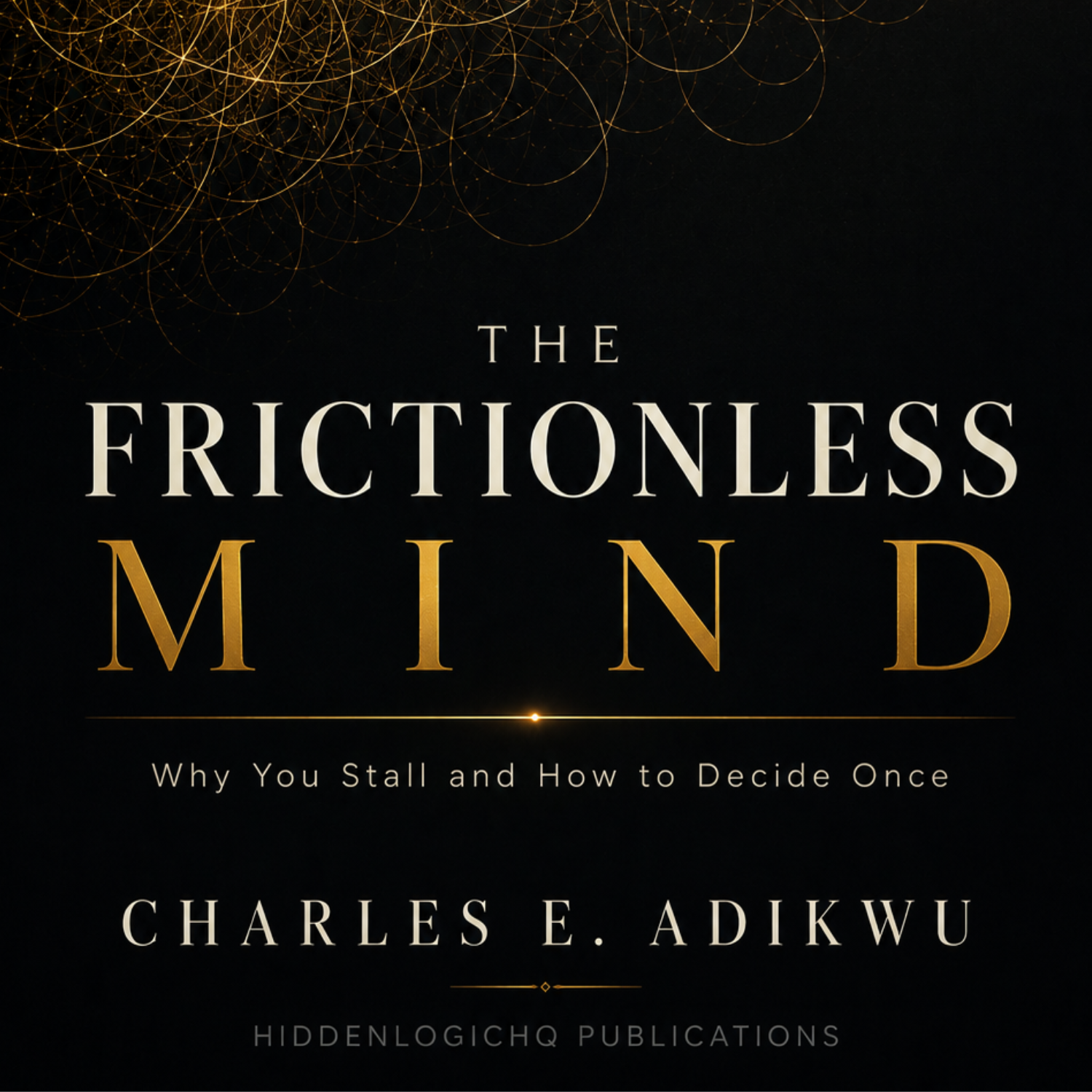
The Frictionless Mind: Why You Stall and How to Decide Once

You are not running low. You are carrying too much at once.
At about seven in the evening, a competent adult stands in front of an open refrigerator and cannot decide what to eat. Nothing in the day explains it. No physical labour. No intellectual difficulty. Just a normal day of messages, meetings, and small unresolved questions. And yet here is a person who negotiates contracts or raises children, defeated by leftovers.
The popular explanation is that willpower is a finite resource and you have spent yours. That explanation is almost certainly wrong. Large-scale replications found the effect close to zero. What collapsed is not the experience of exhaustion. It is the story about its cause.
The Frictionless Mind replaces that story with a structural one. You are not empty. You are full of open decisions—the email read three times and was not answered, the conversation you need to have, the question of whether to stay in the job, the dentist, and the thing about your father. None of them is being worked on. All of them are being carried, and each one takes up room.
When the problem is a draining tank, the only remedy is rest. When the problem is accumulated open decisions, the remedies multiply: resolve them, pre-decide them, externalize them, batch them, set a threshold, drop them, or convert them into a standing policy made once and never revisited.
What you will learn
- Why the fuel metaphor for willpower failed scientific testing
- The four distinguishable reasons a decision gets stuck
- Why the cost is the number of open loops, not their size
- How to decide the class once instead of the instance every time
- How to set “good enough” before you start looking
- How to get matters out of your head without creating a new backlog
- How to spend deliberation only where it cannot be recovered
- Why no method outruns its substrate (sleep, health, recovery)
- How to read procrastination as information rather than character failure
- How to assemble the pieces into a working system
Inside the book you get
- 10 practical chapters organized into three clear parts
- Diagnostic tools and tactical moves you can use the same day
- Composite real-world examples
- Clear boundaries about when the problem is not decision architecture
- A complete 'Frictionless System' that ties every method together
- Tactical Glossary and Research Notes
This is not a productivity book. The purpose of reducing decision load is not to extract more output from your life. It is to have attention left for the things that actually warrant it — your work when it is interesting, the people you like, and the small number of large decisions that deserve a mind that is not already full.
If you have been carrying the belief that you lack discipline, you may be about to be let off a hook you have been on for a very long time.
Key Benefits
- Stop treating exhaustion as a character flaw
- Close open loops instead of carrying them
- Convert recurring decisions into one-time policies
- Spend thinking time only where it cannot be recovered
- Recognize when the problem is not a decision problem
- Free attention for what actually matters
Who This Book Is For
People who feel exhausted by ordinary days, who keep revisiting the same decisions, and who have concluded they lack discipline when what they actually lack is a decision made once. Professionals, parents, and anyone carrying more unresolved matters than their working memory can hold.
Author Bio
Charles E. Adikwu writes about human behavior, decision-making, and the psychology beneath ordinary experience. His work takes research that usually stays inside academic journals and turns it into methods people can use in the decisions that shape a working life. The Frictionless Mind is the fourth in a connected set with The Architecture of Influence, Invisible Armor, and The Deception Blind Spot. He publishes under the HiddenLogicHQ Publications imprint.