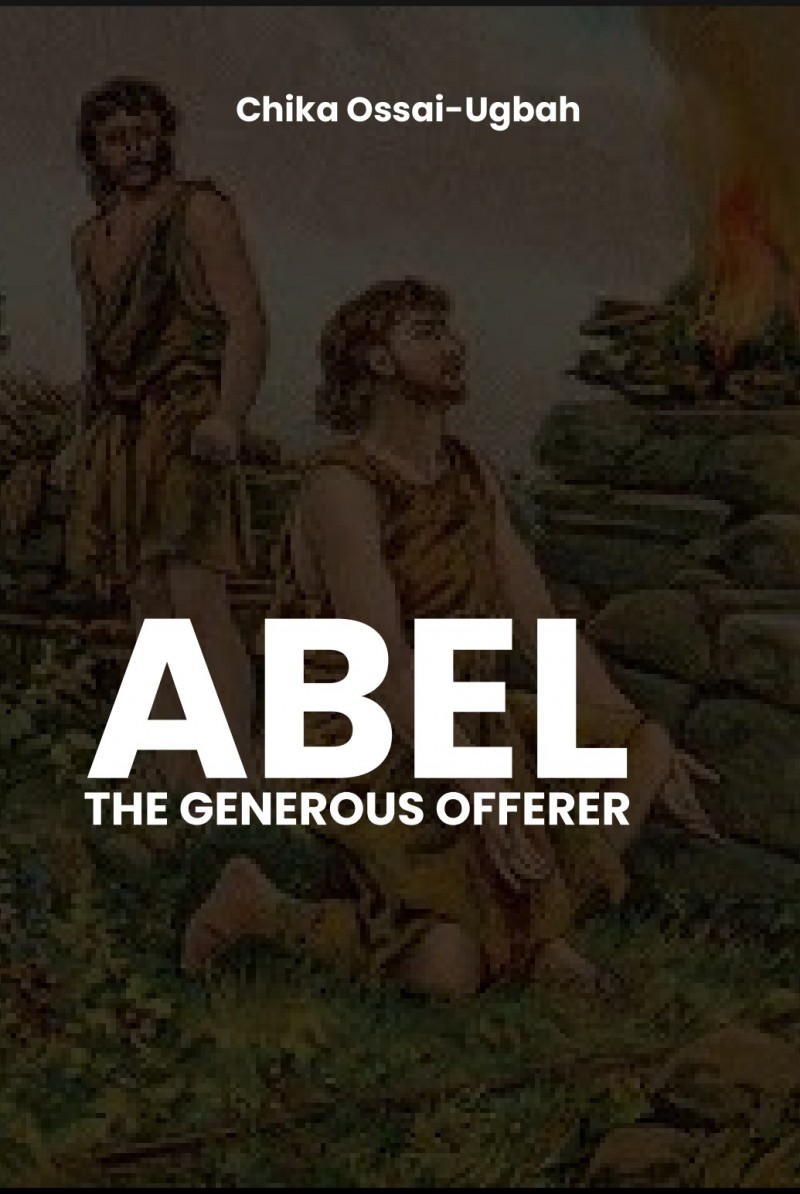
Abel the Generous Offerer
ABEL
Adam lay with his wife Eve, and she became pregnant and gave birth to Cain. She
said, "With the help of the LORD I have brought forth a man." (2) Later she gave
birth to his brother Abel. Now Abel kept flocks, and Cain worked the soil. (3) In the
course of time Cain brought some of the fruits of the soil as an offering to the
LORD. (4) But Abel brought fat portions from some of the firstborn of his flock. The
LORD looked with favor on Abel and his offering, (5) but on Cain and his offering
he did not look with favor. So Cain was very angry, and his face was downcast.
(6) Then the LORD said to Cain, "Why are you angry? Why is your face downcast?
(7) If you do what is right, will you not be accepted? But if you do not do what is
right, sin is crouching at your door; it desires to have you, but you must master it."
(8) Now Cain said to his brother Abel, "Let's go out to the field." And while they
were in the field, Cain attacked his brother Abel and killed him. (9) Then the LORD
said to Cain, "Where is your brother Abel?" "I don't know," he replied. "Am I my
brother's keeper?" (10) The LORD said, "What have you done? Listen! Your brother's
blood cries out to me from the ground.
Genesis 4: 1-10
An offerer is someone who makes an offer or presents an offering. The term
describes someone who presents something to another for acceptance or
rejection. In the Book of Genesis, Abel (Hebrew Hével / Hável) was the
second son of Adam. He was slain by Cain, his elder brother as recorded in
Genesis 4:1-16. The narrative in Genesis states that "the Lord had respect
unto Abel and to his offering, but unto Cain and to his offering he had not
respect."
One proposed Hebrew etymology for the word "Abel" is: "AB", meaning
"source" in Hebrew, and "EL" meaning "God". Thus Abel is often taken to
mean "source of God" (breath), or "transitoriness" (oneness with God). It
more probably means herdsman(compare the name "Jabal", Arabic ibil
"camels"), and a distinction is drawn between the pastoral Abel and the
agriculturist Cain.
The name Hebel (Gen 4:2, 4, 8-9, 25; pausai Häbel, 4:2) is unexplained in the
OT, but a substantive hebel occurs seventy-three times in the MT signifying "breath, vapor, vanity." Whether there is a connection between the
name and the substantive is debated. The Great Bible, the Geneva Bible
and the Bishops' Bible spelled the name "Habel," but the Douay used "Abel"
as did the KJV and the major English Bibles since