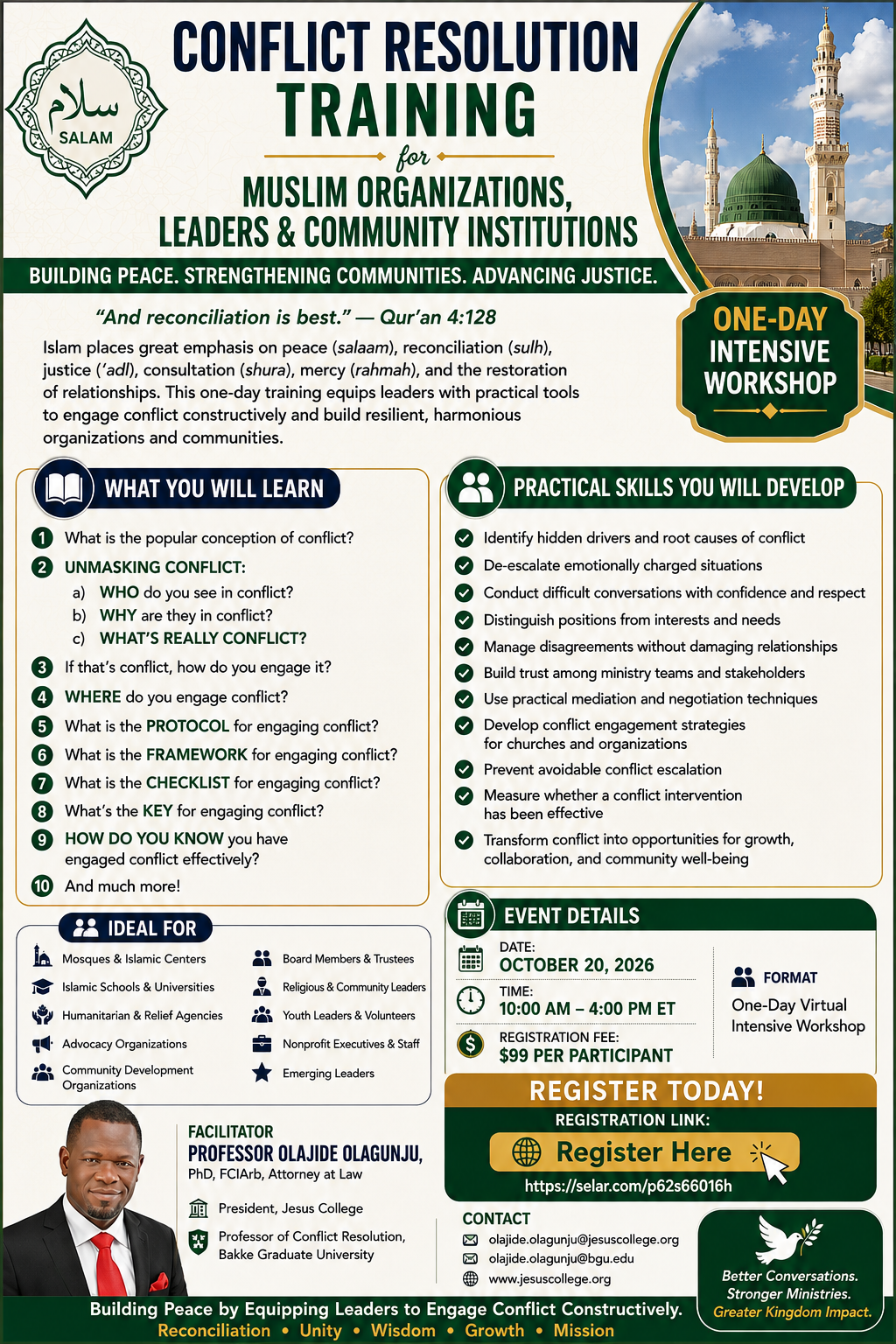
Conflict Resolution Training for Muslim Organizations, Leaders & Community Institutions (Live Online)
Get Tickets
Total Admissions: 0The Islamic tradition places profound emphasis on peace (salaam), justice (adl), reconciliation (sulh), consultation (shura), mercy (rahmah), and the restoration of relationships. Throughout history, Muslim communities have developed rich traditions of mediation, dispute resolution, and community reconciliation aimed at preserving harmony, dignity, and social cohesion.
Today, many Muslim organizations, mosques, educational institutions, advocacy groups, relief agencies, and community leaders face increasingly complex challenges involving organizational disagreements, stakeholder tensions, leadership transitions, workplace conflicts, community disputes, and difficult conversations. These realities require practical conflict resolution skills that strengthen relationships while preserving organizational effectiveness and community trust.
To support this important work, I would like to invite your staff, board members, educators, volunteers, community leaders, and stakeholders to participate in a one-day professional development workshop:
Conflict Resolution and Community Peacebuilding
Facilitator: Professor Olajide Olagunju, PhD, FCIArb, Attorney at Law
Fee: $99 per participant
Format: One-Day Intensive Training Workshop
This highly interactive workshop integrates proven conflict resolution methodologies with practical approaches designed to strengthen leadership, organizational health, and community engagement.
Learning Outcomes
Participants will explore the following critical questions:
1. What is the popular conception of conflict?
How do individuals and organizations commonly think about conflict, and why do those assumptions often lead to ineffective responses?
2. Unmasking Conflict
(a) WHO do you see in conflict?
Understanding the individuals, groups, identities, interests, relationships, and needs involved.
(b) WHY are they in conflict?
Identifying the underlying causes, perceptions, fears, interests, and structural factors driving conflict.
(c) WHAT is really conflict?
Moving beyond surface disagreements to uncover the deeper realities that require attention.
3. If that is conflict, how should we engage it?
Developing effective and constructive approaches that transform conflict into opportunities for growth, understanding, and collaboration.
4. WHERE do we engage conflict?
Understanding the appropriate arenas, contexts, and levels at which intervention is most effective.
5. What is the PROTOCOL for engaging conflict?
Learning a disciplined process for responding to conflict professionally and systematically.
6. What is the FRAMEWORK for engaging conflict?
Applying practical analytical tools that guide assessment, intervention, and resolution.
7. What is the CHECKLIST for engaging conflict?
Using proven tools that help leaders avoid common mistakes and improve outcomes.
8. What is the KEY to engaging conflict successfully?
Identifying the essential principles that distinguish effective conflict management and resolution.
9. How do you know you have engaged conflict effectively?
Recognizing indicators of meaningful resolution, strengthened relationships, improved communication, and sustainable peace.
This workshop is especially valuable for:
- Mosques and Islamic centers
- Muslim educational institutions
- Muslim advocacy organizations
- Muslim humanitarian and relief agencies
- Community development organizations
- Faith leaders and chaplains
- Board members and executive leaders
- Youth and emerging leaders
The program is designed to strengthen the ability of Muslim organizations to foster healthier relationships, manage disagreements constructively, build resilient communities, and advance their mission with greater effectiveness and harmony.
We would be honored to serve your organization and contribute to your ongoing efforts to promote peace, justice, understanding, and community well-being.