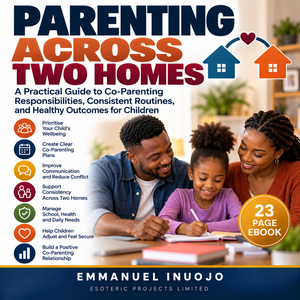
Parenting Across Two Homes
Parenting Across Two Homes
A Practical Co-Parenting System to Reduce Conflict, Coordinate Daily Life, and Protect Your Children After Separation
Two homes. One shared responsibility: your children's wellbeing.
Separation may change a family's living arrangements, but children still need stability, emotional security, dependable routines and responsible support.
For many separated or divorced parents, everyday responsibilities can become difficult to coordinate. School schedules, healthcare appointments, holidays, household expenses, transportation and communication may create new sources of disagreement.
When these arrangements are unclear, children can find themselves caught between conflicting expectations.
Parenting Across Two Homes provides a practical approach to organising co-parenting responsibilities, improving communication and building more consistent routines across separate households.
This guide encourages parents to focus on their children's needs rather than allowing unresolved adult conflicts to dominate everyday decisions.
What You Will Learn
1. Put Your Children's Wellbeing First
Explore how to make child-centred decisions that prioritise safety, emotional security, stability and age-appropriate needs.
2. Establish Clear Co-Parenting Communication
Learn practical ways to share important information, reduce misunderstandings and communicate more constructively about parenting responsibilities.
3. Coordinate Schedules Across Two Homes
Develop better approaches to managing school calendars, appointments, activities, holidays and other important commitments.
4. Make Household Transitions More Predictable
Understand the value of consistent handover arrangements, appropriate routines and clear expectations where children spend time between households.
5. Manage Shared Parenting Expenses
Explore how to document agreed financial responsibilities, communicate expenses and improve transparency around children's needs.
6. Reduce Unnecessary Parental Conflict
Consider ways to establish boundaries, keep conversations focused and avoid involving children in adult disagreements.
7. Support Your Children's Emotional Adjustment
Understand why children may respond differently to separation and how supportive conversations and dependable routines can help.
8. Respect Parenting Agreements and Legal Arrangements
Learn the importance of documenting appropriate agreements, respecting applicable court orders and seeking qualified professional advice when necessary.
9. Create a Repeatable Co-Parenting System
Bring schedules, responsibilities, communication arrangements and important records together into a practical system that can evolve as your children's needs change.
Who Should Read This Book?
This guide is particularly useful for:
- Separated or divorced parents raising children across two households.
- Co-parents struggling with scheduling and communication.
- Parents seeking greater consistency in their children's routines.
- Families navigating new parenting responsibilities after separation.
- Parents coordinating education, healthcare and shared expenses.
- Individuals seeking a more structured, child-centred approach to co-parenting.
What You Receive
- Complete 23-page downloadable PDF ebook.
- A practical framework for organising co-parenting responsibilities.
- Guidance on schedules, communication and household transitions.
- Approaches to tracking children's expenses and coordinating important activities.
- Actionable ideas for reducing avoidable conflict.
- Child-centred planning and reflection exercises.
The Goal
Move from confusing arrangements, repeated disagreements and inconsistent routines towards more organised communication, clearer responsibilities and greater stability for your children.
Successful co-parenting is not about requiring former partners to agree on everything. It is about creating safe, dependable arrangements that support the children's best interests.
Price: ₦5,500
Format: Downloadable PDF ebook
Author: Emmanuel Inuojo
Publisher: Esoteric Projects Limited
Important Notice: This ebook provides general educational guidance and does not replace legal advice, professional family counselling or child-protection services. Parenting arrangements must comply with applicable laws and court orders. Shared arrangements may be inappropriate where abuse, coercion, neglect or violence is present. Always prioritise children's safety and seek qualified professional assistance when necessary.
Two homes can still provide stability, care and a strong sense of belonging.