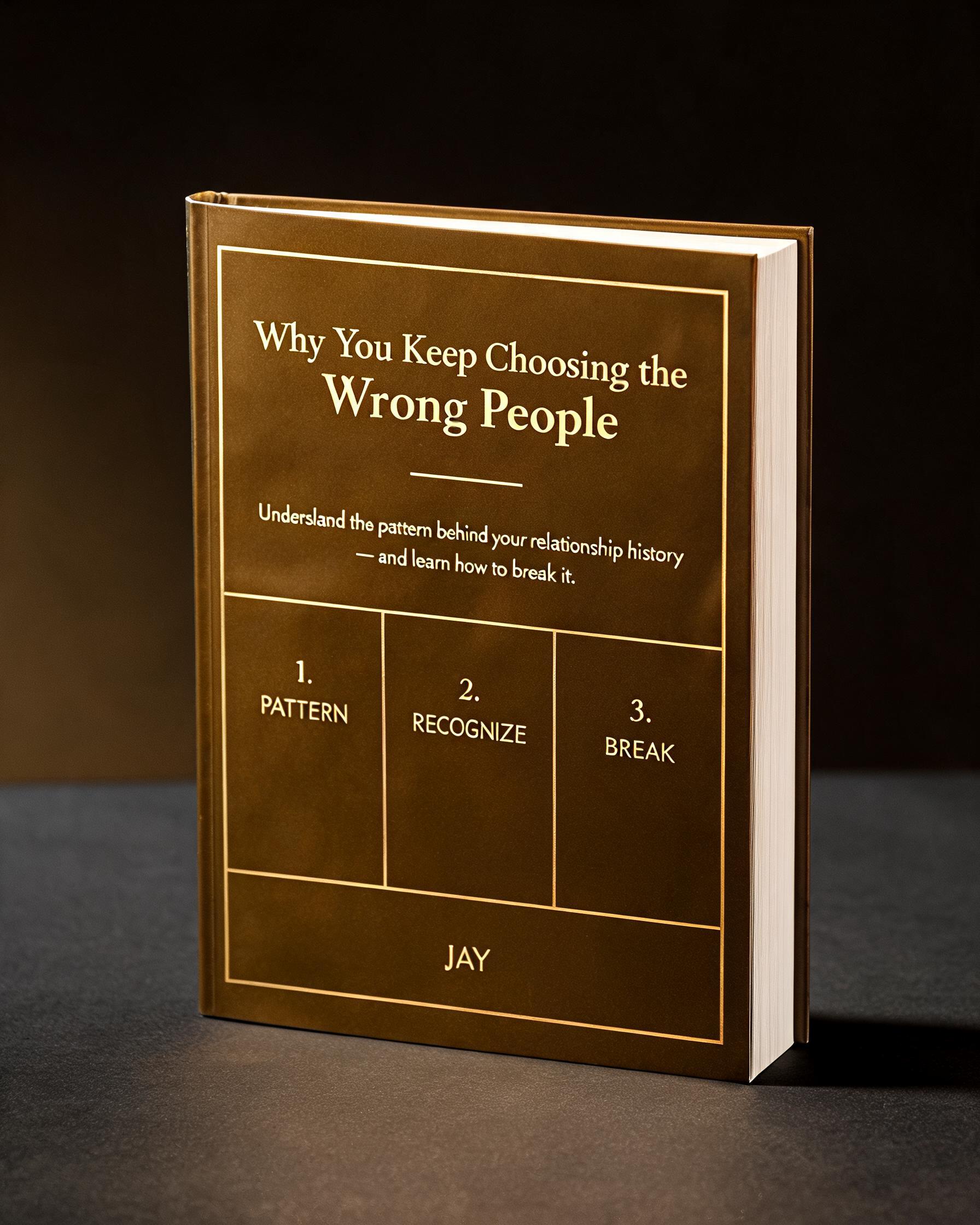
Why You Keep Choosing the Wrong People

🔥🔥🔥Three relationships. One ending.
Different people. Different cities, maybe. Same last conversation.
You've run the audit already. You picked badly. You ignored the obvious thing. You'll be more careful next time — and next time you were careful, and it happened anyway, slower.
At some point the pattern stops looking like bad luck and starts looking like a pattern.
That's the point this book starts at.
What's actually happening
You are not unlucky, and you are not broken. You are running a sequence you learned before you could name it, and it executes faster than your judgement does.
Attachment researchers have been documenting this for fifty years. John Bowlby called the blueprint an internal working model. Mary Ainsworth showed it forming in infancy. Hazan and Shaver showed it running, largely unchanged, in adult romance.
And the reason the wrong person feels so right isn't mystery or chemistry. B.F. Skinner demonstrated it with pigeons: a reward delivered unpredictably produces stronger, more persistent behaviour than a reward delivered reliably. Wolfram Schultz found the neural version — dopamine spikes on the surprise, not the reward.
Which means the person who is warm on Tuesday and distant on Friday will hold your attention harder than the person who is warm every day. That isn't love. It's a variable schedule. Once you can see it, you can't unsee it — and that is the entire mechanism of this book.
✨ What's inside
Seven chapters, each one built around something you actually do rather than something you merely read:
- Introduction — It's Not Bad Luck, It's a Pattern. Lay your history out and see the shape of it.
- Chapter 1 — The Relationship Loop. The five-stage sequence you repeat, and the exact stage where intervention still works.
- Chapter 2 — Why the Wrong Person Feels So Right. Intensity versus intimacy, and why calm feels like boredom when you're wired for chaos.
- Chapter 3 — Red Flags in Real Time. A three-tier system, because "trust your gut" is useless advice when your gut is the thing that's miscalibrated.
- Chapter 4 — Knowing What You Actually Want. Requirements, not a wishlist. The difference decides everything.
- Chapter 5 — Breaking the Loop. How to interrupt the sequence while it's running, not in hindsight.
- Chapter 6 — The First Ninety Days. The window where patterns re-establish themselves, and how to hold the line through it.
The six tools
Not described. Printed in full, with space to write.
- The Pattern Map — twenty minutes, pen and paper. Your relationship history laid out until the repeat becomes undeniable. This is the first exercise in the book, and most people find it uncomfortable within ten minutes. That discomfort is the product of working.
- The Attachment Self-Assessment — score yourself honestly; nobody is reading it but you.
- The Flag Log — a private running record, so you're judging the accumulation instead of arguing with yourself about one incident.
- The Requirements Document — needs and values, separated from preferences. Written down before you're attached, so it can't be renegotiated after.
- Your Interruption Plan — implementation intentions, the technique Peter Gollwitzer's research found dramatically outperforms good intentions. Written while you're calm, for use when you won't be.
- The 90-Day Checkpoint — three dates in your diary and the specific questions to ask yourself on each.
The eight scripts✨
Word for word. Because knowing what you want and being able to say it out loud are not the same skill.
- Stating a need early, without apologising for having it
- Raising a concern before it becomes a crisis
- Declining without justifying — no reason offered, because reasons invite negotiation
- Holding a boundary mid-conflict
- What to say when you're told you're overreacting
- Naming a values mismatch you've both been avoiding
- Enforcing, after nothing changed
- Asking a friend to tell you when you're doing it again
📚Who this is for
People who have already done the surface work. You've read the attachment-style articles. You know your type. You still ended up here.
You want a mechanism and a next action, not comfort.
Who this is not for
If you're looking for reassurance that everyone before you was the problem, this will be an unpleasant read. The book's position is that the pattern is yours — not because you deserved what happened, but because ownership is the only route to change.
It is also not therapy. If you're dealing with abuse or trauma, this is a supplement to professional support, never a substitute.
The format
36 pages, A4, designed to be read — short chapters, no padding, worksheets you can print or fill in on screen. Instant PDF download.
You can complete the first tool tonight.
The honest pitch
The next person you're drawn to will feel different. They always do. That feeling is the pattern announcing itself, and you'll have roughly six weeks to notice before it stops being a choice.