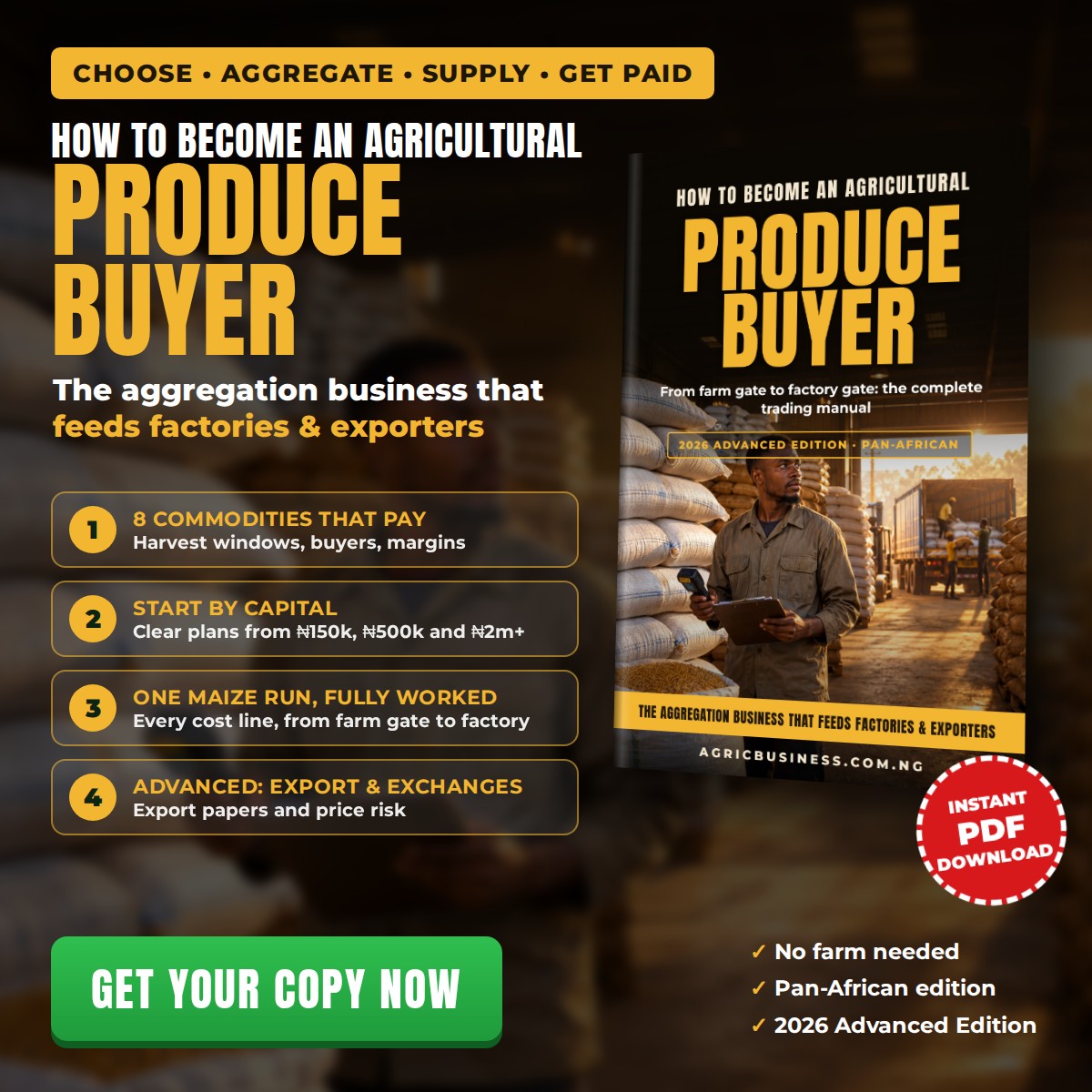
How to Become an Agricultural Produce Buyer: The Aggregation Business That Feeds Factories & Exporters
How to Become an Agricultural Produce Buyer: The Aggregation Business That Feeds Factories & Exporters
Every day across Africa, two people fail to meet. A farmer with 20 bags of maize, no truck, and school fees due — forced to sell cheap to whoever shows up first. And a feed mill in the city is burning through 30 tonnes a week, with no way to reach a hundred scattered villages to gather it bag by bag.
The person who connects them is called an aggregator. You buy where produce is cheap and scattered, bulk it, grade it, and deliver it where it's needed — the farmer gets cash at his gate, the factory gets a reliable supply, and you earn the margin in between. Not extracted. Earned — because you carried the transport, the risk, and the standard neither side could manage alone.
This is the complete manual for that business, from your first ₦150,000 learning run to the exchange-backed, export-ready trading operation most people never learn exists.
What's inside:
- ✅ The 8 commodities that actually pay — harvest windows, who buys each, real spread per bag
- ✅ Startup by capital: ₦150k / ₦500k / ₦2m+ — three honest tiers, what each one actually gets you
- ✅ Sourcing without getting cheated — farm gates, market days, and how to run a village agent system safely
- ✅ Quality IS the business — the moisture and purity specs that separate one deal from a standing weekly contract, and the six tricks used against beginners
- ✅ Who buys, and the exact script to walk in and get your first trial delivery
- ✅ One maize run, fully worked in naira — every cost line, no guessing
- ✅ The five real risks, and the record-keeping habit that turns a hustle into a company
- ✅ NEW — Commodity Exchanges & Trade Finance: how warehouse receipt systems work, how they become loan collateral, and a verified 14-country map of commodity exchanges across the continent
- ✅ NEW — The Export Pathway: the real documentation ladder for getting sesame, hibiscus, ginger, or cashew onto a container — registration, certification, logistics, in order
- ✅ NEW — Managing Price Risk: forward contracts, basis, and hedging explained in plain language, with an honest note on when you actually need them (later than you think)
This is not a "get rich quick" book. No fabricated statistics, no fake testimonials, no guaranteed returns. Aggregation is trade — it carries real price, quality, and counterparty risk, and Chapter Eight exists specifically so you understand that risk before your first big position. Every figure inside is a worked example at real Q2 2026 baselines, built so you can recalculate on the day you actually buy.
Who this is for:
- The salary earner who wants a trading income that doesn't need a farm, a season, or rainfall to cooperate
- The trader who's been buying and selling informally and wants the costing discipline to see their real margin
- The produce buyer is ready to move from village-market trading toward exchanges, exporters, and structured finance
- Anyone across Africa who wants the trade layer above farming — not "start a farm," but the business almost nobody teaches
This is a Pan-African book. The core trading system — value chain, sourcing, quality control, costing — works identically wherever you are. Nigeria, Ghana and Kenya get named hubs and registration bodies because that's the working example this book builds from, but the new commodity exchange map in Chapter Nine names recognised exchanges in fourteen countries, from Tanzania and Uganda to Zambia, Ethiopia, Rwanda and beyond — so wherever you're trading, there's a real institution to start your search with, not just three countries' worth of advice.
👉 Get instant access — your first learning run can start this month.
FAQ block
I've never traded anything — is this too advanced for a beginner? No. Chapters One through Eight are the complete beginner-to-solid-trader path, starting at a ₦150,000 learning run. The three new advanced chapters (Nine to Eleven) are clearly marked as Year 2–3 material — read them so you know the ladder exists, but you don't need them for your first bag.
I'm not in Nigeria, Ghana, or Kenya — is this still relevant? Yes. The trading system itself — sourcing, quality control, costing, selling — is universal; produce aggregation runs the same way on every commodity, in every country, because the underlying economics (farmers scattered, buyers centralized, someone has to bridge that gap) don't change at the border. Nigeria is this book's detailed working example, but Chapter Nine's commodity exchange map names real institutions across fourteen African countries, so you're not left guessing what exists in your own market.
What's actually new in this edition versus the original? Three full chapters: how commodity exchanges and warehouse receipt financing work, the complete export documentation pathway for sesame/hibiscus/ginger/cashew, and a plain-language guide to price-risk tools like forward contracts. Plus a wider, verified Africa-wide market map. Everything from the original edition — the 8 commodities, the capital tiers, the sourcing and quality chapters, the fully worked money math — is still here, unchanged.
Is this investment advice? No. This is a trading and operations manual. Aggregation carries real price, quality, and counterparty risk (Chapter Eight), and the advanced chapters on exchanges and price-risk tools are educational overviews of how real institutions work — not a recommendation to use any specific platform, lender, or financial instrument. Verify current terms directly with any institution before you act.
Do I need money to start, or can I learn first? You need capital to trade — that's the nature of the business — but the entry point is honest: about ₦150,000 runs a genuine first learning cycle. You're not buying a course and hoping; you're buying the manual for a trade you fund yourself, at whatever scale you're ready for.
How to Pay With Mobile Money (Ghana, Kenya, Nigeria & more)
Selar accepts Mobile Money — here's exactly how, step by step:
- On the payment page, look at the "Payment Options" panel and select Mobile Money (not Card, which is selected by default).
- Choose your network from the dropdown — for Ghana: MTN, AirtelTigo, or Telecel. Other countries will show their own local networks.
- Enter your phone number with your country code, no leading zero — for example, a Ghana number starting 0XX becomes 233XX (drop the 0, add 233 in front). Same pattern for Nigeria (234), Kenya (254), etc.
- Tap Pay.
- Check your phone right after tapping Pay — you'll get a prompt (USSD pop-up or app notification) asking you to confirm the payment. This step is easy to miss — if you don't see it immediately, check your notifications or dial your network's balance-check code to refresh it.
- Once confirmed on your phone, the payment completes automatically, and your download unlocks.