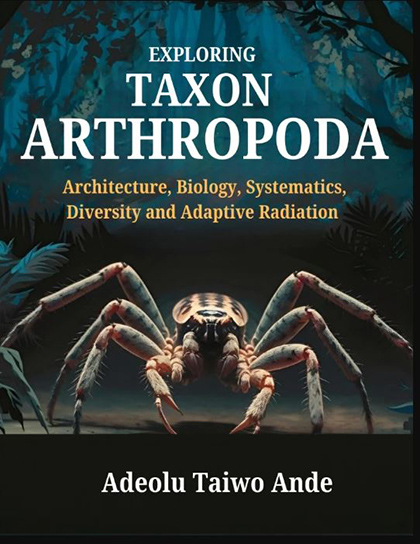
Exploring Taxon Arthropoda: Architecture, Biology, Systematics, Diversity and Adaptive Radiation

This textbook titled Exploring Taxon Arthropoda: Architecture, Biology, Systematics, Diversity and Adaptive Radiation offers a comprehensive overview of the phylum Arthropoda, detailing their biological and ecological significance. The book explores why arthropods are considered the most successful phylum in the animal kingdom and biosphere, explaining their evolutionary origin from annelid ancestors and discussing the structural adaptations that have contributed to their success. It emphasizes the importance of these adaptations in contemporary arthropods and their relevance to improving arthropod-human coexistence.
The text simplifies and explains the general taxonomy and systematics of the vast arthropod taxon, aiming to facilitate a deeper understanding of their diversity and adaptive radiation from subphyla to order taxonomic levels. It provides a foundational expository template to enhance the comprehension of more extensive current literature on arthropods.
Designed to spark discussion about an often-overlooked phylum, this book provides a thorough, engaging, and well-illustrated examination of various aspects of Arthropoda. Written in clear and accessible language, it includes original and contemporary pictorial and diagrammatic illustrations, as well as tabulations and relevant organismal examples.
This textbook is intended for diploma, undergraduate, and postgraduate students and teachers of Arthropodology. It is also suitable for scientists, biologists, naturalists, environmentalists, and professionals in fields such as agriculture, public health, epidemiology, wildlife ecology, and veterinary and medical sciences who are seeking sustainable arthropod management solutions.