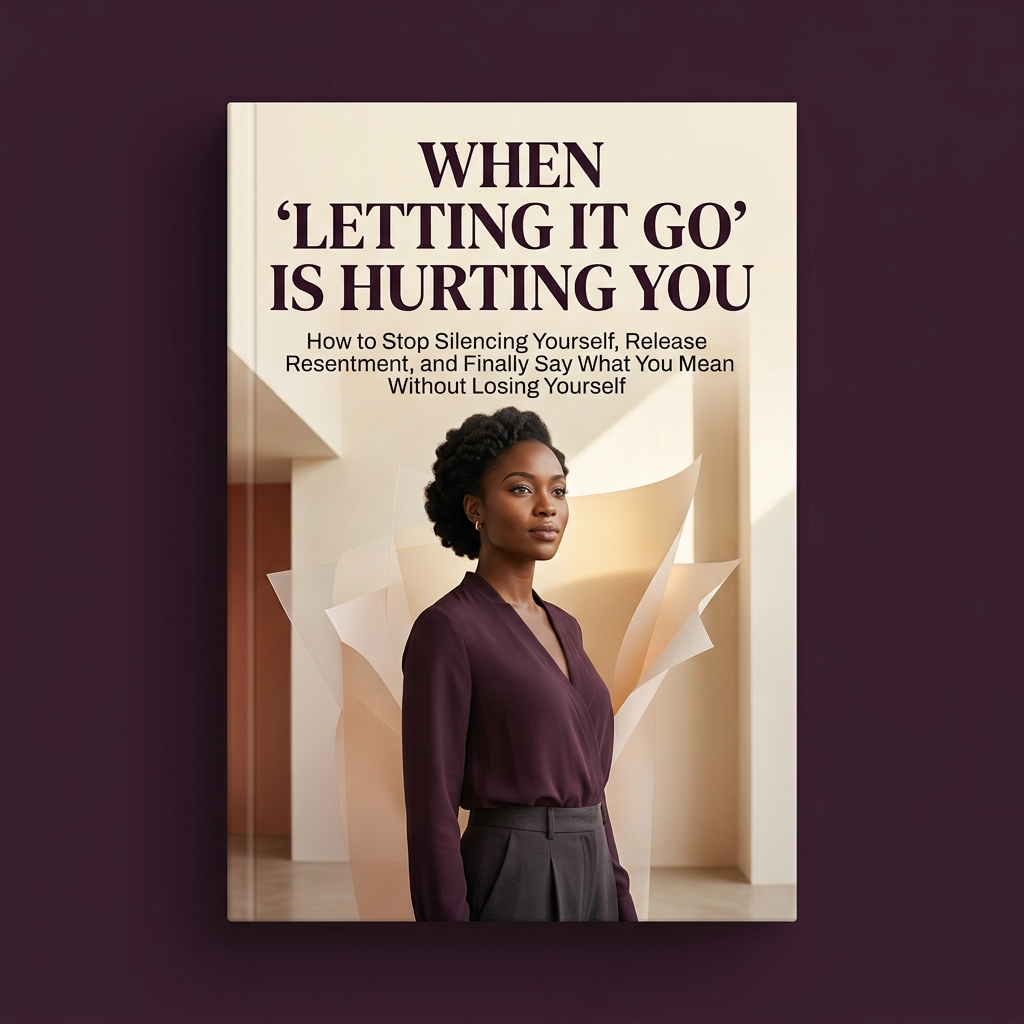
WHEN “LETTING IT GO” IS HURTING YOU
WHEN “LETTING IT GO” IS HURTING YOU
How to Stop Silencing Yourself, Release Resentment, and Finally Say What You Mean Without Losing Yourself
You can forgive someone without pretending nothing happened.
You can seek peace without swallowing everything you feel.
And you can set a boundary without becoming cruel.
There is a difference between letting go and silencing yourself.
This practical guide will help you understand that difference.
WHAT IF “LETTING IT GO” ISN'T ALWAYS THE HEALTHIEST CHOICE?
Sometimes, letting something go is exactly what you need.
Other times, what looks like “letting go” can actually mean avoiding an important conversation, suppressing emotions, or repeatedly accepting situations that need a boundary.
The difficult part isn't always knowing that something feels wrong.
The difficult part is knowing:
Should I release this?
Should I talk about it?
Should I set a boundary?
Or am I simply avoiding what needs to be addressed?
That's where this book comes in.
MEET YOUR NEW APPROACH TO “LETTING GO”
When “Letting It Go” Is Hurting You is a practical guide for navigating emotional situations with more clarity, honesty, and self-respect.
Instead of telling you to simply “move on,” this book helps you examine what you're carrying and decide what deserves your attention.
You'll learn how to distinguish between:
Letting go vs. suppressing
Releasing something emotionally doesn't require pretending it never happened.
Forgiveness vs. avoidance
Forgiveness can bring freedom—but avoiding a necessary conversation can leave important issues unresolved.
Peace vs. silence
Keeping quiet can sometimes preserve peace. Other times, honest communication is what creates healthier peace.
Communication vs. confrontation
Speaking honestly doesn't have to mean attacking, blaming, or starting an argument.
Boundaries vs. punishment
A healthy boundary isn't about controlling another person. It's about being clear about what you will and won't participate in.
WHAT YOU'LL DISCOVER INSIDE
1. Why being “the bigger person” can become exhausting
You don't have to win every argument.
But you also don't have to make yourself disappear just to avoid one.
Learn how to recognize the difference.
2. What happens when feelings stay unspoken
Unexpressed emotions don't always disappear simply because they're ignored.
Explore how unresolved feelings can influence communication and relationships.
3. How to tell whether something should be released or addressed
Not every issue deserves your energy.
But some things deserve an honest conversation.
Learn how to make that distinction.
4. How resentment quietly develops
Sometimes resentment doesn't begin with one enormous event.
It can grow from small disappointments, repeated silence, unmet expectations, and conversations that never happened.
5. How to communicate without becoming aggressive
Learn practical ways to express yourself clearly without turning every difficult conversation into a confrontation.
6. How boundaries actually work
Boundaries aren't threats.
They're clarity.
Learn how to communicate your limits while respecting both yourself and other people.
7. How to stop carrying relationships by yourself
Healthy relationships require participation from more than one person.
Explore what happens when one person repeatedly does all the emotional work.
8. How to choose peace without abandoning yourself
The goal isn't to become harder.
It's to become clearer.
THIS BOOK IS FOR YOU IF YOU WANT TO...
✓ Understand your emotions more clearly
✓ Communicate difficult feelings more effectively
✓ Know when to speak and when to release
✓ Stop confusing silence with peace
✓ Understand resentment before it takes over
✓ Build healthier boundaries
✓ Handle difficult conversations with more confidence
✓ Protect your self-respect while still being compassionate
✓ Let go of what no longer deserves your energy
THIS ISN'T ABOUT BECOMING COLD
It's not about holding grudges.
It's not about turning every disagreement into a confrontation.
It's not about cutting everyone off.
And it's not about refusing to forgive.
It's about developing the emotional clarity to know what deserves your energy—and what doesn't.
Sometimes the healthiest response is forgiveness.
Sometimes it's a conversation.
Sometimes it's a boundary.
And sometimes it's simply letting go.
The wisdom is knowing the difference.
IMAGINE HAVING MORE CLARITY IN DIFFICULT MOMENTS
Instead of immediately asking:
“Should I just let this go?”
You can begin asking better questions:
What am I actually feeling?
Does this need to be communicated?
Is there something I need to understand first?
Would a boundary help here?
Am I releasing this—or simply suppressing it?
Is this worth my emotional energy?
That shift in perspective can change the way you approach difficult conversations and relationships.
YOUR VOICE MATTERS TOO
You don't have to choose between being compassionate and being honest.
You don't have to choose between forgiveness and boundaries.
You don't have to choose between peace and self-respect.
There is a healthier middle ground.
When “Letting It Go” Is Hurting You gives you practical tools for finding it.
WHAT YOU'LL GET
📖 The Complete Ebook
A practical guide to emotional clarity, communication, boundaries, resentment, forgiveness, and self-respect.
🧠 Practical Reflection
Questions and exercises designed to help you think through difficult emotional situations with greater clarity.
💬 Communication Guidance
Practical ways to express what you mean without unnecessarily escalating difficult conversations.
🚧 Boundary Guidance
A clearer understanding of when boundaries may be appropriate—and how to communicate them.
DON'T JUST “MOVE ON.”
UNDERSTAND WHAT YOU'RE MOVING ON FROM.
Letting go can be powerful.
But it should not require you to abandon your voice.
Learn how to release what needs releasing, communicate what needs communicating, and protect what deserves protecting.
WHEN “LETTING IT GO” IS HURTING YOU
How to Stop Silencing Yourself, Release Resentment, and Finally Say What You Mean Without Losing Yourself
[GET YOUR COPY TODAY]
A FINAL THOUGHT
You don't need to carry every disagreement forever.
You don't need to explain yourself endlessly.
You don't need to hold onto resentment.
And you don't need to silence yourself just to prove that you're mature.
Sometimes, letting go is the answer.
Sometimes, speaking is the answer.
Sometimes, a boundary is the answer.
The goal is learning which one you need.
Get your copy of When “Letting It Go” Is Hurting You today.