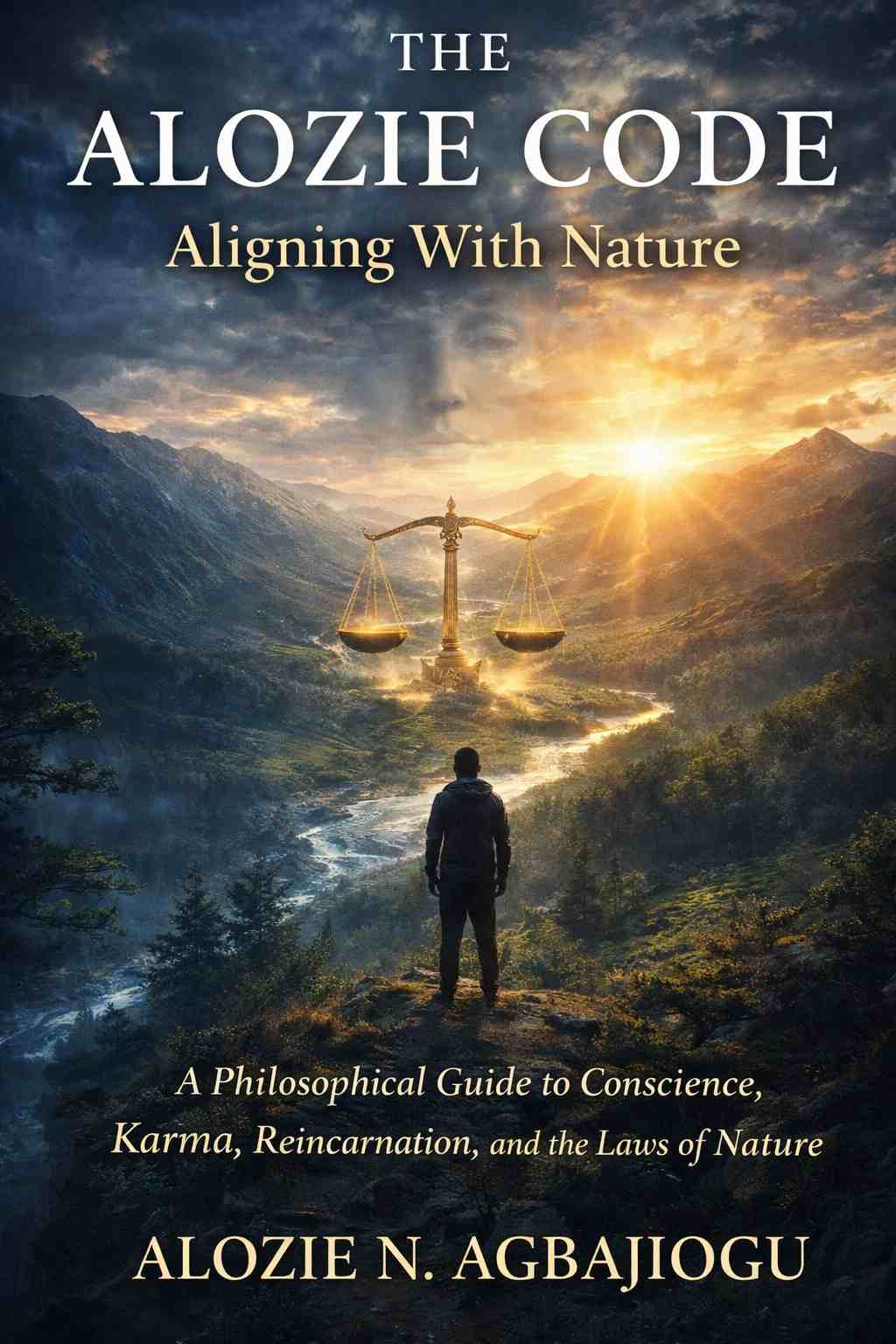
The Alozie Code: Aligning With Nature

THE ALOZIE CODE:
ALIGNING WITH NATURE
A Philosophical Guide to Conscience, Karma, Reincarnation and the Laws of Nature
By ALOZIE N. AGBAJIOGU
The Alozie Code is a non-religious philosophical framework developed from years of observation, hardship, questioning, work, self-examination, and confrontation with the realities of human life.
It did not emerge from an academic institution or a theological tradition. It emerged from lived experience.
It is the work of a man who grew through struggle, who experienced the limitations of poverty and fragmented family structures, who had to develop himself deliberately, and who became increasingly interested in one fundamental question:
What laws actually govern human existence?
The Alozie Code proposes that life is best understood not through wishful thinking, emotional convenience, or unquestioned tradition, but through alignment with Nature, reality, responsibility, conscience, consequence, and the patterns that govern existence.
Nature, within this philosophy, is not presented as a deity to be worshipped. It is understood as an ordered system of existence governed by principles that human beings must learn to recognize and respect.
At the center of the philosophy is the proposition that human beings are participants in a larger cycle of existence. The soul is understood as a traveler with lessons, responsibilities, and an unfinished assignment. Concepts such as karma and reincarnation are therefore examined as mechanisms through which actions, consequences, learning, and existence may be understood across cycles of life.
The philosophy also challenges conventional assumptions about suffering, luck, justice, A forgiveness, and destiny.
Why do some people appear to suffer despite their innocence?
Why do some people prosper despite their wrongdoing?
Is everything that happens to us random?
Can human beings escape the consequences of their actions?
Does forgiveness erase consequences, or does life ultimately seek balance?
What role does conscience play in determining the direction of a person's life?
The Alozie Code approaches these questions without attempting to provide emotional comfort at the expense of intellectual honesty.
It proposes that suffering may contain lessons, consequences may contain correction, and circumstances may contain information that human beings often fail to understand.
Within this framework, luck is not necessarily regarded as pure randomness. It may be interpreted as the visible outcome of circumstances, choices, preparation, relationships, opportunities, and—within the philosophical concept of karma—the consequences of actions extending beyond a single lifetime.
Conscience is equally central.
The Alozie Code does not primarily interpret conscience as the voice of a particular religious authority. Instead, it presents conscience as an internal mechanism through which human beings encounter the distinction between what they know to be right and what they choose to do.
When conscience is repeatedly ignored, the individual may gradually become comfortable with actions that once caused internal resistance.
When conscience is respected, it can become an instrument of alignment.
This philosophy therefore challenges the idea that morality exists merely to secure reward or avoid punishment.
It proposes something more fundamental:
Do right because alignment with what is right is itself a form of freedom.
The Alozie Code also questions conventional ideas of divine favoritism, automatic forgiveness, and salvation without transformation.
Within its philosophical framework, forgiveness does not necessarily eliminate consequence.
Balance replaces exemption.
Actions produce consequences. Choices create conditions. Behavior shapes character. Character influences destiny. And the individual remains responsible for understanding the relationship between what they do and what they ultimately become.
Yet The Alozie Code is not intended merely to explain suffering or human failure.
It is also a philosophy of deliberate living.
To align with Nature is to accept responsibility.
It is to develop competence.
It is to understand reality.
It is to control what can be controlled.
It is to learn from consequences.
It is to build meaningful relationships.
It is to create value.
It is to develop oneself rather than wait for circumstances to rescue oneself.
It is to leave something of enduring value behind.
The philosophy therefore extends beyond questions of karma and reincarnation into the practical realities of human existence: work, responsibility, relationships, personal development, economic survival, leadership, morality, and legacy.
The Alozie Code is not a religion.
It does not ask the reader to worship.
It does not demand blind belief.
It invites examination.
It asks the reader to observe life, question assumptions, examine consequences, and determine whether the principles presented provide a more coherent way of understanding existence.
The Code can therefore be accepted, challenged, refined, or rejected.
Its purpose is not to eliminate questioning.
Its purpose is to make questioning more deliberate.
At its deepest level, The Alozie Code is a philosophy of alignment:
Align your actions with reality.
Align your character with conscience.
Align your ambition with responsibility.
Align your knowledge with action.
Align your life with the consequences you are willing to live with.
And ultimately: Align yourself with Nature.
This is the foundation upon which the wider Alozie Code has been developed—a philosophy built around deliberate living, responsibility, competence, strategic thinking, productive work, enduring relationships, and meaningful legacy.
It is not a promise of an easy life.
It is an invitation to understand life more honestly.
The question is therefore not whether life will obey us.
The question is whether we are willing to understand the laws by which life operates.
The Code is yours to examine.
Yours to challenge.
Yours to live.
“Do right—not to be forgiven, but to be free.”