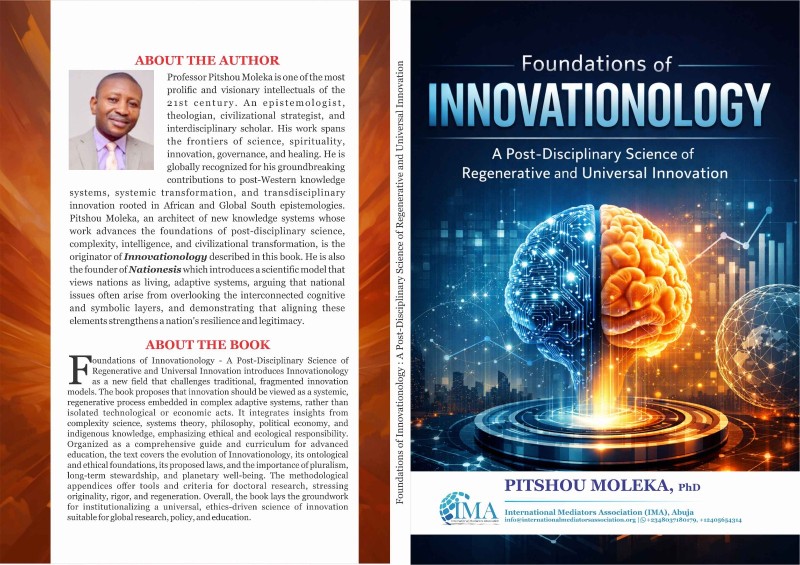
Foundations of Innovationology - A Post-Disciplinary Science of Regenerative and Universal Innovation

This book is written by Pitshou Moleka. Moleka is also the author of The Scientific Foundation of Workplace Spirituality: A Multidisciplinary and Cross-Cultural Perspective (2023), which examines how finding meaning, purpose, and connection at work can enhance employee well-being, engagement, ethics, and performance. That earlier book takes a holistic approach that goes beyond religious aspects, drawing from research in psychology, management, and cross-cultural studies to create a strong theoretical foundation for cultivating thriving work environments.
In this new book, Foundations of Innovationology - A Post-Disciplinary Science of Regenerative and Universal Innovation, Moleka presents new concepts summarised below.
Key Concepts and Contributions:
· Innovationology critiques conventional, fragmented, and sector-specific models of innovation (technological, economic, managerial) for their inability to address twenty-first-century complexities, such as climate instability, technological acceleration, institutional fragility, and global inequality.
· The discipline reconceptualizes innovation as a process of systemic transformation, emphasizing distributed intelligence, emergence, and relationality, rather than isolated acts or outputs. Innovation is framed as a property of complex adaptive systems, not just human agency or economic activity.
· Innovationology’s meta-scientific approach integrates complexity science, systems theory, philosophy of science, political economy, indigenous and non-Western epistemologies, and ethical theory. It insists on epistemic plurality, decolonial critique, and the inclusion of marginalized knowledge forms.
· A core theme is the regenerative paradigm: innovation must not merely disrupt or extract value but sustain and renew ecological and social systems. Ethics is intrinsic, not external, to innovation, with an emphasis on justice, dignity, and planetary integrity.
Structure and Pedagogical Features:
· The book is organized as a theoretical charter, methodological guide, and curriculum for master’s and doctoral education, with extensive pedagogical apparatus. Each chapter provides conceptual foundations, learning outcomes, assessment frameworks, and case studies.
· Chapters progress from (1) the post-disciplinary genesis of Innovationology and the critique of conventional paradigms; (2) the ontological and methodological redefinition of innovation as emergence, including arts, fiction, and spirituality; (3) the dynamics and proposed laws of innovation (creative tension, selective stabilization, regenerative compatibility, multilevel coevolution, meaning-driven emergence); (4) the anatomy of innovation as a multi-scalar, political, ethical, and knowledge-structured phenomenon; (5) innovation ecosystems as complex adaptive, living architectures integrating indigenous, artistic, and spiritual domains; (6) the temporal dimension, emphasizing long-term responsibility, temporal ethics, and future-oriented governance; (7) innovation governance as the ethical, participatory, and pluralistic stewardship of future-making; and (8) scenarios, singularities, and the metaphysics of innovation, culminating in planetary intelligence and a science of future-making.
Methodology and Doctoral Framework:
· The appendices detail a rigorous methodological toolkit, emphasizing ontological alignment, multi-scalar integration, epistemic plurality, ethical reflexivity, and regenerative orientation. Methods include systems analysis, historical and comparative methods, narrative and participatory approaches, and normative evaluation.
· Doctoral research in Innovationology is defined by original theoretical, methodological, applied, symbolic, or ethical contributions, with explicit criteria for rigor, integration, and regenerative orientation.
Overall Significance:
· Innovationology inaugurates a new, post-disciplinary, and regenerative science of innovation, suitable for guiding research, education, policy, and civilizational transformation. It positions innovation as an ethical, universal, and meaning-driven force, integrating arts, spirituality, indigenous wisdom, and planetary stewardship. The discipline is designed for institutionalization, doctoral accreditation, and global application, with a comprehensive corpus of foundational works authored by Moleka.