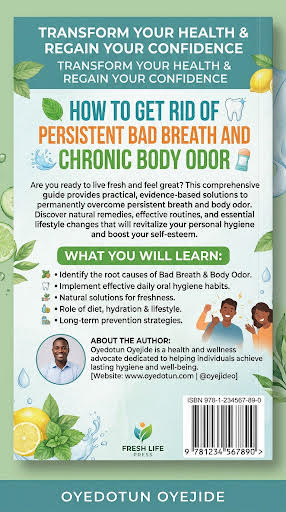
HOW TO GET RID OF PERSISTENT BAD BREATH & CHRONIC BODY ODOR

HOW TO GET RID OF PERSISTENT BAD BREATH & CHRONIC BODY ODOR
A Practical Health Guide to Understanding the Causes, Breaking the Cycle and Building Freshness & Confidence
By Dr. OYEDOTUN OYEJIDE FIMC
WHAT IF THE PROBLEM IS NOT SIMPLY “POOR HYGIENE”?
Persistent bad breath and chronic body odor can be embarrassing.
They can affect how confidently you speak to people, how close you feel comfortable standing to others, your social life, relationships, workplace interactions and even the way you see yourself.
And sometimes, despite brushing your teeth, bathing regularly, using deodorant, chewing gum or trying different mouthwashes, the problem keeps coming back.
Why?
Because persistent odor can sometimes have an underlying cause that ordinary perfumes, mouth fresheners and deodorants do not address.
This practical guide was created to help you understand the problem more intelligently—and take sensible steps toward dealing with it.
INTRODUCING
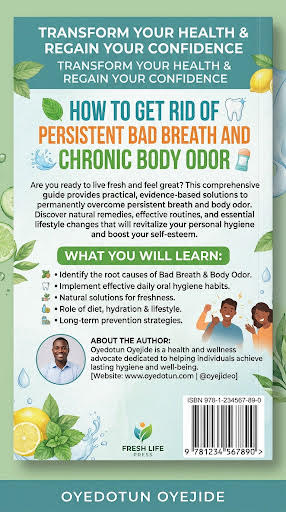
HOW TO GET RID OF PERSISTENT BAD BREATH & CHRONIC BODY ODOR
Discover the possible causes of persistent mouth and body odor—and learn practical, evidence-informed ways to improve freshness, hygiene and confidence.
This is not another book telling you simply to “brush more” or “use more deodorant.”
It takes a broader look at factors that can contribute to persistent odor, including oral hygiene, the tongue, gums, food and drink, dry mouth, lifestyle habits, skin and sweating, clothing, personal hygiene practices and situations where medical or dental assessment may be necessary.
THIS GUIDE IS FOR YOU IF…
You have ever wondered:
- “Why does my breath still smell after brushing?”
- “Why does my mouth smell again only a short time after cleaning it?”
- “Could my tongue be contributing to the problem?”
- “Why does my body odor return so quickly?”
- “Am I using deodorant incorrectly?”
- “Could my food or lifestyle be contributing?”
- “Why do some products work temporarily but the smell returns?”
- “Could there be an oral, dental or medical reason behind this?”
- “What practical daily routine can I follow?”
- “When should I stop trying home remedies and see a professional?”
If any of these questions sound familiar, this guide was written with you in mind.
THE REAL PROBLEM WITH COVERING UP ODOR
Perfume can mask an unpleasant smell.
Mouthwash can temporarily improve breath.
Deodorant can reduce or mask body odor.
But when the underlying contributor remains, the problem may return.
That is why this guide focuses on an important principle:
DON'T JUST MASK THE SMELL. UNDERSTAND THE POSSIBLE SOURCE.
The goal is to help you move from embarrassment and guesswork toward better understanding, practical hygiene and appropriate professional care when necessary.
WHAT YOU WILL DISCOVER INSIDE
1. Understanding Persistent Bad Breath
Learn what bad breath actually is, why it happens and why persistent halitosis deserves more attention than occasional morning breath.
2. The Mouth-Breath Connection
Explore how teeth, gums, tongue, saliva and oral hygiene can influence breath freshness.
3. The Tongue Factor
Understand why the tongue can harbor odor-producing substances and why tongue cleaning may form an important part of oral hygiene.
4. Food, Drinks & Breath
Discover how certain foods, drinks and dietary habits can influence breath temporarily or contribute to an unpleasant oral environment.
5. Dry Mouth & Bad Breath
Understand the relationship between saliva and oral freshness—and why persistent dry mouth should not simply be ignored.
6. Chronic Body Odor Explained
Learn why body odor develops and why sweat itself is not always the whole story.
7. Sweat, Skin & Bacteria
Understand how sweat interacts with microorganisms on the skin to produce characteristic odors.
8. Clothing, Feet & Personal Hygiene
Practical strategies for dealing with odor associated with clothing, footwear, feet and areas prone to sweating.
9. Deodorants, Antiperspirants & Fragrances
Understand the differences between products designed to control sweat and those primarily intended to provide fragrance.
10. Everyday Habits That May Be Making Things Worse
Identify overlooked habits that can contribute to persistent unpleasant smells.
11. The Home Hygiene Routine
Build a realistic daily freshness routine you can actually maintain.
12. When You Should See a Dentist or Doctor
Learn important warning signs and situations where professional assessment is more appropriate than continually experimenting with home remedies.
A PRACTICAL FRESHNESS ROUTINE
The guide doesn't stop at information.
It helps you turn knowledge into action.
You will be guided toward practical routines involving areas such as:
Morning care → oral hygiene → tongue care → hydration → food awareness → bathing → underarm care → clothing management → footwear/feet care → evening hygiene → monitoring changes.
The emphasis is on consistency, not expensive products.
DON'T LET EMBARRASSMENT STOP YOU FROM SEEKING HELP
One of the most painful aspects of persistent odor is the silence surrounding it.
People may notice it but hesitate to tell you.
Friends may move away.
Someone may cover their nose.
A colleague may make an indirect comment.
A person you care about may become less comfortable being physically close.
And you may begin wondering:
“Does everyone else notice this?”
This can affect confidence in ways that go far beyond hygiene.
But persistent odor should not automatically become a source of shame.
It is a problem to understand—not a reason to condemn yourself.
IMPORTANT: WHEN HOME REMEDIES ARE NOT ENOUGH
This guide also emphasizes something many “natural remedy” books fail to say:
Persistent symptoms deserve appropriate attention.
Bad breath can sometimes be associated with dental or oral conditions, while body odor can occasionally be associated with skin problems or other health circumstances.
Therefore, the guide helps you recognize when self-care may be reasonable and when it is wiser to consult an appropriate healthcare professional.
No miracle promises. No dangerous shortcuts. No shame.
Just practical health education.
WHO CAN BENEFIT FROM THIS GUIDE?
This guide may be useful for:
- Adults struggling with persistent bad breath
- People experiencing recurring body odor
- Teenagers and young adults learning better personal hygiene
- Parents teaching children healthy hygiene habits
- Workers and professionals concerned about workplace confidence
- People who have tried several products without lasting improvement
- Anyone who wants a structured personal freshness routine
- Couples and families who want to discuss sensitive hygiene issues respectfully
WHAT MAKES THIS GUIDE DIFFERENT?
 PRACTICAL
Designed for everyday life—not just medical terminology.
EASY TO UNDERSTAND
Complex health concepts are explained in simple language.
HUMANE
The subject is handled without ridicule, embarrassment or judgment.
SAFETY-CONSCIOUS
It recognizes that persistent symptoms can sometimes require professional evaluation.
ACTION-ORIENTED
You don't just read—you learn what to observe and what practical steps to take.
CONFIDENCE-BUILDING
Because good health education should improve both knowledge and quality of life.
IMAGINE THE DIFFERENCE…
Imagine being able to speak to someone without constantly worrying about your breath.
Imagine going to work without wondering whether people can smell you.
Imagine participating in conversations without covering your mouth.
Imagine understanding your personal hygiene routine instead of randomly buying one product after another.
Imagine having the confidence to seek appropriate professional help when something doesn't seem normal.
That is the kind of transformation this guide is designed to support.
YOUR NEXT STEP
You don't have to continue guessing.
You don't have to keep hiding behind chewing gum.
You don't have to keep changing deodorants every few weeks.
And you certainly don't have to feel ashamed of asking questions about a sensitive health issue.
Start by understanding the problem.
Then build better habits.
And when necessary, seek the right professional help.
GET YOUR COPY TODAY
HOW TO GET RID OF PERSISTENT BAD BREATH & CHRONIC BODY ODOR
By Dr. OYEDOTUN OYEJIDE FIMC
Your practical guide to understanding persistent odor, improving everyday hygiene and knowing when professional assessment may be necessary.
Read it. Apply it. Build better habits. Protect your confidence.
DOWNLOAD YOUR COPY TODAY.
A FINAL WORD FROM THE AUTHOR
Your health deserves attention even when the subject feels embarrassing.
Bad breath and body odor are sensitive issues, but they are not subjects that should prevent you from seeking knowledge or appropriate help.
Knowledge removes unnecessary fear.
Read this guide with an open mind, apply the practical recommendations that are appropriate for you, and remember that persistent or unexplained symptoms deserve proper professional attention.
Your confidence matters. Your health matters. And you deserve to understand what is happening to your body.
Dr. OYEDOTUN OYEJIDE FIMC