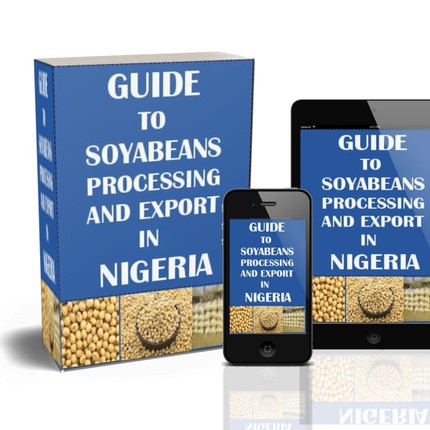
Comprehensive Soyabean Processing Business Plan - Guide to Soyabean Processing and Export in Nigeria + Access Membership of International Food and Agro Business WhatsApp Group

In many developing countries, soybean processing plants are usually very few and their combined production capacity isn’t in any way close to meeting the overwhelming demand for the soybean milk, tofu, yoghurt, and other products. In addition, the poverty rates in these countries are so high, only few entrepreneurs can afford the cost of starting a soybean processing plant.
Soybean is processed to produce a number of food products that are generally in huge demand. These include soymilk, soy yoghurt, tofu, soybean oil, soy flour, soy sauce, fermented bean paste, textured vegetable protein, natto, tempeh, and many others. Of these products, soymilk, tofu, soybean oil are the most popular and most sought-after.
DEMAND
Nigeria Soybean has a very high demand internationally. Soybean production is a very profitable-lucrative business that yields very fast returns and one can increase crop output to meet the growing needs.
It is essential to minimise your export risk by conducting thorough market research which will help you understand the risks of doing business in a particular country, then you can decide on how you want to control those
risks. It is also important to ensure you meet buyer’s requirement by providing evidence of origin and delivery.
Never worry about price volatility, it makes good management essential.
There are various methods for the processing of soybeans. The most effective soya processing method consists of a combination of heat treatment and crushing. This method removes the anti-nutritional factor and makes the oil more accessible.
PRODUCTION
Soyabeans were introduced to Nigeria in
1908 but first export was in 1947.Improving quality and increasing yieldsi n 17 Producing States and include smallholders and commercial farmers.The crop is well- suited for Nigeria. Soybean crop farming is spread equally between north and middle belt region.Nigeria’s soyabeans production is rising steadily, spurred by favourable grower prices and high demand.
MARKETS
The market for soybean in Nigeria is growing very fast with opportunities for improving the income of farmers.
Currently, SALMA Oil Mills in Kano, Grand Cereals in Jos, ECWA Feeds in Jos, KARMA FOOD Ltd in Gwagwalada, AFCOT Oil Seed Processors, Ngurore, Adamawa State, and
P.S. Mandrides in Kano, all process soybean. IITA and Olam grain have developed improved technologies for soybean production in Nigeria.
Over the past few years, soybean production and consumption has expanded rapidly because of the growth in the industrial sector in oil production, animal feed production, and much more.
The global conventional soybean market will experience a 5% CAGR from 2017 to 2025 reaching a total market value of USD 214.36 billion. This might potentially help balance
the existing oversupply.
The largest-soybean exporting countries in 2021, were Brazil, the United states and Argentina and the largest importing countries were China, Mexico and Netherlands.
Furthermore, so much efforts should be made to increase soybean yields and there should be an increasing crop output to meet the growing needs of local feed millers and
poultry farmers.
However, there are some key factors for prospective export processors when dealing with buyers in export markets.
• Certification improves the processes of
production, exporters need certification because of both the internal and external factors.
• Exporters must be able to provide certificates of quality that the product meets the quality specification and the laws of the importing country e.g., mycotoxin limits or maximum pesticide residue levels.
• Packaging should be the standard packaging agreed with the customer. Soya beans are usually packed in according to the buyer’s requirements.
Soybeans are generally transported as bulk cargo but occasionally also as break-bulk cargo on bags of woven natural materials (pp bags) or woven plastic bags. soybean is packed manually in 50kg polypropylene bags with moisture content of 11%-12% and temperature of 18%-24%.
• Export contract is an agreement between the buyer and seller. It is important to assure your buyer that you are capable of executing the contract, thereby making sure you pay attention to details of the export contract agreed upon by both parties. As an exporter be familiar with government policy and regulations.
FINDING BUYERS
Soybeans could be exported and sold locally due to high demand for it. The soybeans must be cleaned in accordance with the storage regulations which is based on the
temperature and moisture content. As the moisture levels increases.
The watchwords for the potential export of soybeans are as follows:
✓ Which product? -bulk or consumption goods?
✓ Which market? do some research taking into account your advantages of location, quality and communication skills Europe and North America have high potential
✓ Which Channel? Will you sell through an
Agent/Dealer, an Importer or direct to a buyer? If you are selling directly you will have to manage the buyer and to find new buyers. If you sell through an Agent/Dealer, it is more difficult to build a long term business.
QUALITY ASSURANCE DOCUMENTS
These are key export documents which will help you to ensure that your exported goods conform to safety measures:
• Exporters registration certificate-NEPC
• Certification of quality and weight.
• Certificate of origin
• Phyto sanitary Certificate for agricultural
commodities (issued by NAQS)
• Health certificate for processed food items issued by NAFDAC)
• Test certificate for harmful microbiological activity e.g., salmonella and aflatoxin.
The agricultural sector has no regulatory impediments to export. There is no export tax on soya beans and no import tax in high potential markets).
NEPC can coordinate and harmonise export development and promotion activities such as providing exportable products list and simplifies export procedures.
SUCCESS STORIES
There are few success stories a soyabean processor, dealer and exporter can identify with.
First, in the crop year 2016-17, 2021-22, Olam was the largest buyer of Nigerian soybeans from local farmers and traders, Olam successfully created an export market for Nigerian soybeans and accounted for the bulk of soybean export.
Surveys conducted by project researchers in the Oyo state region in Nigeria shows that in the last 5 years the number of people eating soybean has risen from near zero to 54%
There are other success stories like ‘’soy milk’, soy ogi and soy iru, dawadawa. The milk made from soy flour can be prepared in the home in less than 15minutes. In the short term, children and nursing mothers have benefited greatly from the creation of protein-rich baby food like ‘’soyamusa’’ and “babeena” many hospitals and women’s group programs in Nigeria are promoting soybeans in their campaign to raise family and children’s nutrition levels.
Another success story is Soybean research and its implications for increased nutrition level among the Nigerian people has had a strong impact on the government. The long- term goals of the soybean project in Nigeria are not only to increase nutrition in all sectors but to promote the beans in other African countries. Indeed, this project in Nigeria is having an impact in other countries as well.
TABLE OF CONTENT OF SOYA BEAN PROCESSING FACTORY/BUSINESS PLAN
An Overview of The Soya Bean Processing Business
Project Summary
The Extruder
The Expeller or Expresser machine.
The Hammer Mill
The Storage Facility
Sundry Factory Tools
The Market
The Project Cost and Financing
Financing
Profitability Profile
Profitability Calculation
Economic Benefits
Conclusion and Recommendation
The Company
Vision and Mission Statement
Organizational and Management Plan
Key Personnel of The Organization
Roles and Responsibilities of The Senior Staff
Manpower Requirement
The Market
Product Identification and Uses
Market Location
Our Target Market
Product Demand
Product Sales
Our Pricing Strategy
Assumptions:
Payment Options
Sales Forecast
Our Competitive Advantage
SWOT Analysis
Technical Analysis
Project Location and Site
Machines and Equipment:
The Equipment and their Costs are as follows.
The Raw Material:
Utility Equipment
Working Capital
Production Capacity
Production Process
Technical Management
Project Implementation Schedule
Financial Analysis
Project Cost
Project Financing Structure
Project Profitability Analysis
Materials Purchases Budget for One Month
Segregation of Costs into Fixed and Variable Costs
Assumptions:
Sales Forecast for The First One Year
Sales Forecast for The First Five Years
Projected Income Statement for The First One Year
Projected Condensed Income Statement for the Next Five Years
Projected Cash Flow
Appendices
Conclusions
In addition,
You will be added to an International Food and Agro Business WhatsApp group of over 350 members comprising Foreign buyers, foodstuff exporters and suppliers.
We will support you all the way.
Gaining adequate knowledge and vital information set you ahead. We have got you great offer. We expect your order.
You are sure of our support and assistance throughout your foodstuff & Export venture.