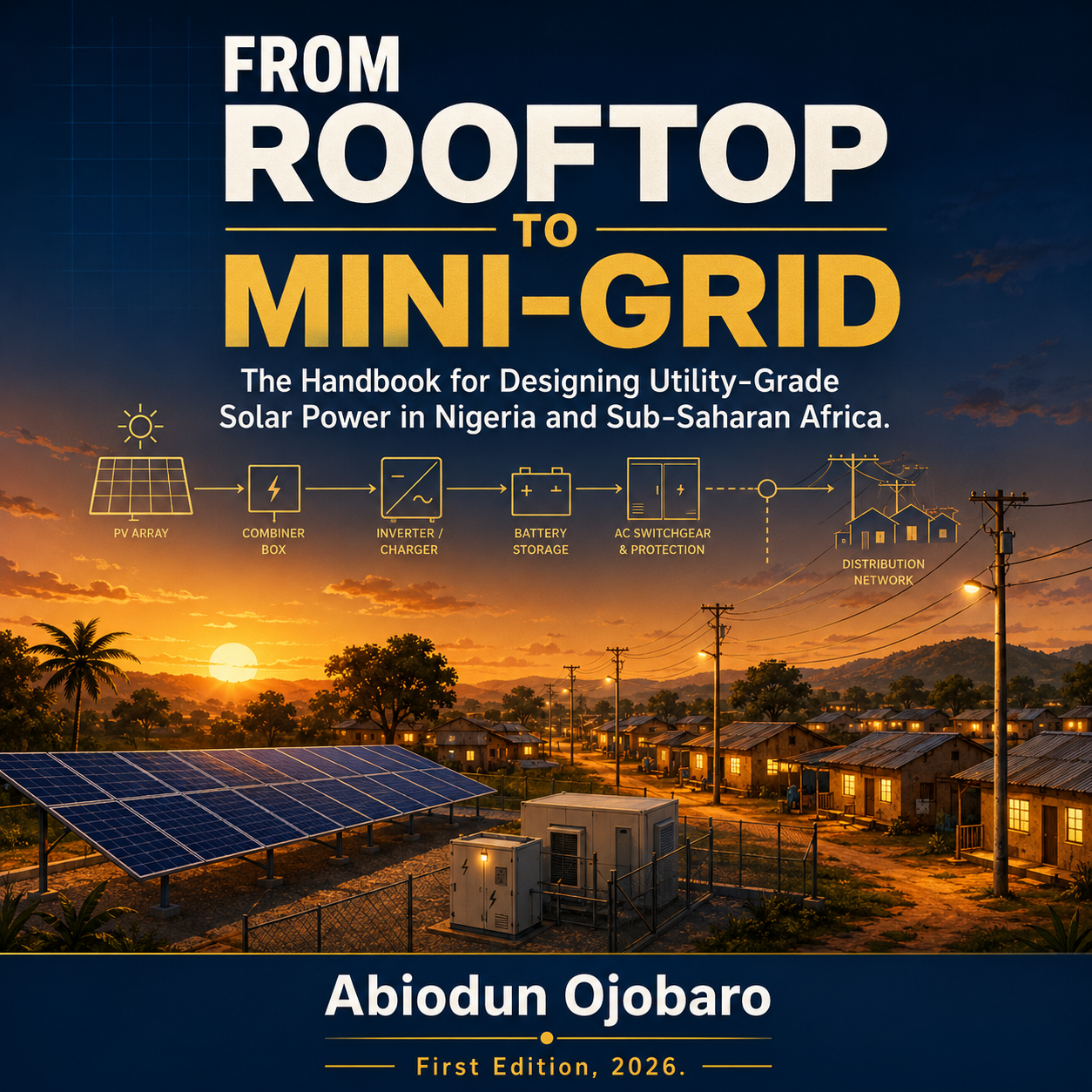
FROM ROOFTOP TO MINI-GRID

For the solar installer or engineer who can already wire a rooftop — and is ready to build something far bigger.
Nigeria Needs 1,350 New Mini-Grids. The Engineers Who Can Actually Design One Are About to Become the Most Valuable People in the Sector.
And right now, almost nobody is teaching the part that decides whether your project earns money for twenty years — or rusts into a monument to good intentions.
Picture a town you won't find on most maps.
It's a little after seven in the evening, and the first thing you notice isn't darkness. It's noise — the flat, tireless drone of a hundred small petrol generators, each bolted to a verandah, each burning fuel a family can barely afford, each coughing blue smoke into the same air the children breathe.
A shopkeeper runs one bulb and a freezer off a machine that cost her more last month in petrol than her rent.
A clinic keeps its vaccines cold by the grace of a generator that may or may not start tomorrow.
A student does her homework in the wash of a phone torch — then gives up.
Here's the part that stays with you: it isn't the darkness that's cruel. It's the expense of the darkness. That shopkeeper, burning 8 litres a day at ₦900 a litre, is spending roughly ₦216,000 a month — in fuel alone — for noisy, dirty, unreliable power that runs only part of the day.
She is already paying a fortune. For the worst supply in the country.
Now imagine you're the engineer who can offer her something cheaper, cleaner, quieter, and on all evening.
Not a charity. A business. A solar PV mini-grid.
That is the opportunity sitting in front of you right now. And this book is the only thing standing between you and the skill to claim it.
Here's the Trap That Sinks Almost Every First Project
The first time most installers stand on a mini-grid site, they make the same quiet calculation:
"This is just a big version of what I already do. Same panels. Same inverters. Same batteries. More of everything — but nothing genuinely new."
That calculation is wrong. And unlearning it is the difference between a career and a catastrophe.
A rooftop system serves one customer who understands what they bought. If their battery runs flat, that's their lesson.
A mini-grid is the opposite on every axis. The moment you serve many independent customers across a distance — with meters, a tariff, a regulator, and a twenty-year horizon — you are no longer doing residential installation. You are building and running a small electric utility.
The engineering is different. The economics are different. The risks — wind, lightning, harmattan dust, theft, a load that grows faster than you planned — are different. And in Nigeria and across Sub-Saharan Africa, the rules and the money are very different, and they change often.
The panels and inverters turn out to be the easy part. What separates a mini-grid that runs profitably for twenty years from one that fails is everything around the generation — and that is exactly the part no book has ever taught you.
Until now.
Why There Was No Book for This — So I Wrote One
Go looking for a book on solar power today and you'll find a shelf groaning with guides. Almost every one is written for someone with a camper van, a sailboat, or a cabin in a temperate country who wants to charge a laptop off-grid for fun.
Fine books. Useless to you if your job is to power a Nigerian village.
Because a mini-grid is not a big version of a rooftop system, and a community is not a camper van. There was no single book that took an engineer who can already wire a rooftop and walked them — all the way through — to designing and delivering a real mini-grid in our part of the world: the calculations, the network, the metering, the regulation, the field craft, and the business of it.
So I wrote one.
I'm Abiodun Ojobaro. I'm a practising power engineer, registered with COREN. I trained at RENAC in Berlin and at the Siemens Power Academy. More to the point: I have designed and commissioned these systems in the field — in our heat, our dust, under our regulations, with our supply chains and our budgets. I've made the mistakes in this book, or watched good engineers make them, and I've learned what survives a storm and what does not.
This Is Not Theory. It's the Whole Method, Worked in Full, Twice.
Most engineering books show you the answer. This one shows you the entire calculation — because the design is a chain, and every link feeds the next. The load you measure sizes the array; the array sizes the inverters; the currents size the cables. Get one early number wrong and the error rides all the way to the bill of materials.
So we leave nothing hidden.
The whole book is built around a complete companion project — the Riverside community, about eighty connections — carried from the very first load estimate to the final single-line diagram. When you see Riverside, you're watching the method work end to end. And there's a second full worked example in the appendices: a dispersed town with medium-voltage distribution, so you see the method scale.
Two complete designs. Every calculation shown. No hand-waving and no shortcuts — just the method that works.
What You'll Be Able to Do by the Last Page
You'll take a real community — a name on a map, a count of households, a maize mill, a clinic — and produce a permit-ready design package. That means you can:
- Audit a demand nobody has ever metered — and forecast the diversified peak so you don't build (and charge for) capacity that never gets used.
- Size every component with the numbers corrected in the open — the array, the inverters, the storage, the backup generator, the cables, the protection — including the stray-minus-sign and wrong-voltage-window errors that quietly sink first projects.
- Design and build a real low-voltage distribution network — poles, conductors, earthing, lightning protection — so the lights don't dim at the far house every time the mill starts.
- Meter for revenue and for grant verification, because on a mini-grid the meter is the cash register, not an accessory — and the funder pays you per verified connection.
- Navigate NERC, the REA, NEMSA and the tariff methodology well enough to file, finance, and stand behind your design in the DARES era.
- Commission it safely — and turn one project into a practice.
Inside the Handbook
A practical, calculation-first guide across 10 chapters and 9 appendices, including:
- The Mini-Grid Opportunity (and why it isn't a big rooftop)
- Getting Legal and Getting Paid
- Site Selection, Survey & Layout
- Load Assessment & Demand Forecasting
- Solar Resource & PV Array Sizing
- Inverters, Batteries & the Backup Generator
- Cables, Protection, Earthing & Lightning
- Mounting, Civil Works & the Distribution Network
- Metering, Revenue, Security & Keeping It Alive
- Commissioning, Safety & Building a Mini-Grid Practice
Plus the appendices you'll actually keep on the bench: the Riverside single-line and architecture, a full bill of materials, a design summary sheet, blank templates you can carry to your own project, a glossary, a formula quick-reference, a standards-and-bodies directory, the second worked example, and a commissioning & troubleshooting field guide.
Throughout, you'll meet Worked Examples, Common Mistakes (real errors that cost real money, corrected here), Design Checks (go/no-go tests before you commit), Checklists, and Exercises — because reading about sizing a string is not the same as sizing one, any more than reading about swimming keeps you afloat.
Why This Is the Moment — Not Next Year
Three things have shifted at once, and they won't all stay open forever:
- The technology got cheap and good. Module prices have fallen roughly tenfold in fifteen years; lithium followed. The risk is no longer "will it work?" — it's "did the engineer size and build it correctly?" That risk is precisely what this book removes.
- The policy and the money arrived. Nigeria's legal framework has been rebuilt around decentralised power, and large donor-backed programmes now pay a substantial share of capital cost — against verified connections. You are not funding these out of your own pocket.
- The demand is real, and it grows. Reliable power doesn't just meet demand — it creates it. The mill runs longer. The welder opens. The shopkeeper buys a freezer. Within two years the load has grown, sometimes sharply. A well-designed mini-grid is an engine of a local economy — and a business that grows with the community it serves.
The continent needs tens of thousands of these systems. It does not need them designed like oversized rooftops. The engineers who can tell the difference are the ones who will own this decade.
This Book Is For You If…
- You can already design or install solar at the scale of a home or a small business — and you're ready to step up to utility-grade community power.
- You're an installer growing into mini-grids, an electrical or energy engineer moving into the sector, or a developer who needs to understand the engineering well enough to commission it, finance it, and stand behind it.
It is not for absolute beginners. I assume you know what a panel, an inverter and a battery are. I do not assume you've ever sized a string for temperature, designed an LV distribution network, filed a tariff with NERC, or argued with laterite soil about a pole foundation. We'll do all of that together.
My Promise to You — and Your Risk-Free Guarantee
Read it cover to cover once. Run your own prospective site alongside Riverside, doing each calculation as we do it.
If you do that and don't finish the book genuinely able to produce a permit-ready mini-grid design package — more capable, more confident, and more bankable as an engineer than the day you opened it — [tell me within (XX) days for a full refund. Keep the templates. No hard feelings.]
The only thing you can lose is the cost of a single litre… of the diesel you're about to help a whole community stop burning.
[Get From Rooftop to Mini-Grid Today
Nigeria needs 1,350 new mini-grids. This book shows you how to design one.
[ORDER NOW