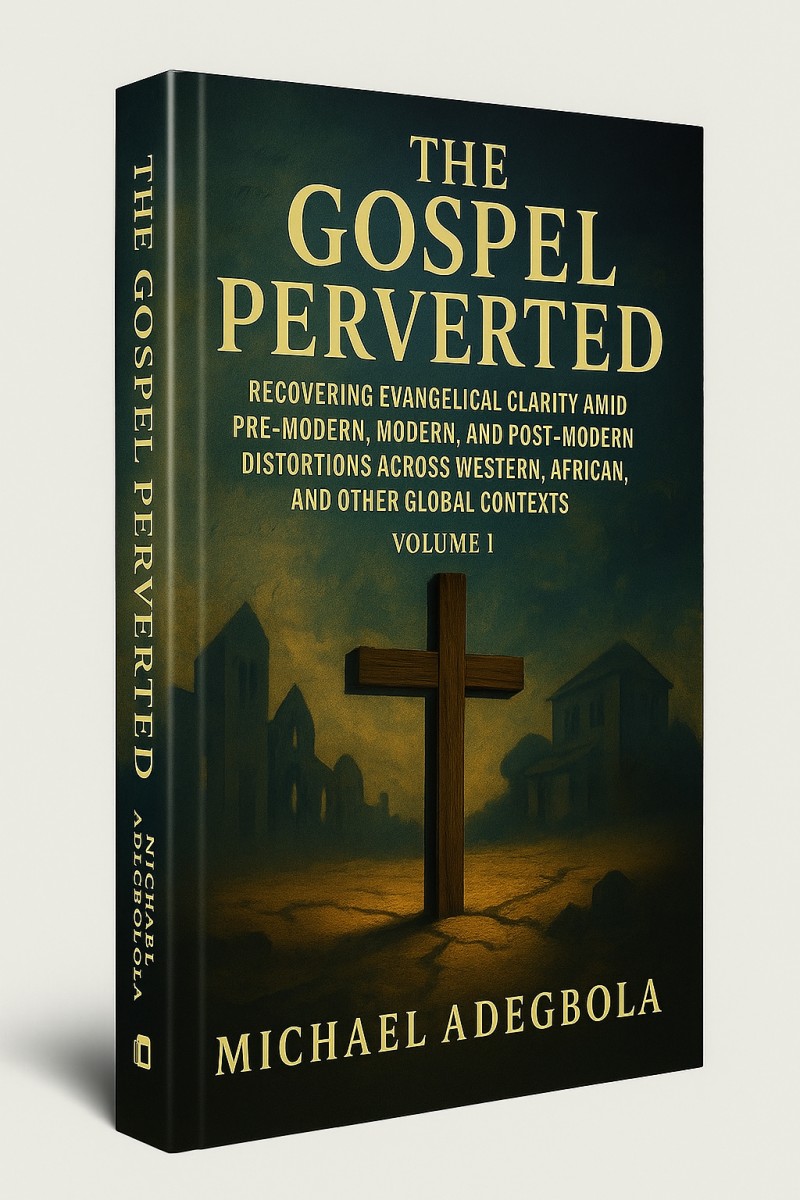
The Gospel Perverted: Recovering Evangelical Clarity Amid Pre-Modern, Modern, and Post-Modern Distortions Across Western, African, and Other Global Contexts

Pages: 512
INTRODUCTION
This book, in its two volumes—The Gospel Perverted: Recovering Evangelical Clarity Amid Pre-Modern, Modern, and Post-Modern Distortions Across Western, African, and Other Global Contexts—is written in response to that reality. It arises from a deeply evangelical burden to recover, clarify, and proclaim the true Gospel of Jesus Christ in the face of historical and contemporary distortions.
This recovery is not a call to a narrow Western traditionalism, nor is it a nostalgic longing for a supposedly pure past. Rather, it is a biblical, Spirit-driven call to re-anchor the global Church in the apostolic message entrusted to her—the Gospel of grace through Christ alone.
Purpose and Burden
The Gospel is the power of God for salvation to everyone who believes. It is the divine announcement that, in Christ, God has acted to redeem a fallen world and reconcile sinners to Himself through the life, death, and resurrection of His Son. Yet across generations and cultures, this Gospel has been repeatedly misrepresented, neglected, reshaped, or replaced—sometimes subtly, often dramatically.
The burden of this book arises from the realization that in many churches today, the Gospel is no longer clearly understood or faithfully proclaimed. What is often offered in its place is a moralistic, therapeutic, ideological, or ritualistic substitute—forms of Christianity that may use biblical language but ultimately obscure the truth that saves.
The purpose of The Gospel Perverted is to recover clarity about the Gospel—its nature, its biblical content, its theological depth, and its historical centrality to the Christian faith. This volume calls the Church, in every context, to return to the Gospel as revealed in Scripture and to resist the perversions that continue to threaten its purity and power.
Theological Commitment
This work is written from a deeply evangelical perspective. That is, it is rooted in the full authority and divine inspiration of Holy Scripture, the centrality of Jesus Christ as Lord and Savior, the necessity of regeneration through faith and repentance, the sufficiency of grace, and the active role of the Holy Spirit in bringing about new life and empowering the Church.
I believe the Gospel is not a vague spiritual ideal or evolving religious narrative. It is the concrete, historic, unchanging message of God’s saving work in Christ. To abandon, alter, or soften that message is not merely to weaken the Church’s witness—it is to jeopardize the souls of those who hear a false gospel in place of the true one.
This conviction demands theological precision, spiritual courage, and pastoral clarity—especially in an age that prizes novelty, personalization, and compromise.
Methodological Approach
This book employs a multi-dimensional method to engage the Gospel theologically, historically, and contextually. The goal is not just to define the Gospel, but to examine how it has been distorted over time, and how the Church must respond today.
1. Biblical and Theological Analysis
Part One of this volume is anchored in the authority of Scripture. It presents a biblical definition of the Gospel and surveys how the Gospel is described, preached, and applied across the New Testament. This includes examining the central themes of redemptive history, the identity and mission of Christ, and the apostolic witness to the saving work of God.
Theological categories such as sin, grace, atonement, justification, kingdom, faith, and repentance are discussed in light of Scripture, with the goal of forming a coherent and faithful understanding of the Gospel’s essential content.
2. Historical Survey and Evaluation
Part Two provides a critical overview of how the Gospel has been perverted across three historical eras: pre-modern (prior to the 1650s), modern (1650s–1980s), and post-modern (1980s to the present). Within each period, I explore the theological shifts, socio-cultural influences, and ecclesial movements that contributed to the corruption or obscuring of the Gospel message.
This survey includes Western, African, and other global expressions of Christianity, recognizing that Gospel distortions are not confined to one region or tradition but emerge in varying forms throughout Church history.
3. Contextual and Practical Implication
Each chapter aims to move beyond description to application. By identifying the patterns and pressures that distort the Gospel, I seek to equip readers with discernment for their own contexts—whether in pastoral ministry, theological education, evangelism, or personal discipleship. The Gospel must not only be rightly defined; it must be faithfully embodied and boldly proclaimed.
This practical concern is especially relevant in today’s pluralistic and globalized Church, where various forms of false gospels—legalistic, consumeristic, syncretistic, or therapeutic—continue to circulate and gain influence.
Structure of the Book
This volume is divided into two major parts. Part One, The True Gospel—Foundation for Every Age and Context, lays the groundwork for Gospel clarity. Chapter 1 offers a definition of the Gospel grounded in Scripture and informed by core evangelical convictions. Chapter 2 surveys the Gospel’s proclamation and function across the New Testament, demonstrating its theological unity and contextual adaptability without compromising its essence.
Part Two, Historical Perversions of the Gospel, traces the distortion of the Gospel message throughout history. Chapter 3 examines how ecclesiastical traditions and sacramental systems often supplanted Gospel clarity in the pre-Reformation era. Chapter 4 analyzes distortions shaped by rationalism, liberal theology, and spiritual movements that displaced biblical authority from the 1650s through the 1980s. Chapter 5 explores how relativism, deconstructionism, identity ideologies, and consumer Christianity have redefined or replaced the Gospel in the contemporary Church since the 1980s.
Each chapter includes focused sections on the Western, African, and other global contexts, recognizing the need for a culturally aware and globally sensitive approach to Gospel faithfulness.
Why Now?
We live in a time of unprecedented spiritual confusion. In many places, the Gospel has been replaced with moralistic advice, self-help mantras, political ideology, or vague spirituality. The authority of Scripture is questioned, doctrinal precision is dismissed, and the centrality of Christ’s atoning work is downplayed or ignored.
In the West, Gospel clarity is undermined by individualism, relativism, and theological revisionism. In Africa and other parts of the Global South, prosperity teaching, legalism, syncretism, and shallow forms of Christianity often crowd out the biblical Gospel. Meanwhile, global movements—seeker-sensitive strategies, progressive theologies, and identity-driven ideologies—continue to reshape the Gospel according to the spirit of the age.
Now is the time for the Church to recover its message. Not through nostalgia or defensiveness, but through faithful re-commitment to the Gospel revealed in Scripture. Gospel clarity is not a secondary concern—it is a first-order issue. Where the Gospel is lost, the Church is lost.
A Word to the Reader
This book is written for pastors, Bible students, seminarians, and theologians who feel the weight of the present theological confusion and long for a renewal grounded in Gospel truth. Whether you are preaching weekly, teaching in the classroom, preparing for ministry, or laboring to think biblically amid cultural pressures, this volume is for you.
Here you will find not only theological reflection, but also historical analysis and pastoral urgency. You may be challenged—and at times unsettled—but above all, my prayer is that you will be drawn back to the Gospel itself: unchanging, sufficient, and glorious.
May the Lord use this work to strengthen His Church, exalt His Son, and awaken His people to the truth that saves.
Soli Deo Gloria.
— Michael Adegbola