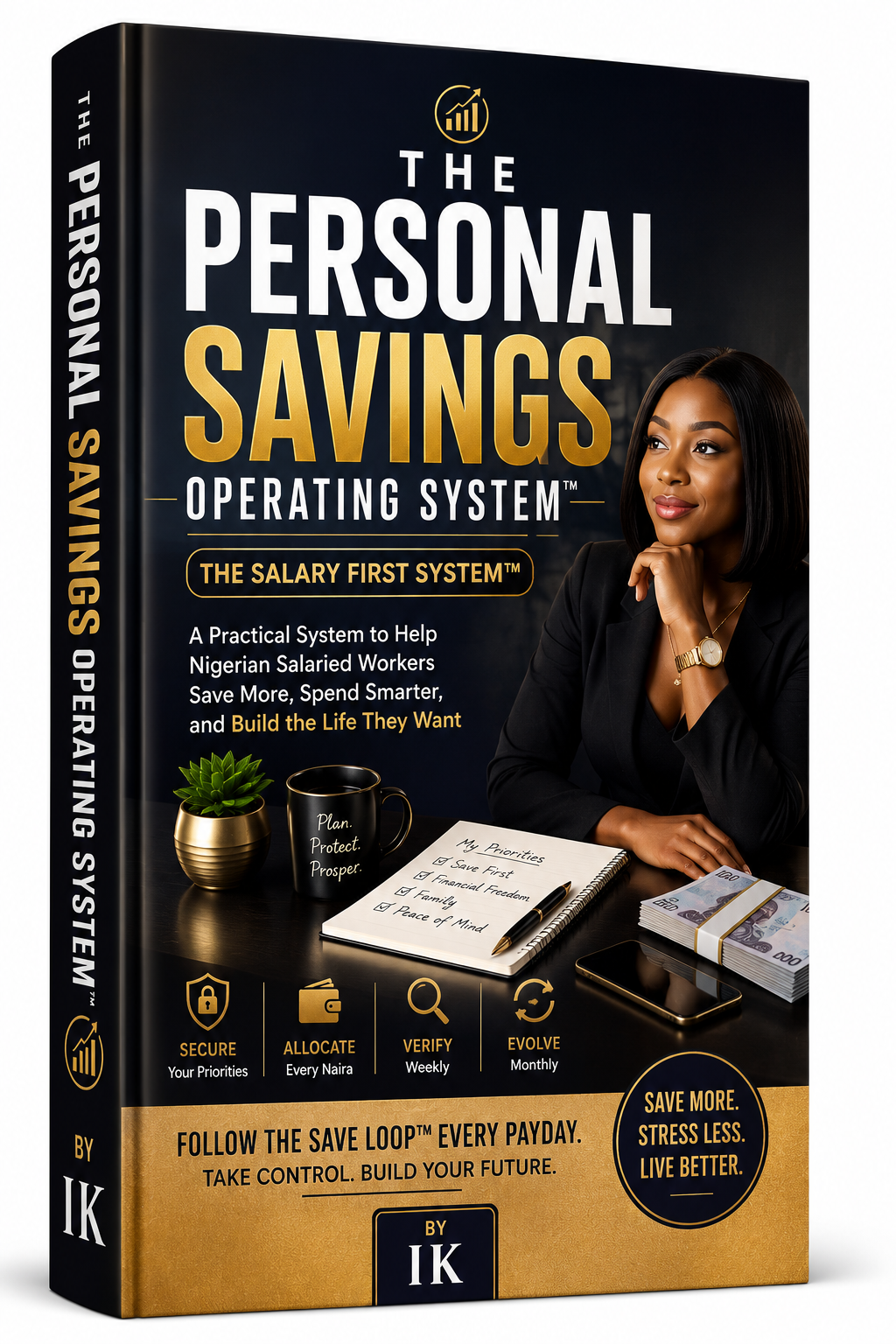
Personal Savings Operating System - A Practical System for Staying in Control of Your Salary After Payday Even If You've Never Managed to Save Consistently Before
Your salary comes in. A few days later, you're wondering where it went.
You planned to save this month.
Then the bills came.
Someone needed help.
You made a few purchases you hadn't planned for.
One expense became another.
And before month end, you're thinking: "How did I spend all that money?"
Then you promise yourself:
"Next month will be different."
Until the next salary arrives.
The Personal Savings Operating System gives you a practical process for managing your salary after payday so more of your money goes where you intended.
Stop relying on willpower to save
Knowing that you should save isn't usually the problem.
The harder part is deciding what happens to your salary before spending decisions start piling up.
This system gives you a repeatable payday-to-month-end process instead of another collection of financial advice.
You use it when your salary arrives.
You use it during the month.
Then you review what happened and improve your approach for the next salary cycle.
Here's how the system works
The Salary First System gives you the overall implementation process.
Inside it, you use the SAVE Loop:
S — Secure
Protect the money you've already decided should support your goals.
A — Allocate
Give your salary specific jobs before discretionary spending takes over.
V — Verify
Pause and check spending decisions against your plan.
E — Evolve
Review what happened and adjust your approach for the next month.
Then you repeat the process when your next salary arrives.
Salary arrives → Secure → Allocate → Verify → Evolve → Repeat
What you get
1. Personal Savings Operating System Guide
Understand the system and how to apply it throughout your salary cycle.
You'll learn how to:
- Set up your salary system
- Apply the Salary First System
- Use the SAVE Loop
- Build a repeatable payday routine
- Review and improve your process
2. Payday Action Checklist
A step-by-step checklist for when your salary arrives.
Instead of wondering what to do first, you follow the sequence.
Use it every payday.
3. Salary Allocation Worksheet
Turn your salary into a written plan before spending begins.
Use it to decide where your money should go based on your actual situation.
4. Weekly Savings Tracker
Track your progress during the month.
See what is happening before you reach month end and find out you've lost control.
5. Monthly Review Worksheet
Look back at the salary cycle.
Identify what worked.
Identify where you lost control.
Then adjust your approach for the next month.
6. Habit Scorecard
Track the behaviours that support your savings system.
Because progress isn't only about the amount saved.
It's also about becoming more consistent with the process.
7. Savings Progress Tracker
Track your savings progress over time.
See what you're building across multiple salary cycles.
You also get Quick Start resources
Quick Start Guide
Know exactly where to begin after purchasing.
First Payday Action Plan
A simplified sequence for completing your first payday implementation.
You don't need to read everything before taking action.
Start with the first practical step.
Your first implementation cycle
You don't need to completely change your finances overnight.
Your first goal is simple:
Step 1
Set up your salary plan.
Step 2
Make your first savings decision.
Step 3
Complete your payday process.
Step 4
Use the spending filter during the month.
Step 5
Complete your first monthly review.
Then repeat.
Who is this for?
The Personal Savings Operating System is designed for you if:
- You earn a regular monthly salary.
- You want to save consistently.
- You often lose control of spending after payday.
- You regularly wonder where your money went.
- You've tried budgeting or savings methods but struggle to maintain them.
- You want a practical process rather than more financial theory.
This is NOT an investment course
The Personal Savings Operating System does not teach you how to pick stocks, crypto, mutual funds or investments.
It doesn't promise a specific amount of savings.
It doesn't assume everyone has the same income or financial obligations.
It gives you a structured process for making better salary decisions.
You can use it alongside savings apps such as PiggyVest or Cowrywise.
The apps can help you store or automate money.
This system helps you decide what should happen before and around that process.
From "I'll save next month" to having a process
You don't need another reminder that saving is important.
You need a process you can return to.
Every payday.
Every week.
Every month.
That's what the Personal Savings Operating System is designed to give you.
WHAT'S INCLUDED
Personal Savings Operating System Guide
Salary First System
SAVE Loop
Payday Action Checklist
Salary Allocation Worksheet
Weekly Savings Tracker
Monthly Review Worksheet
Habit Scorecard
Savings Progress Tracker
Quick Start Guide
First Payday Action Plan
YOUR NEXT SALARY CAN FOLLOW A DIFFERENT PROCESS
Instead of waiting until month end to ask where your money went, start making your salary decisions earlier.
Get the Personal Savings Operating System and set up your first salary cycle.
[BUY NOW]
Small disclaimer
This product provides general educational and organisational guidance. It does not constitute financial, investment, tax or legal advice. Your financial decisions should reflect your individual circumstances.