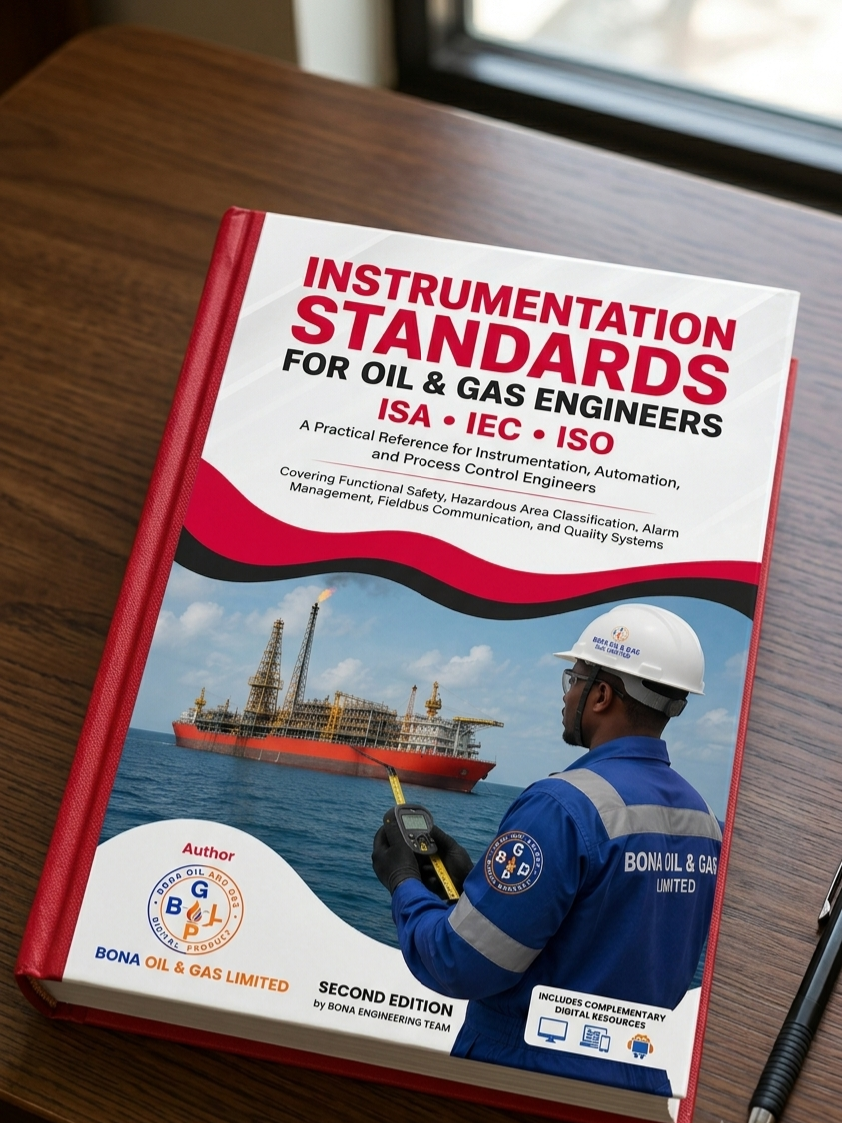
INSTRUMENTATION STANDARDS FOR OIL & GAS ENGINEERS ISA • IEC • ISO

INSTRUMENTATION STANDARDS
FOR OIL & GAS ENGINEERS
ISA • IEC • ISO
A Practical Reference for Instrumentation, Automation,
and Process Control Engineers
Covering Functional Safety, Hazardous Area Classification, Alarm
Management, Fieldbus Communication, and Quality Systems
Author: Bona Oil and Gas Digital Product
Table of Contents
Introduction 3
Chapter 1: The Standards Landscape — Why ISA, IEC & ISO Matter 4
Chapter 2: ISA Standards for Oil & Gas Instrumentation 6
Chapter 3: IEC Standards — Functional Safety, Hazardous Areas & Communication 8
Chapter 4: ISO Standards — Measurement, Quality & Materials 10
Chapter 5: Applying Standards Across the Project Lifecycle 13
Chapter 6: Solutions — Troubleshooting Common Compliance Problems 15
Conclusion 16
Introduction
Instrumentation engineering in oil and gas does not happen in a vacuum. Every transmitter you specify, every safety loop you design, every enclosure you rate for a hazardous area, and every alarm you configure sits inside a web of international standards written by three organizations: the International Society of Automation (ISA), the International Electrotechnical Commission (IEC), and the International Organization for Standardization (ISO). These bodies do not compete so much as divide the work — ISA writes much of the practical automation and safety guidance that IEC later formalizes as international law-equivalent standard, while ISO covers measurement, quality, and materials that instrumentation depends on but that fall outside pure automation.
For a working engineer, the problem is rarely a lack of standards — it is knowing which standard governs which decision, how the three bodies' documents relate to and reference each other, and how to apply them practically on a live project without stalling design, procurement, or commissioning. This guide exists to close that gap.
It is written for instrumentation, automation, and process control engineers working across upstream, midstream, and downstream facilities — whether you are specifying a new safety instrumented system, classifying a hazardous area for a new wellsite, selecting a fieldbus protocol for a brownfield upgrade, or preparing documentation for an audit. Each chapter takes a standards body, explains the standards that matter most in oil and gas, and shows how to apply them in practice, with actionable tips drawn from real project experience.
How to Use This Guide
Read Chapters 2–4 in sequence if you are new to the standards landscape — each builds on cross-references from the last.
Jump directly to Chapter 5 if you need a lifecycle view of which standards apply at which project stage, from FEED through commissioning.
Use Chapter 6 as a quick-reference troubleshooting table when a compliance question stalls a design review or an audit finding needs a fast, defensible fix.
Keep the tip boxes in each chapter as a field-ready checklist — they translate the standard's language into the practical question you actually need to answer.
A standard you have not applied is just a document on a shelf. The value is in the discipline of using it consistently, project