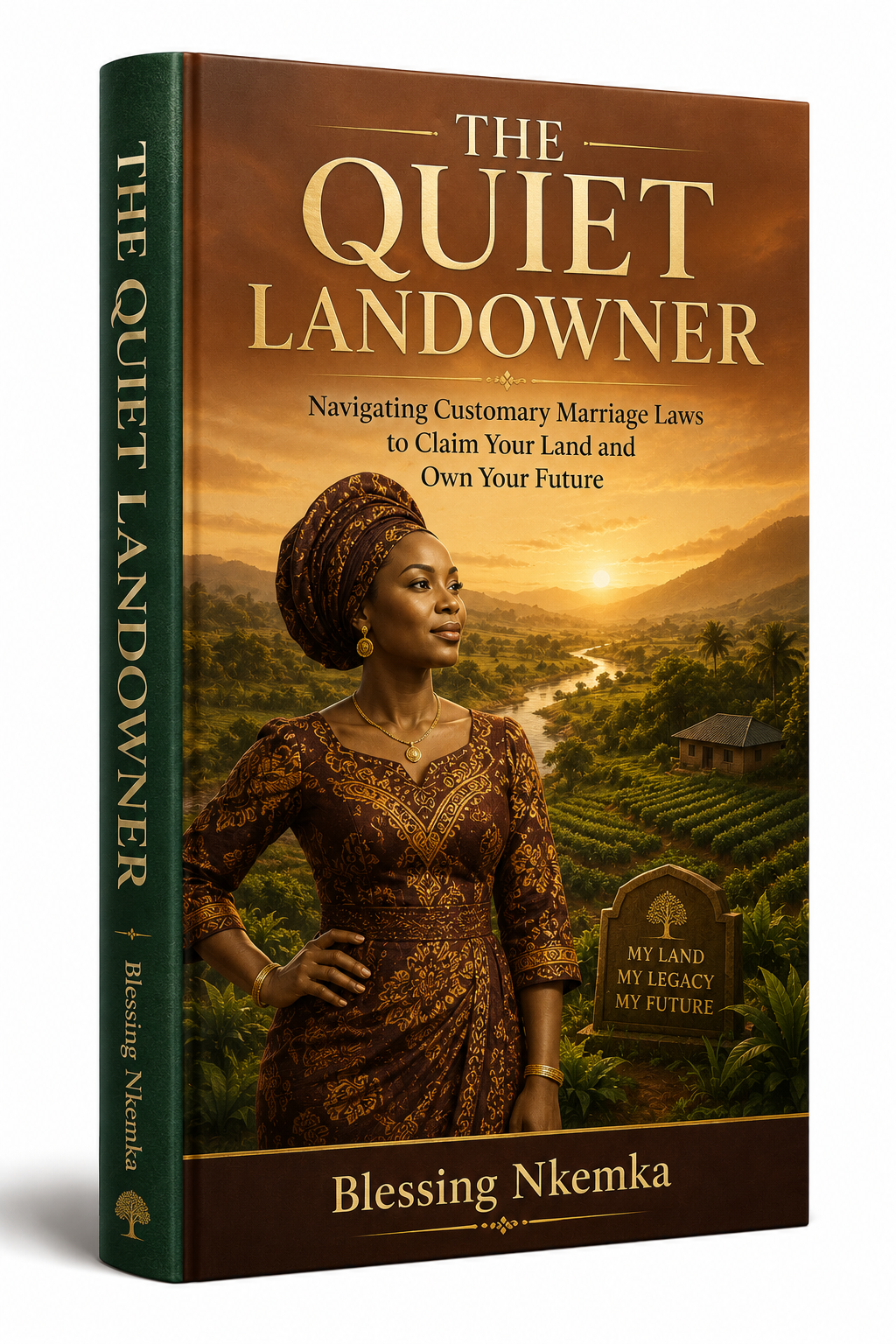
The Quiet Landowner: Navigating Customary Marriage Laws to Claim Your Land and Own Your future.

She found out on a Wednesday.
Not from a lawyer.
Not from a court document.
Not from any official process that gave her time to prepare or words to respond with.
She found out from her brother-in-law.
He called in the morning — polite, measured, the kind of careful voice that people use when they have already decided something and are simply informing you of it rather than discussing it.
Her husband had passed eight months earlier.
She had spent those eight months grieving, managing the children, keeping the household running, returning to work before she was ready because the bills did not pause for her pain. Eight months of doing everything that needed to be done, the way she had always done everything — quietly, competently, without complaint.
She had assumed the property was safe.
They had been married for eleven years. Traditionally. A beautiful ceremony in his village — both families present, bride price paid, photographs that she still kept in an album on the sitting room shelf. Eleven years of building a life together in that house. Eleven years of her hands in that home — the renovation she had largely funded, the garden she had planted, the children's rooms she had painted herself one Easter weekend when he was travelling.
She had assumed all of that meant something legally.
Her brother-in-law's careful voice explained otherwise.
The property was family land, he said.
It had always been family land.
She was welcome to stay — for now — but decisions about the land would be made by the family.
Her husband had left no Will.
Her name was on nothing.
She sat with the phone in her hand for a long time after the call ended.
Eleven years.
Three children.
A renovation she had paid for.
And not a single document with her name on it.
She was not a careless woman.
She was not uninformed or naive or financially irresponsible.
She simply had not been told.
Nobody told her that a traditional marriage — no matter how elaborate, how witnessed, how culturally complete — is not a statutory marriage under Nigerian law. Nobody told her that customary law in most communities does not automatically protect a widow's right to the property she lived in and helped build. Nobody told her that love and years and contribution and sacrifice do not appear in a land registry.
Only names appear in a land registry.
And her name was not there.
That is the story I keep hearing.
In different cities. In different circumstances. From women who are educated and uneducated, wealthy and middle-income, young and old.
The details change.
The outcome does not.
A woman who contributed enormously — financially, physically, emotionally — to property that she assumed was also hers. And a legal system that looked at the documents and said: your name is not here.
The Quiet Landowner was written because that story needs to stop.
Not with anger.
Not with activism.
With information.
Specific, practical, legally grounded information about how Nigerian property law actually works — and exactly what a woman needs to do to make sure her name is on what she paid for, what she built, and what she deserves to own.
What This Guide Will Do For You
The Quiet Landowner is a legal and practical wealth protection guide written specifically for Nigerian women who want to acquire, secure, and protect land and property in their own name — regardless of their marital status, their family situation, or the community they live in.
It does not assume you are a lawyer.
It does not assume you have bought property before.
It assumes you are a woman who is serious about building something with her name on it — and who deserves to understand exactly how to do that safely, legally, and permanently.
Here Is What You Will Get Inside
🏛️ Customary Law vs. Statutory Marriage — The Property Truth Nobody Told You
A clear, plain-language breakdown of what each type of marriage actually means for your property rights in Nigeria. What happens to land when a husband dies under customary law. What happens under a court marriage. Why even a statutory marriage does not automatically put your name on property your husband purchased. And what the widow's trap looks like in practice — so you can make sure it never catches you.
🏛️ The Private Corporate Shield — The LLC Method
How to register a Limited Liability Company through the CAC and use it to purchase land or property without your personal name appearing on the land registry at all. Step-by-step CAC registration instructions — what documents you need, what it costs, how long it takes, and exactly how to use your company to execute a property purchase. Who should be named as directors and shareholders — and who should never be. The complete CAC registration checklist included.
🏛️ Bulletproofing Your Property Documentation
Every document your property ownership requires — explained clearly, in order, with no legal jargon. The Certificate of Occupancy and why it is the most important document in Nigerian property law. The Deed of Assignment and exactly what it must contain to be legally valid. Governor's Consent — the step most buyers skip and most regret — and how to obtain it. Why buying land under a male relative's name for convenience is one of the most financially dangerous decisions a Nigerian woman can make. The complete property documentation stack — every document, in the correct sequence.
🏛️ The Property Audit — Twenty Points Before You Pay a Single Kobo
The five most common land scams targeting Nigerian property buyers — and the specific red flags for each one. How to conduct a title search at the Land Registry. How to verify a C of O is genuine and not forged. How to check for government acquisition notices. How to verify a developer before committing any money. How to confirm that the person selling the land actually has the legal right to sell it. The complete twenty-point Property Audit Checklist — step by step, in the right order, before any money moves.
🏛️ How to Add Your Name to an Existing Property Title
If property you contributed to is currently registered in your husband's name or a relative's name — here are the specific legal options available to you. Amendment of the C of O. A new Deed of Assignment. A Declaration of Trust. And when legal proceedings become necessary.
🏛️ What Nigerian Law Actually Says About Women and Property
A plain-language overview of the Land Use Act, the Administration of Estates Law, the Matrimonial Causes Act, and the customary law frameworks that govern property rights in marriage and divorce — so you understand the legal ground you are standing on before you make any property decision.
🏛️ How to Find a Trustworthy Property Lawyer in Nigeria
Why you need independent legal representation for every property transaction and how to find a qualified property lawyer — including referrals to organizations that provide free and subsidized legal aid specifically for women.
🏛️ What to Do If You Have Already Paid and Something Is Wrong
If you are reading this guide and a previous property transaction already has problems — here is exactly what to do. How to register a caution at the Land Registry. When to contact the EFCC. How to assess your legal position and what your options are.
🏛️ The Complete Resources Directory
Contacts for FIDA Nigeria, the Legal Aid Council, NIESV, the Nigerian Bar Association, REDAN, the Lagos Land Registry, AGIS Abuja, the CAC, and every other body you may need for your property journey — organized and ready to use.
This Guide Is For You If
→ You are traditionally married and you have never had someone explain clearly what that means for your property rights if your husband dies or if your marriage ends.
→ You are planning to buy land or property and you want to make sure your ownership is legally complete — not just paid for, but properly documented and registered.
→ You have contributed to property that is currently in your husband's name or a relative's name — and you are beginning to understand that this arrangement may not protect you the way you assumed it would.
→ You are a single woman who wants to own land in your own name but you are not sure how to navigate the social, cultural, and legal complexities of doing that in Nigeria.
→ You have already bought land and you are not sure whether your documentation is complete — whether you truly own it in the way the law recognizes.
→ You want to understand how to use a registered company to hold property privately — so that your ownership is legally protected without creating unnecessary personal visibility.
→ You simply want to know the rules of the game before you play it.
The Guarantee
Read every chapter of this guide.
Work through the Property Audit Checklist.
Review the documentation stack against any property you currently own or are planning to purchase.
If within 7 days of purchase you do not feel significantly more informed, more legally protected, and more practically equipped to own and secure property in your own name — send me a message on any of my platforms.
I will refund you every kobo.
No argument.
No conditions.
No guilt.
Because I am not interested in selling you information that does not help you.
I am interested in making sure that the story that opened this page — the woman on the phone with her brother-in-law, the woman whose name was not on the document, the woman who lost property she helped build because nobody gave her the right information before it was too late — does not become your story.
This guide is the information she needed before that Wednesday morning call.
It is the information you deserve to have now.
And it delivers.
She eventually found a lawyer.
A woman lawyer — recommended by a friend — who sat with her for two hours and went through everything.
She could not recover the property her husband's family had claimed.
Without a Will, without a statutory marriage certificate, without a single document in her name — her legal position was extremely difficult. Not impossible. But difficult and expensive and uncertain.
But she could protect herself going forward.
She registered a company.
She opened a corporate bank account.
She began saving toward her first personal land purchase.
She found a plot, verified it through twenty steps with her lawyer, and completed the transaction with every document in the correct order.
The C of O is in the company's name.
The company belongs entirely to her.
Her children are named as beneficiaries in a Will that her lawyer helped her draft.
Nobody can call her on a Wednesday morning and tell her that her home is a family decision now.
Because this time, her name — through her company — is on the document.
This time, the law knows she was there.
That is what ₦5,000 protects.
Not just land.
Your right to own it properly.
Your right to keep it permanently.
Your right to pass it on intentionally.
Your right to never sit with a phone in your hand wondering why nobody told you.
Get Instant Access — ₦5,000
Digital guide.
Instant download the moment your payment is confirmed.
Yours to keep, reference, and return to for every property decision you make from this point forward.
If you are ready to own land the right way —
If you are ready to have your name on something that lasts —
If you are ready to make sure no Wednesday morning phone call can take from you what you worked for —
Click Buy Now.
Your land is waiting.
Own it properly.
— Blessing Nkemka
Africanwomantalks
📱 TikTok | Facebook | Instagram: @Africanwomantalks