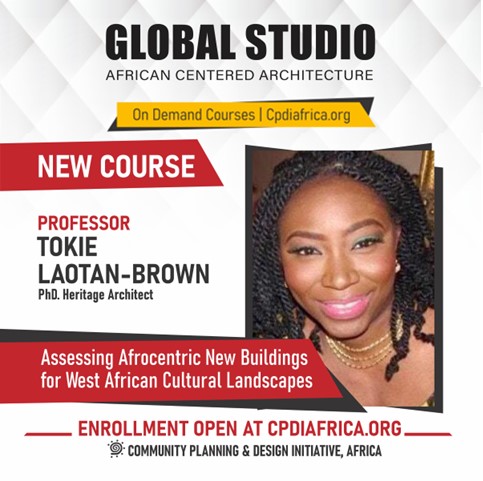
HT1216 Module 5: Instructor: Dr. Tokie Laotan-Brown; Assessing Afrocentric New Buildings for West African Cultural Landscapes

COURSE SYLLABUS
HT1216 – Assessing Afrocentric New Buildings for West African Cultural Landscapes
Instructor: Dr. Tokie Laotan-Brown
COURSE DESCRIPTION
This course examines the role of Afrocentric architectural design in shaping new buildings within West African cultural landscapes. The course focuses on how contemporary architecture can integrate with historic environments while preserving the aesthetic, cultural, environmental, and historical values of African heritage.
Students will explore the relationship between new development and cultural landscapes, and how designers can create innovative solutions that respect the dynamics of the existing natural and built environment. Through lectures, discussions, case studies, and fieldwork, students will learn methods for assessing the impact of new buildings on historic landscapes.
The course also encourages critical discussions about cultural democracy, African heritage, community values, and environmental sensitivity in architectural practice.
COURSE OUTLINE
This course introduces students to the principles and frameworks used in evaluating new architectural developments within culturally significant African landscapes. Students will develop skills in visual analysis, mapping, documentation, and heritage assessment.
The course emphasizes the importance of interdisciplinary collaboration among designers, planners, heritage professionals, and communities to safeguard African cultural identity in the built environment.
COURSE OBJECTIVE
The objective of this course is to equip students with the knowledge and analytical tools needed to interpret and assess cultural landscapes and propose design interventions that respect African heritage.
Students will learn to:
- Understand the relationship between architecture, heritage, and cultural landscapes
Interpret cultural and community values embedded within African built environments
- Apply legal and policy frameworks related to heritage conservation
- Conduct field research and landscape documentation
- Translate research findings into visual and spatial representations
- Develop proposals for heritage-sensitive new developments
COURSE MODULES
MODULE ONE
New Builds, Heritage and Cultural Landscapes
In this module, students will explore the relationship between new architectural developments and historic cultural landscapes. The module introduces key concepts and terminology used in visual assessments of traditional townscapes and landscapes.
Students will also participate in observation exercises, including city walkabouts and documentation of cultural landscapes through photography, sketches, and notes.
MODULE TWO
Heritage Conservation
This module introduces the principles and legal frameworks guiding heritage conservation. Students will examine the cultural and economic values associated with heritage preservation and review international and national legislation relevant to cultural landscapes.
Case studies will be used to understand how heritage laws are applied in real-world contexts.
MODULE THREE
Heritage and the African Community
This module examines the relationship between African communities and their cultural heritage within the built environment. Students will explore indigenous knowledge systems, spiritual meanings, and cultural values embedded in African architecture.
The module also introduces concepts such as Yoruba spatial organization, sacred landscapes, and fractal patterns in African settlements.
MODULE FOUR
Understanding a Proposal
This module focuses on methods used to observe, research, and document cultural landscapes. Students will learn techniques for reading landscapes and collecting spatial and historical data.
Research methods will include:
- Archival and desktop research
- Fieldwork and observation
- Interviews and surveys
- Documentation using drawings, maps, and photographs
MODULE FIVE
Interpretation of Assessments
This module teaches students how to interpret and represent collected data in meaningful ways. Students will learn techniques for mapping landscapes and translating information into visual, spatial, and textual representations.
Participatory mapping exercises will also be introduced to incorporate stakeholder perspectives into design processes.
MODULE SIX
Assessment Submission
This final module focuses on the development and submission of a heritage-sensitive proposal. Students will apply the knowledge gained throughout the course to prepare a cultural landscape assessment and design proposal.
The proposal will consider:
- Heritage significance
- Impact assessments
- Planning regulations
- Environmental and cultural considerations
- Project feasibility