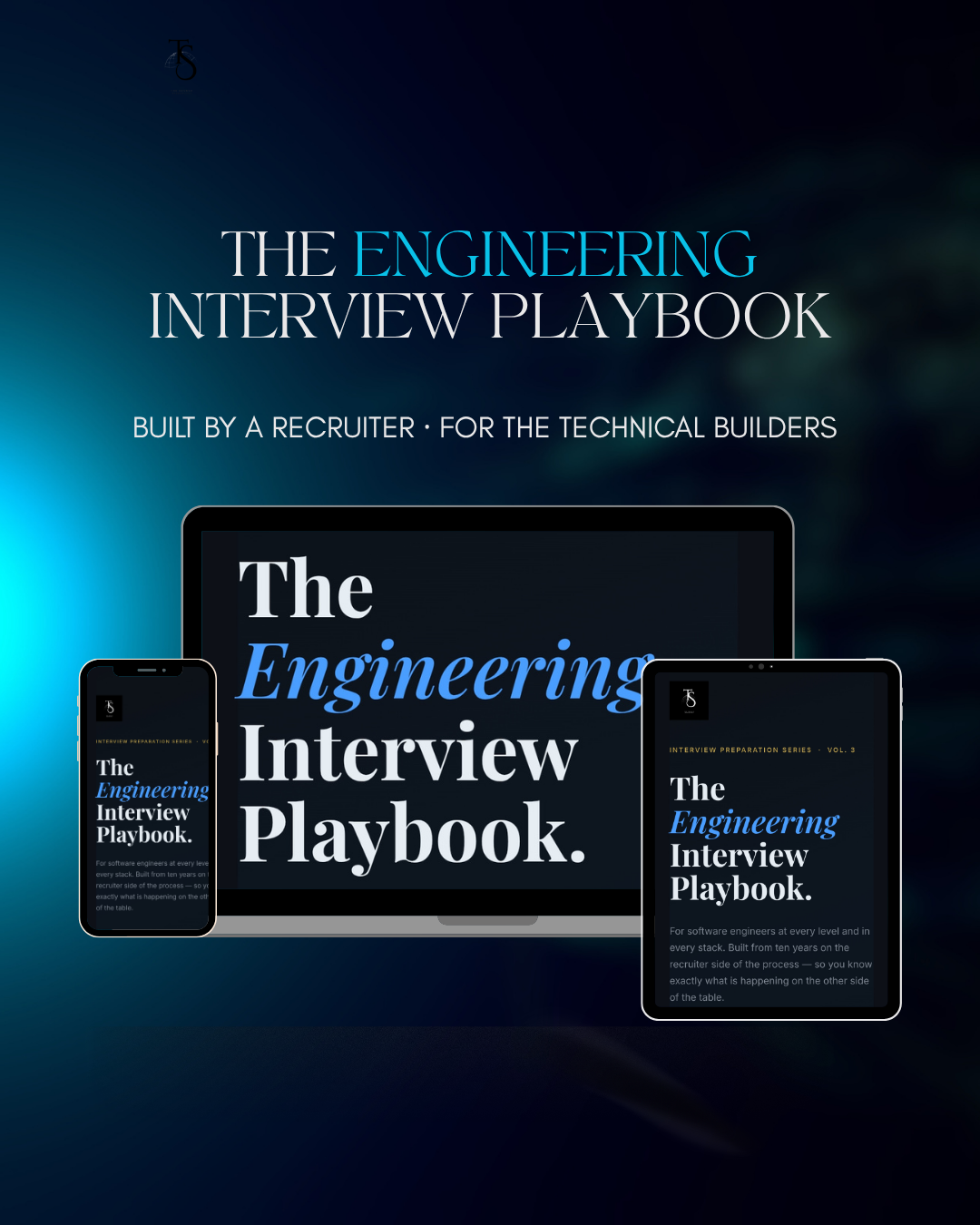
The Engineering Interview Playbook (Vol. 3)
The Engineering Interview Playbook (Vol. 3)
Title: The Engineering Interview Playbook — Interview Prep for Software Engineers | Digital Download PDF
Description:
You can build distributed systems, ship production code, and debug issues at 2am. But walking into an interview and performing well? That's a different skill set. This playbook is built to close that gap.
10 years of placing engineers across South Africa and Europe means I've sat on the other side of this process hundreds of times. I've seen technically exceptional engineers get declined because they couldn't communicate. I've watched strong candidates lose roles they were absolutely qualified for because they didn't know what each interviewer was actually looking for. This guide is everything I wish every engineer knew before they walked into the room.
This is for software engineers at every level and in every discipline - backend, frontend, mobile, full stack, DevOps, solutions engineering, and AI/ML.
---
📥 INSTANT DIGITAL DOWNLOAD — PDF delivered immediately after purchase. No physical item is shipped.
---
WHAT'S INSIDE — SECTION BY SECTION
PART 1: Before You Apply
- 01 — Know your room (stakeholder map)
- What a recruiter is actually listening for on a call — and how to become their advocate
- What HR and talent teams are assessing, and why underestimating this stage is one of the most common mistakes
- What the engineering manager is evaluating — technically, behaviourally, and culturally
- What a Head of Engineering or CTO wants to see at senior level (hint: it goes beyond your code)
- What the technical interviewer wants from you — and why your process matters as much as your answer
- Why your future teammate carries more influence on the final decision than most candidates realise
- 02 — LinkedIn: your digital first impression
- Why your profile needs to work even when the recruiter reading it doesn't fully understand your stack
- How to write a banner that immediately signals the kind of engineer you are
- What a compelling headline looks like vs. a generic job title
- How to write an About section that gets you indexed in LinkedIn search
- Why impact statements in your Experience section beat responsibilities every time — and exactly how to write them
- How the "Open to Work" setting actually affects your visibility (and what the evidence says)
- 03 — GitHub and public profiles
- What a contribution graph signals to a hiring manager — and what an empty one implies
- How to choose and document the right pinned repositories
- Why README quality is a communication signal, not a formality
- How to use open source contributions as genuine interview material (even small ones)
- What to do when your best work is behind an NDA
- 04 — CV checklist for engineers
- Relevance check: how to tailor your CV so it tells a story, not just a list of jobs
- Tech stack placement: how to make your core skills visible in the first third of the document
- Impact statements: how to quantify experience and show influence beyond your own code (critical for senior roles)
- ATS reality check: why beautiful formatting can make your CV invisible, and what to do instead
---
PART 2: The Recruiter Call
- 05 — What the recruiter call is actually for
- What the recruiter is checking — and what happens when you treat this call as admin
- Why what you say to the recruiter becomes the story they tell the hiring manager
- Your one-minute intro: how to describe yourself clearly and compellingly
- How to describe your stack accessibly to a non-technical recruiter without losing accuracy
- Why you need to know your salary range and notice period before the call starts
- 06 — How to help an inexperienced recruiter
- Why keyword alignment matters more than nuance when a recruiter isn't deeply technical
- How to frame your experience so a non-technical person can relay it accurately
- The closing summary technique: how to effectively write the recruiter's pitch to the hiring manager before you hang up
---
PART 3: HR and Competency
- 07 — The HR interview: what it's really testing
- The six things an HR interviewer is actually assessing beneath every question
- Why communication in engineering interviews is evaluated at every stage — not just by HR
- How the same question gets a different quality of answer depending on your seniority — and what a senior answer actually looks like
- 08 — Building your evidence bank
- What an evidence bank is and why it's the most effective prep tool available
- How to use STAR structure properly (including why you should say "I" not "we")
- The eight story types every engineer should have prepared before any significant interview process
- How to pair your stories with the free Interview Psychology Sheet from The Source
- 09 — Competency questions for engineers
- What interviewers are really asking beneath common and more specific interview questions
- 10 — Cross-functional communication
- Why this is one of the most consistently undervalued skills in engineering interviews
- The two explanations you need to prepare for every complex project
- How to switch between registers fluidly — and why this is what seniority looks like in the room
---
PART 4: The Technical Interview
- 11 — Take-home assessments
- What the reviewer is actually assessing — and why code quality and documentation matter as much as a working solution
- A five-step approach
- Tips for your README
- 12 — Live coding: thinking out loud
- The single most common reason technically strong candidates don't progress in live coding rounds
- The think-out-loud discipline: exactly what to narrate, and when
- How to name your decisions during the code
- What to do when you get stuck
- A practical method for practicing this before your interview
- 13 — The engineering manager interview
- What the EM or Head of Engineering is evaluating — and why theory questions matter more than most engineers expect
- The CS fundamentals to review before any EM interview
- What a senior-level answer looks like — and what leadership signals to prepare if you're going for a senior role
- 14 — Demeanor: dial it up 10%
- Why "relaxed" in an engineering interview often reads as disinterested to the person across the table
- The 10% adjustment
- Signs you may be underperforming on demeanor — and what the adjustment actually looks like in practice
---
PART 5: Why Engineers Get Declined
- 15 — The real feedback no one gives you after a decline — and why it gets coded as "not quite the right fit"
- Five specific communication failure modes in engineering interviews
- A practical test for whether your communication is in good shape before you go in
- 16 — Technical gaps
- The two forms technical rejection usually takes — and the most avoidable one
- A four-step process to close gaps before a technical interview
- How to use AI tools to simulate a technical interview in your specific stack
- 17 — Culture fit
- What culture fit actually means in an engineering context — and why it's more preventable than people think
- The three failure modes: too passive, too rigid, and unprepared
- How to research company values and use them as your interview framework
- The technique for turning their published values into your evidence bank stories
---
PART 6: Discipline-Specific Questions (with interviewer psychology)
Each discipline section covers the questions asked across seniority levels — and what the interviewer is actually looking for beneath each one.
- 18 — Backend engineering
- 19 — Frontend engineering
- 20 — Mobile engineering
- 21 — Full stack engineering
- 22 — DevOps and infrastructure
- 23 — Solutions and deployment engineering
- 24 — AI and machine learning
---
PART 7: After the Offer
- 25 — Negotiating your offer
- Why engineers leave money on the table more consistently than almost any other professional group
- When to negotiate — and when not to
- Four negotiation steps
- Market context for both South Africa and Europe (Netherlands, Germany, UK)
- 26 — Helpful resources
- Technical practice resources
- AI tools for interview simulation and practice problem generation
- Free upskilling resources
- Job search platforms for SA and Europe
---
DETAILS
- Format: PDF, digital download
- Instant delivery — no waiting, no shipping
- Personal use only. Not for redistribution.
- Part of the TSI Interview Preparation Series — Vol. 3
---
When this playbook helps you, we would love to hear about it, please leave us a review.