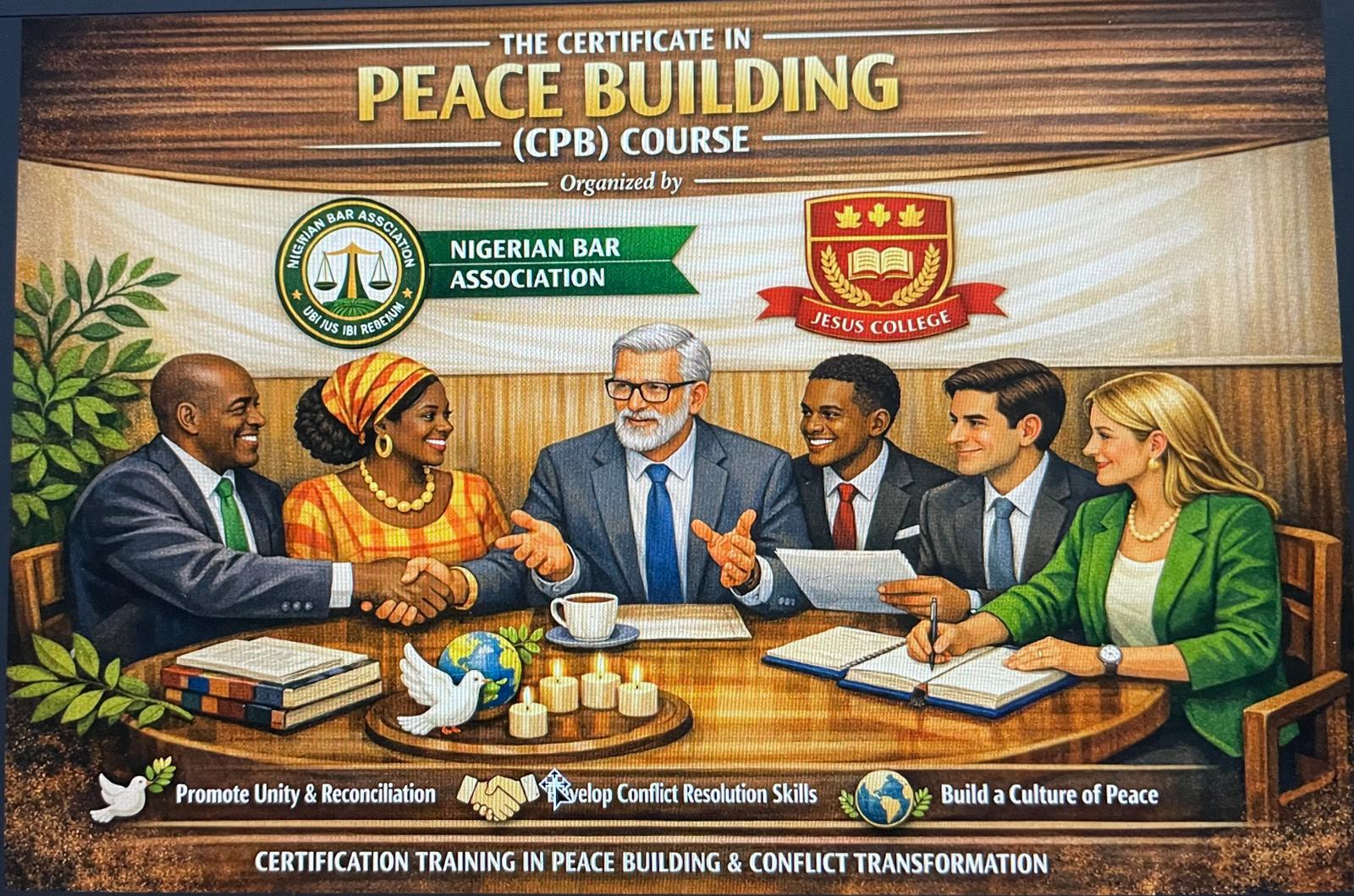
Certificate in Peace Building (CPB) Course

Get Tickets
Total Admissions: 0CERTIFICATE TRAINING IN PEACE BUILDING
Build Peace. Transform Communities. Shape the Future.
Jesus College / Nigerian Bar Association (NBA)
Certificate in Peace Building (CPB)
Virtual Training
Jul 23, 2027 - Jul 24, 2027
Dear Colleague,
In a world increasingly challenged by conflict, polarization, insecurity, displacement, and social fragmentation, the demand for skilled peacebuilders has never been greater. Whether in families, businesses, communities, institutions, or nations, sustainable peace requires more than conflict resolution—it requires deliberate peacebuilding.
Jesus College, in partnership with the Nigerian Bar Association (NBA), is pleased to invite lawyers, mediators, judges, academics, clergy, development practitioners, public servants, security professionals, community leaders, NGO personnel, and students to an intensive two-day Certificate in Peace Building (CPB) training to be held virtually on July 24–25, 2026.
This highly practical and interactive program is designed to equip participants with the knowledge, tools, and institutional frameworks required to build sustainable peace in local, national, and international contexts.
Why This Training Matters
Most people know how to make peace. Few know how to build it.
While conflict resolution and peacemaking are essential, sustainable peace requires institutions, networks, systems, and leadership structures capable of preventing conflict and fostering long-term social harmony.
This course explores peacebuilding as a collaborative and institutional process that transforms communities and societies by addressing the underlying causes of conflict and establishing durable structures for peace.
Participants will learn how peace is built, sustained, and institutionalized through practical models that can be applied immediately in professional and community settings.
What You Will Learn
By the end of this training, participants will be able to:
✅ Distinguish between peacekeeping, peacemaking, and peacebuilding
✅ Analyze the role of Alternative Dispute Resolution (ADR) and international law in peacebuilding
✅ Design and establish Community Peace Centers using ADR tools
✅ Understand civilian peacekeeping and post-conflict reconstruction strategies
✅ Apply Multi-Track Diplomacy and multi-sector approaches to peacebuilding
✅ Develop local, national, and international peace networks
✅ Explore career and leadership opportunities in international peacebuilding organizations
✅ Utilize legal and professional expertise to contribute to the United Nations Sustainable Development Goals (SDGs)
Course Topics
Participants will explore:
- ADR and Peacebuilding
- International Law and Peacebuilding
- Local and International Opportunities for Lawyers in Peacebuilding
- Conflict Resolution and Sustainable Peace
- Civilian Peacekeeping
- Post-Conflict Reconstruction
- Community Peace Institutionalization
- Designing Community Peace Centers
- Multi-Track Diplomacy
- Building Local and International Peace Networks
- Peacebuilding and Sustainable Development
A Hands-On, Practical Learning Experience
This is not merely a theoretical course.
Participants will engage in:
- Interactive lectures
- Case studies
- Guided discussions
- Applied peacebuilding analysis
- Practical design exercises
- Group projects
- Peace center development exercises
- Network design simulations
Every participant will leave with practical tools and actionable strategies that can be implemented immediately in professional and community settings.
Final Peacebuilding Project
Following the training, participants will complete a practical project to be submitted within thirty (30) days.
The project may include:
- A Community Peace Center Model
- A Peacebuilding Network Framework
- A Peacebuilding Policy Proposal
- A Sustainable Development Peace Initiative
Successful participants will earn the Certificate in Peace Building (CPB).
Faculty and Course Resources
The training draws upon leading global scholarship and practical peacebuilding literature, including:
- Getting to Yes – Fisher, Ury & Patton
- Building Peace – John Paul Lederach
- Multi-Track Diplomacy – Diamond & McDonald
and the peacebuilding works of:
Olajide Olagunju, PhD, FCIArb (UK), FICMC, Attorney-at-Law
including:
- How to Resolve a Conflict
- Legal Theft: Making Law for Underdevelopment and Conflict
- Ancient Dispute Resolution Practices and Their Lessons for Today
- Management of Internal Displacement in Nigeria
- Traditional African Dispute Resolution (TADR) Mechanism
- Peacebuilding Without Jobs Is Fragile
- Law as Handmaiden of Underdevelopment and Armed Conflict in Nigeria
Who Should Attend?
This program is particularly valuable for:
- Lawyers
- Mediators and Arbitrators
- Judges and Magistrates
- Government Officials
- Community Leaders
- Clergy and Faith Leaders
- Educators
- NGO and Development Professionals
- Security Sector Personnel
- Students and Researchers
- Anyone interested in peacebuilding and social transformation
Training Details
Program: Certificate in Peace Building (CPB)
Mode: Virtual
Dates: July 24–25, 2026
Certificate Awarded: Certificate in Peace Building (CPB)
Project Submission Deadline: 30 Days After Training
Join the Movement to Build Sustainable Peace
The future of peaceful communities and nations depends on leaders who can move beyond conflict management to the intentional design of peace systems, institutions, and networks.
We invite you to become one of those leaders.
Register today and take your place among the next generation of peacebuilders committed to transforming communities, strengthening institutions, and advancing sustainable peace locally and globally.
Peace is not merely the absence of conflict—it is the presence of systems that sustain justice, opportunity, reconciliation, and human flourishing.
We look forward to welcoming you on July 24–25, 2026.