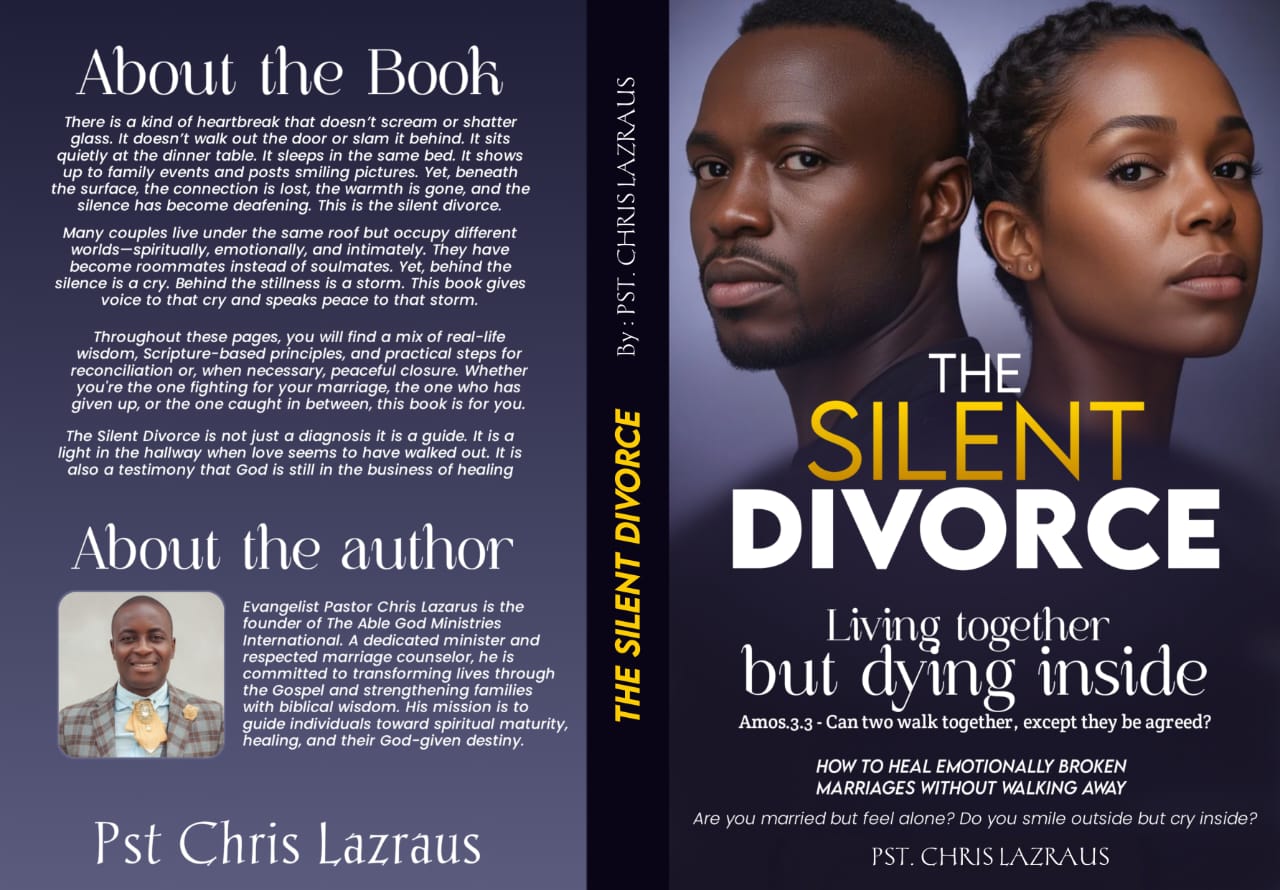
THE SILENT DIVORCE: LIVING TOGETHER BUT DYING INSIDE
Unspoken Words, Unhealed Wounds
What You Never Talk About Is Slowly Tearing You Apart
There is a silent pain that lives in many marriages—not the pain of what was said, but the pain of what was never said.
It is the pain of the apology that was never voiced.
The appreciation that was never expressed.
The hurt that was never acknowledged.
The forgiveness that was never asked—or offered.
The dreams that were never shared.
The fears that were kept locked away.
The needs that were pushed down because "they won't understand anyway."
In emotionally disconnected marriages, the loudest sound is often silence.
And that silence becomes deadly—not just to the joy of the relationship but to its very life.
The Silent Killers of Connection
Most marriages don’t collapse overnight.
They die slowly, under the weight of:
Words left unspoken
Feelings suppressed
Needs unmet
Offenses untreated
You don’t even realize you’re bleeding—until you’re empty.
Spouses drift apart not always because of betrayal or abuse—but because of emotional neglect and silence.
And what makes it worse is that both people often believe they’re doing the “peaceful” thing by keeping quiet.
But silence is not peace.
It is often the soil in which bitterness and distance grow.
The Garden of Hidden Pain
Think of your marriage like a garden.
When things are spoken, shared, and resolved, it’s like pulling weeds, watering flowers, and nurturing growth.
But when pain is hidden, it’s like burying poisoned seeds:
A comment that stung, but you didn’t bring it up.
A need that’s been ignored, but you say “it’s okay.”
A behavior that bothers you, but you smile through it.
Eventually, those buried things start to sprout—not as beautiful fruit, but as thorns.
And the garden becomes overrun.
There’s still a marriage.
Still a house.
But the love feels distant.
The connection is dry.
And the two hearts that once beat in sync now beat in separate rhythms.
Biblical Insight: David and Absalom
There is a haunting story in the Bible that mirrors this dynamic.
In 2 Samuel 13–15, Absalom, the son of King David, is hurt and offended after his sister Tamar is violated. David, though deeply affected, doesn’t address the issue with justice or communication.
What happens?
Absalom harbors his pain silently. For two years, he says nothing.
Eventually, that silence turns into bitterness, rebellion, and separation. Absalom rises up against his father—dividing the kingdom.
The tragedy?
It all began with an unspoken wound.
This isn’t just a story about a king and his son—it’s a warning to families and couples today:
What we refuse to confront in love, will confront us in destruction.
Why Do Couples Choose Silence?
There are many reasons people stop talking:
“It’s not worth the fight.”
“They won’t change.”
“I’m too tired to explain again.”
“They should know how I feel.”
“If I talk, I’ll just be misunderstood again.”
“I’ve been disappointed too many times.”
But here's the truth:
Silence is often a sign of hopelessness—not peace.
It means someone has given up.
Given up on being heard.
Given up on being understood.
Given up on believing things can change.
But God never intended for marriages to survive in hopeless silence.
He designed marriage to be a place of healing, honesty, and heartfelt connection.
How the Enemy Uses Silence
Satan doesn’t need to tempt you into adultery to destroy your marriage.
He just needs to convince you to stop talking.
He knows:
When you stop sharing, you stop caring.
When you stop listening, you stop learning.
When you stop being honest, you stop being intimate.
And once the emotional connection is lost, the physical and spiritual bond weakens.
That’s why the Bible says:
“Confess your faults one to another, and pray one for another, that ye may be healed.”