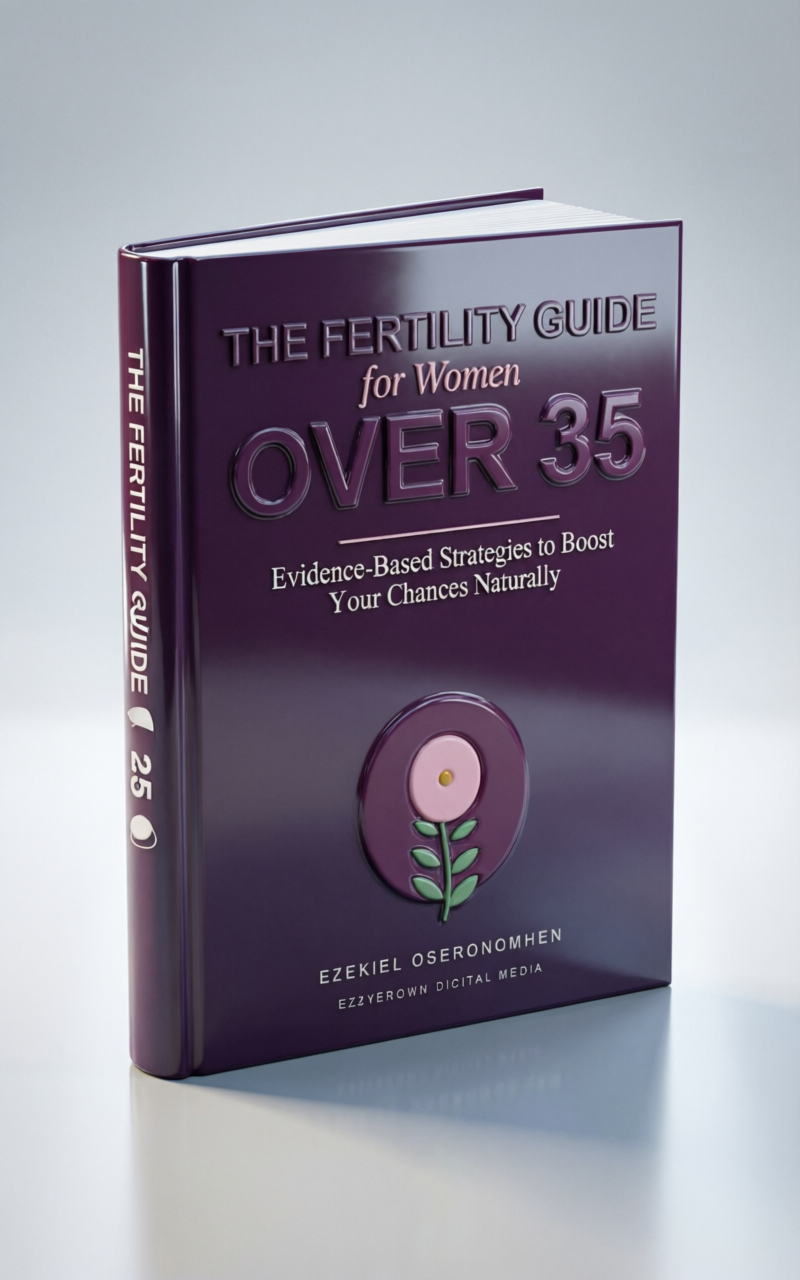
The Fertility Guide for Women Over 35

The Fertility Guide for Women Over 35
Evidence-Based Strategies to Boost Your Chances Naturally
By Ezekiel Oseronomhen | Published by Ezzybrown Digital Media
It's 1:40 in the Morning, and You're Still Awake
You're scrolling. One article says thirty-five is a "fertility cliff." Another says celebrities have babies at forty-four with no trouble. A third sells a supplement that promises to "reverse egg aging in ninety days."
You close your phone more confused than when you opened it.
If that sounds familiar, you already know the real problem. It is not that there is too little information about fertility after thirty-five. It is that there is too much of it, and most of it is either frightening or too good to be true.
This book is different.
What This Book Is Not
- It is not a collection of miracle claims
- It is not a supplement sales pitch disguised as advice
- It is not vague encouragement to "just relax"
What This Book Is
A carefully sourced, honest, and practical guide to what the major professional bodies, large studies, and national data actually show about fertility after thirty-five.
It sits between fear and false promises. It tells you plainly when the evidence is strong, when it is thin, and when nobody knows.
The Honest Truth About Fertility After 35
This book opens with the facts most guides avoid:
- A healthy thirty-year-old has about a 20% chance of conceiving in any single cycle
- By forty, that falls to under 5% per cycle
- Fertility declines gradually through the thirties, more noticeably after thirty-five
- There is no sudden cliff at thirty-five—it is a slope that steepens
But here is what the headlines miss: your odds are not zero, and they do not vanish on a birthday.
Many women in their late thirties and early forties conceive. The question is not whether it is possible—it is how to give yourself the best possible chance.
What You Will Learn Inside
Chapter 1: The Truth About Fertility After 35
What age really does to your odds, why the "cliff" is a myth, and the three levers you control: optimize, time it well, and escalate on schedule.
Chapter 2: What Age Really Changes
Egg quantity vs. egg quality. Why chromosomal errors rise with age. What changes in your cycles. And what age does not change.
Chapter 3: Your Preconception Checkup
The single most useful thing you can do before trying. What to bring, what to ask, and why folic acid is the one supplement with strong, high-certainty support.
Chapter 4: Timing Is Everything
The fertile window is about six days long. Learn how to find yours using methods from free to high-tech. Why once-a-week intercourse misses the window—and why daily is not necessary.
Chapter 5: Eating for Fertility
What the evidence actually supports. Why the Mediterranean-style pattern has the best support. And why claims about gluten-free, dairy-free, and detox diets do not hold up.
Chapter 6: Supplements: What Helps, What Doesn't, and What to Skip
A 2020 Cochrane review rated the evidence for most fertility supplements as very low quality. This chapter tells you which ones have real support, which carry risks, and how to read a supplement ad like a skeptic.
Chapter 7: Weight, Movement, and Metabolic Health
Why weight matters at both ends. How much exercise is enough—and when it becomes too much. Why metabolic health affects ovulation and pregnancy risk.
Chapter 8: Sleep, Stress, and the Emotional Side of Trying
The honest answer to "Does stress cause infertility?" (Spoiler: the evidence is mixed and weak.) Practical tools for the two-week wait, hard conversations, and protecting your relationship.
Chapter 9: Smoking, Alcohol, Caffeine, and Everyday Exposures
Which risks have strong evidence (smoking). Which have moderate evidence (alcohol, caffeine). And which are uncertain but worth low-cost steps (plastics, household chemicals).
Chapter 10: Conditions That Can Stand in the Way
PCOS, thyroid disease, endometriosis, fibroids, blocked tubes, diminished ovarian reserve, and unexplained infertility—explained clearly and without jargon.
Chapter 11: Fertility Testing: What It Measures and What It Cannot Tell You
Why a large JAMA study found that low AMH did not significantly reduce natural conception over twelve months. What AMH is actually good for. And why the semen analysis should come first.
Chapter 12: Your Partner's Role
Male factors contribute to 40–50% of couples' fertility difficulties. This chapter covers what a semen analysis involves, what affects sperm, and how to have the conversation without blame.
Chapter 13: When Natural Isn't Enough
The treatment ladder explained—from ovulation induction to IUI to IVF. CDC 2021 data: singleton live birth per egg retrieval was 49.8% under 35, 37.3% at 35–37, 24.9% at 38–40, and 9.0% over 40. What these numbers really mean.
Chapter 14: Pregnancy Loss, Hard Decisions, and Staying Whole
Early pregnancy loss occurs in about 10% of recognized pregnancies, rising with age. Why it happens. What it means for the future. And how to grieve, heal, and decide what comes next.
Chapter 15: Your 90-Day Action Plan
Three dates to write down today. A week-by-week plan for the first ninety days. How to review, adjust, and repeat.
What Makes This Book Different
1. Every Strategy Is Graded by Evidence
You will see plain labels throughout:
- Strong support — recommended by major medical bodies on solid evidence
- Some support — reasonable, low-risk, backed by observational research
- Little or no support — popular, but evidence is weak or unproven
When you read an advertisement, you will know which category the claim honestly belongs to. It will save you money and disappointment.
2. It Does Not Pretend Age Does Not Matter
Here is the most important honest statement in the book:
"Healthy lifestyle habits do not offset the natural age-related decline in fertility."
No diet, supplement, or routine reverses age-related changes in eggs. Anyone who promises otherwise is selling hope at a price.
But "cannot reverse age" is not the same as "cannot help." Natural strategies matter because they remove avoidable obstacles, improve pregnancy health, and protect your wellbeing.
3. It Respects Your Intelligence
You will not be told to "just relax." You will not be sold a miracle. You will be given facts you can check, a timeline you can use, and a plan you can start.
Who This Book Is For
- Women aged 35 and above who are trying to conceive
- Women who have been told their "biological clock is ticking" and want a clear roadmap
- Women who want to understand their options before seeking medical intervention
- Women who have experienced a loss and need honest, compassionate guidance
- Partners who want to understand how they can help
What You Will Walk Away With
By the end of this book, you will:
✅ Understand what age actually changes—and what it does not
✅ Know the exact timeline for seeking evaluation (6 months at 35–39, immediately at 40+)
✅ Be able to identify your fertile window using methods that work for you
✅ Understand which supplements help, which do not, and which carry risks
✅ Know what tests measure—and what they cannot tell you
✅ Have a 90-day action plan with specific, dated steps
✅ Feel informed, organized, and unafraid to ask your clinician questions
About the Author
Ezekiel Oseronomhen is the author of this book and the founder of Ezzybrown Digital Media, a digital media company dedicated to creating high-value educational resources for professionals, entrepreneurs, and self-learners.
His mission is simple: take complex, fast-moving subjects and turn them into clear, practical guides that people can apply the same day they read them.
For The Fertility Guide for Women Over 35, that meant working from published guidance of professional medical societies, national data, and systematic reviews—including sources from ASRM, ACOG, the CDC, the U.S. Preventive Services Task Force, and Cochrane.
Ezekiel Oseronomhen is not a physician, and this book is not medical advice. He encourages every reader to confirm decisions about testing and treatment with a qualified clinician.