AI-Native Learning Infrastructure: The Next Step in Modern eLearning
Organizations are changing the way they approach employee training. As businesses grow, their knowledge becomes more complex, while employees need faster access to information, practical training, and continuous support.
Traditional learning systems can provide courses and assessments, but modern organizations increasingly need a broader environment that connects knowledge, learning, and everyday work.
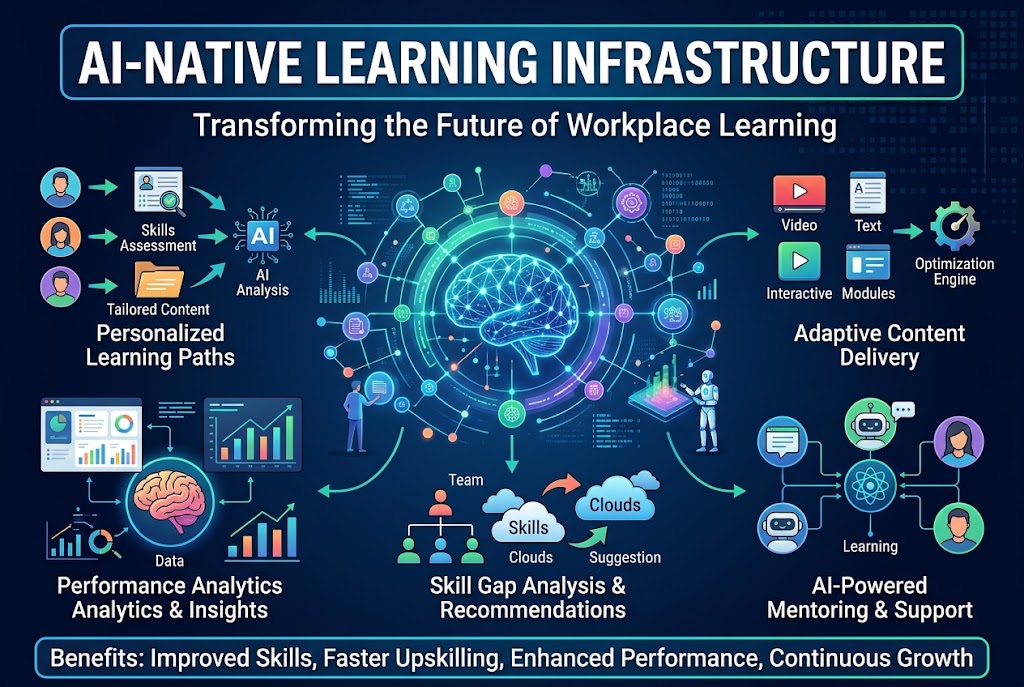
An AI-Native Learning Infrastructure can provide the foundation for this connected approach by bringing together AI, organizational knowledge, interactive learning, and learner support.
The Changing Needs of Modern Learning Teams
Learning and development teams are no longer responsible only for creating courses.
They may also need to support:
- Employee onboarding
- Compliance training
- Product education
- Professional development
- Knowledge management
- Continuous employee support
At the same time, business information changes frequently. A process that is correct today may need to be updated tomorrow.
This makes maintaining learning content a continuous responsibility.
From Traditional Training to Continuous Learning
Traditional training often follows a fixed structure. Employees complete a course and move on to their daily responsibilities.
However, real learning continues after the course.
Employees may need clarification about a procedure, additional examples, or help applying a concept to a real situation.
A modern learning environment can make relevant knowledge available throughout the employee journey rather than limiting it to formal training sessions.
What Is Mexty?
Mexty is an AI-native learning platform designed for educators, instructional designers, corporate trainers, and enterprise learning teams.
It brings together learning experiences, interactive activities, evaluations, learning paths, knowledge bases, AI Agents, and analytics.
Rather than treating AI as an isolated feature, Mexty uses an AI-native approach to support different parts of the learning process.
This allows organizations to develop learning experiences while keeping human expertise involved in reviewing, editing, and improving the final content.
Building Learning Around Trusted Knowledge
AI-supported learning needs a reliable information foundation.
Organizations already have valuable knowledge stored in company documents, policies, procedures, product information, and internal resources.
A Source of Truth approach can help connect learning experiences with this trusted organizational knowledge.
For example, when a company updates a procedure, the updated information can become part of the knowledge foundation used when reviewing related training.
This helps learning remain aligned with the information employees are expected to follow.
Turning Information Into Interactive Learning
Simply providing information does not always help employees understand how to apply it.
Interactive learning can turn organizational knowledge into practical experiences.
Learning teams can create:
- Real-world scenarios
- Simulations
- Interactive exercises
- Knowledge checks
- Decision-making activities
- Role-specific training
For example, instead of asking employees to memorize a customer-service policy, a training activity can place them in a realistic situation and ask them to choose an appropriate response.
This gives learners an opportunity to practice applying their knowledge.
How AI Can Support Content Creation
Creating learning content can involve many repetitive tasks.
Instructional designers may need to organize source material, structure lessons, create activities, prepare assessments, and make repeated updates.
AI can help accelerate suitable parts of this workflow.
An AI-native learning approach can assist with organizing information, creating learning structures, developing activities, and reducing repetitive production work.
However, human expertise remains essential.
Learning professionals can review AI-assisted material, improve explanations, adjust activities, and ensure that learning objectives are appropriate for the target audience.
AI Agents Extend Learning Support
Learning does not have to end when an employee completes a course.
AI Agents can provide additional support by helping employees interact with relevant organizational knowledge.
For example, employees may need to ask questions, clarify procedures, discover resources, or review information while completing their daily responsibilities.
AI-supported interactions can make this knowledge easier to access when it is needed.
This helps transform learning from a scheduled activity into an ongoing resource.
Personalized Learning for Different Roles
Employees have different responsibilities and levels of experience.
A new employee may need basic onboarding information, while an experienced professional may require advanced training.
Organizations can create different learning paths while maintaining a common foundation of organizational knowledge.
For example:
New employees: onboarding and essential company information.
Sales teams: product knowledge and customer scenarios.
Support teams: troubleshooting and service situations.
Managers: leadership and decision-making activities.
This approach can make learning more relevant to each employee's role.
Assessment and Practical Application
Completing a course does not necessarily demonstrate that an employee can apply the information.
Interactive assessments can help learners practice making decisions in realistic situations.
A training activity might present a workplace scenario, ask the learner to select an action, and then provide feedback explaining the result.
This creates a practical cycle:
Learn → Practice → Assess → Improve
It also gives learning teams useful information about topics that may require additional attention.
Using Analytics to Improve Learning
Learning experiences can continue to evolve after they are published.
Analytics can help L&D teams understand how employees interact with courses and activities.
These insights can highlight areas where learners may need additional explanations, examples, or practice.
For instance, if employees consistently struggle with one assessment, the learning team may review the related lesson and make improvements.
This creates a continuous process of learning development rather than treating a course as a finished product.
Keeping Learning Current
Business information changes constantly.
Organizations introduce new products, update policies, modify processes, and adopt new technologies.
Training content needs to keep pace with these changes.
When learning experiences are connected to organizational knowledge, teams can more easily review content when important information changes.
This can help reduce the risk of employees relying on outdated training.
Security and Governance
Enterprise learning can contain sensitive information, including internal processes, product documentation, compliance materials, and organizational knowledge.
As AI becomes part of learning workflows, organizations need to consider how this information is managed and protected.
Security, governance, and access control can therefore play an important role in an AI-supported learning environment.
Organizations can use AI while maintaining appropriate control over important business knowledge.
Creating a Connected Learning Ecosystem
The future of workplace learning is broader than simply producing courses.
A connected learning ecosystem can bring together:
- Trusted organizational knowledge
- AI-assisted learning creation
- Interactive experiences
- Assessments
- Learning paths
- AI Agents
- Analytics
Each component can support another part of the learning process.
Knowledge provides the foundation, interactive activities encourage application, assessments help measure understanding, and analytics can identify opportunities for improvement.
Conclusion
Modern organizations need learning environments that can adapt to changing knowledge, different employee roles, and evolving business requirements.
An AI-Native Learning Infrastructure can provide a foundation for connecting organizational knowledge, AI-supported content creation, interactive learning, assessments, AI Agents, learning paths, and analytics.
The goal is not simply to create courses more quickly. It is to make learning more accessible, practical, and connected to the work employees perform every day.
As organizations continue adopting AI, this connected approach can help learning teams build scalable experiences that evolve alongside their people, knowledge, and business.