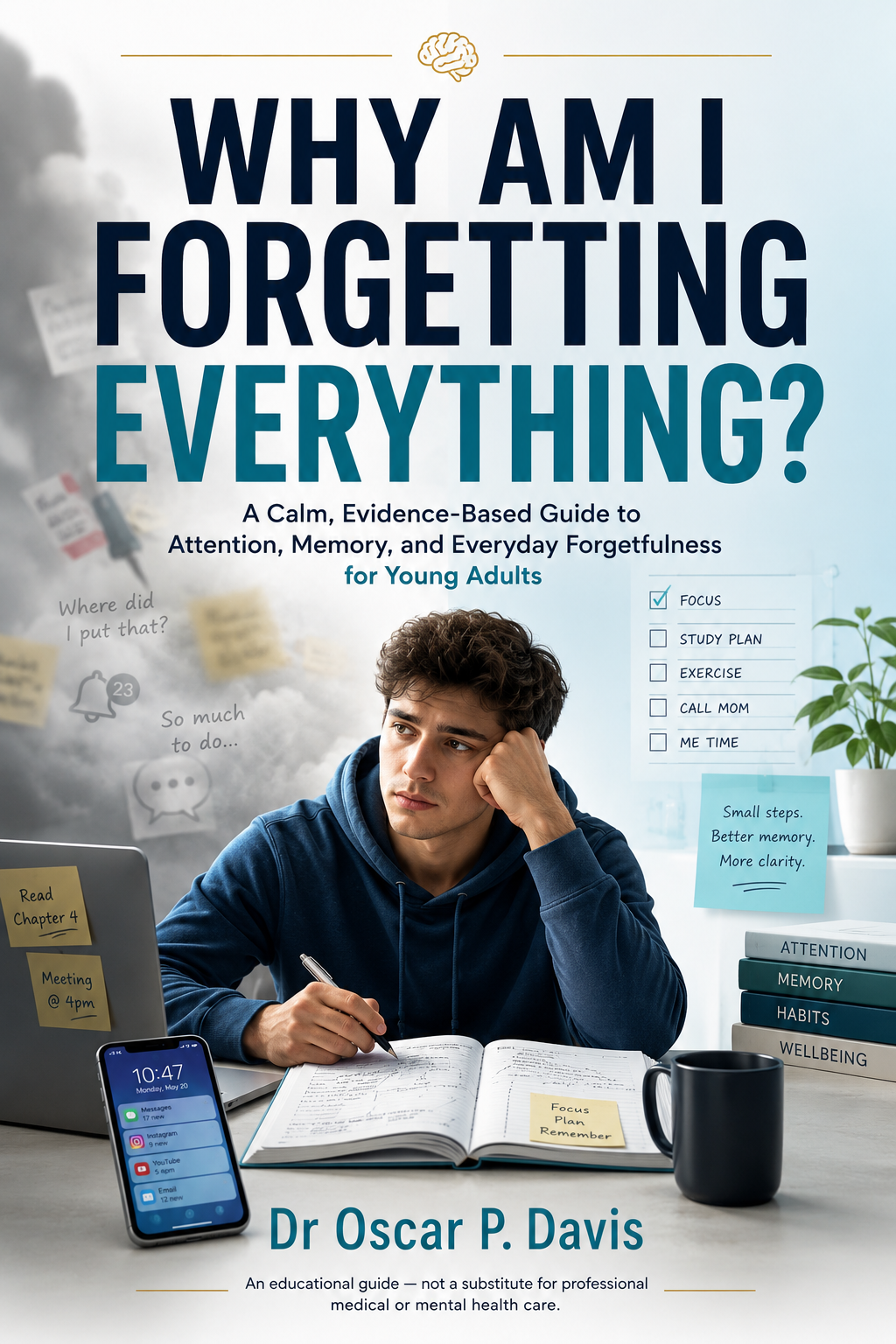
Why Am I Forgetting Everything? A Calm, Evidence-Based Guide to Attention, Memory, and Everyday Forgetfulness for Young Adults

Do You Keep Forgetting Things You Just Read, Heard, or Planned to Do?
You read the same paragraph several times, yet nothing seems to stay.
Someone gives you an instruction, but a few minutes later, the important details are gone.
You forget appointments, names, conversations, assignments, errands, passwords, deadlines, or why you entered a room in the first place.
And somewhere in the back of your mind, you may be wondering:
“Why am I forgetting everything?”
“Is something wrong with my brain?”
“Am I becoming careless?”
“Why can’t I concentrate like I used to?”
“How will I cope with school, work, business, or everyday responsibilities if this continues?”
You are not alone.
Many teenagers, students, graduates, young professionals, entrepreneurs, and other young adults experience everyday forgetfulness without fully understanding what may be contributing to it.
In many cases, what feels like a memory problem may also involve attention, poor sleep, emotional stress, digital distraction, information overload, weak study methods, or the absence of a reliable system for organising daily life.
That is why this guide was created.
INTRODUCING
Why Am I Forgetting Everything?
A Calm, Evidence-Based Guide to Attention, Memory, and Everyday Forgetfulness for Young Adults
This practical 42-page guide helps you understand how memory works, recognise the habits and conditions that may be affecting your concentration, strengthen the way you learn and recall information, and build reliable systems so important responsibilities no longer have to live only inside your head.
It does not frighten you with extreme claims.
It does not tell you that ordinary forgetfulness automatically means dementia.
It does not promise an overnight cure.
Instead, it gives you a calm, practical and research-informed starting point for understanding your experience and taking sensible next steps.
THIS GUIDE MAY BE FOR YOU IF YOU:
- Forget instructions shortly after receiving them.
- Read repeatedly but struggle to retain what you studied.
- Miss appointments, deadlines, meetings or important tasks.
- Frequently misplace your phone, keys, documents or personal items.
- Forget names shortly after meeting people.
- Feel mentally scattered, distracted or overwhelmed.
- Struggle to concentrate because of constant phone notifications.
- Feel that stress, poor sleep or burnout may be affecting your mind.
- Depend on your memory instead of using calendars, notes and reminders.
- Are worried that forgetfulness means you are lazy or unintelligent.
- Want to know when forgetfulness may require professional attention.
- Need a realistic plan for improving your attention, recall and organisation.
WHAT YOU WILL LEARN
1. Why Forgetting Is Not Just One Problem
You will discover five different reasons memory can appear to fail:
- Information was never properly encoded.
- Distraction interrupted the information.
- Stress or exhaustion affected consolidation or retrieval.
- The information is stored but difficult to retrieve.
- A medical or psychological contributor may need professional evaluation.
Understanding the difference can help you stop treating every memory problem in the same way.
2. How Memory Actually Works
The guide explains the memory process in simple language:
Attention → Encoding → Consolidation → Storage → Retrieval
You will understand why information cannot be remembered properly when it was never fully attended to or encoded in the first place.
You will also learn the difference between working memory and long-term memory, as well as the memory types you use in everyday life.
3. The Everyday Habits That Can Affect Memory
You will examine common lifestyle factors that may affect concentration and recall, including:
- Poor or irregular sleep.
- Constant notifications.
- Multitasking.
- Physical inactivity.
- Dehydration.
- Skipping meals.
- Excessive caffeine.
- Unstructured routines.
- Alcohol, cannabis, nicotine and other substances.
- Keeping too many responsibilities in your head.
A Lifestyle Memory Audit is included to help you identify which areas may deserve attention first.
4. How Stress and Emotional Overload Affect Recall
Chronic stress, anxiety, rumination, low mood, burnout and emotional exhaustion can compete with the mental resources needed for attention and memory.
The guide explains the common cycle:
Stress → reduced attention → poor recall → shame and anxiety → even more stress
You will receive practical grounding and simplification exercises to help reduce mental overload.
5. How Digital Distraction Can Feel Like Bad Memory
Your phone may be affecting your concentration even when you are not actively using it.
Inside the guide, you will learn how to:
- Reduce unnecessary notifications.
- Remove your phone during focused work.
- Use single-tasking blocks.
- Improve active listening.
- Repeat instructions in your own words.
- Take better notes.
- Reduce constant task-switching.
6. Physical Factors Worth Discussing With a Professional
The guide carefully explains possible contributors such as:
- Vitamin B12 and folate deficiency.
- Iron deficiency and anaemia.
- Thyroid function.
- Blood sugar and inadequate nutrition.
- Hormonal changes.
- Sleep apnoea and other sleep disorders.
- Medication side effects.
- Chronic illness.
- Vision or hearing difficulties.
The guide does not encourage self-diagnosis or random supplementation. It explains why symptoms should be discussed with an appropriately qualified healthcare professional.
7. When Forgetfulness May Need Medical Attention
You will learn the difference between ordinary everyday forgetfulness and symptoms that may require urgent or routine medical evaluation.
The guide includes warning signs such as:
- Sudden confusion.
- Memory problems following a head injury.
- New weakness, numbness or difficulty speaking.
- Seizures.
- Severe headaches with neurological symptoms.
- Unexpectedly getting lost in familiar places.
- Rapidly worsening memory problems.
- Forgetfulness that interferes seriously with work, school or safety.
You will also receive a Doctor-Visit Preparation Worksheet to help you organise your concerns before an appointment.
8. Evidence-Supported Memory Techniques
Instead of depending only on rereading and highlighting, you will learn practical methods such as:
- Active recall: testing yourself instead of repeatedly rereading.
- Spaced repetition: reviewing information at increasing intervals.
- Chunking: breaking information into smaller, meaningful groups.
- Association: connecting new information to something familiar.
- Visualisation: creating vivid mental images.
- Teaching: explaining information to another person.
- Elaboration: rewriting or explaining ideas in your own words.
These techniques can be used for studying, workplace learning, names, instructions, appointments, errands and important conversations.
9. How to Build a Reliable “Second Brain”
Highly organised people do not necessarily remember everything naturally.
They use systems.
The guide shows you how to create:
- One trusted calendar.
- One task manager.
- One notes system.
- Reusable checklists.
- Reminders and voice notes.
- Habit-stacking routines.
- Daily and weekly reviews.
- A “write it down immediately” rule.
This reduces the pressure on your working memory and helps prevent important tasks from disappearing.
10. The Complete 30-Day Memory Reset Plan
The guide contains a structured four-week implementation plan.
Week 1: Identify the Problem
Track sleep, stress, mood, distractions and forgetfulness incidents.
Week 2: Repair Attention
Reduce interruptions, use focused work blocks and practise active listening.
Week 3: Strengthen Recall
Use active recall, spaced repetition, association and visualisation.
Week 4: Build Long-Term Systems
Create lasting calendars, task lists, notes, checklists and weekly review habits.
The plan requires approximately 15–30 minutes per day and focuses on realistic, repeatable progress rather than perfection.
BONUS WORKSHEETS AND PRACTICAL RESOURCES
Your purchase also includes practical tools you can begin using immediately:
Memory Symptom Tracker
Track what you forgot, when it happened, your sleep, stress, mood, food, hydration and distractions.
Doctor-Visit Preparation Worksheet
Organise your symptoms, timeline, sleep history, medication use, mood changes and real-life examples before speaking with a professional.
Workplace Instruction Template
Record tasks, steps, deadlines, questions and completion details.
Study-Retention Planner
Plan active-recall questions and spaced reviews after one day, three days, one week and two to three weeks.
Seven-Day Digital Distraction Detox
A realistic plan for reducing notifications, phone dependence and digital interruptions.
Sleep and Energy Audit
Evaluate sleep times, night waking, caffeine use, fatigue and screen habits.
Scripts for Requesting Repeated Instructions
Professional phrases you can use when you need someone to explain something again without feeling embarrassed.
WHAT MAKES THIS GUIDE DIFFERENT?
This is not a collection of random memory tips.
It is a structured guide that connects:
- Attention.
- Sleep.
- Stress.
- Emotional overload.
- Lifestyle habits.
- Digital distraction.
- Learning techniques.
- Physical health considerations.
- Personal organisation.
- Professional support.
The guide also contains named research sources and a detailed bibliography, while clearly acknowledging when scientific evidence is strong, mixed, preliminary or still being debated.
WHAT THIS GUIDE DOES NOT PROMISE
This guide does not promise that you will never forget anything again.
It does not diagnose ADHD, dementia, anxiety, depression, nutritional deficiencies, thyroid conditions or sleep disorders.
It does not replace a doctor, psychologist, psychiatrist or other licensed healthcare professional.
It is designed to help you understand possible patterns, improve everyday habits, learn practical memory methods, prepare for informed professional conversations and build reliable systems around your life.
WHO SHOULD GET THIS GUIDE?
This guide is suitable for:
- Secondary-school students.
- University and polytechnic students.
- Examination candidates.
- NYSC members.
- Recent graduates.
- Young professionals.
- Remote workers.
- Entrepreneurs and creators.
- People managing busy schedules.
- Anyone who feels distracted, mentally overloaded or unusually forgetful.
- Parents or guardians who want to better understand a young person’s memory concerns.
PRODUCT DETAILS
Product: Digital PDF guide
Length: 42 pages
Format: Downloadable PDF
Author: Dr Oscar P. Davis
Language: English
Access: Delivered digitally after successful payment
Launch Price: ₦5,000
Regular Price: ₦10,000
Stop Guessing About Why You Keep Forgetting Things
You do not have to keep blaming yourself.
You do not have to continue searching through disconnected videos, posts, supplements and online symptom checklists without a structured plan.
You can begin by understanding how memory works, identifying your personal patterns and following a realistic system designed for everyday life.