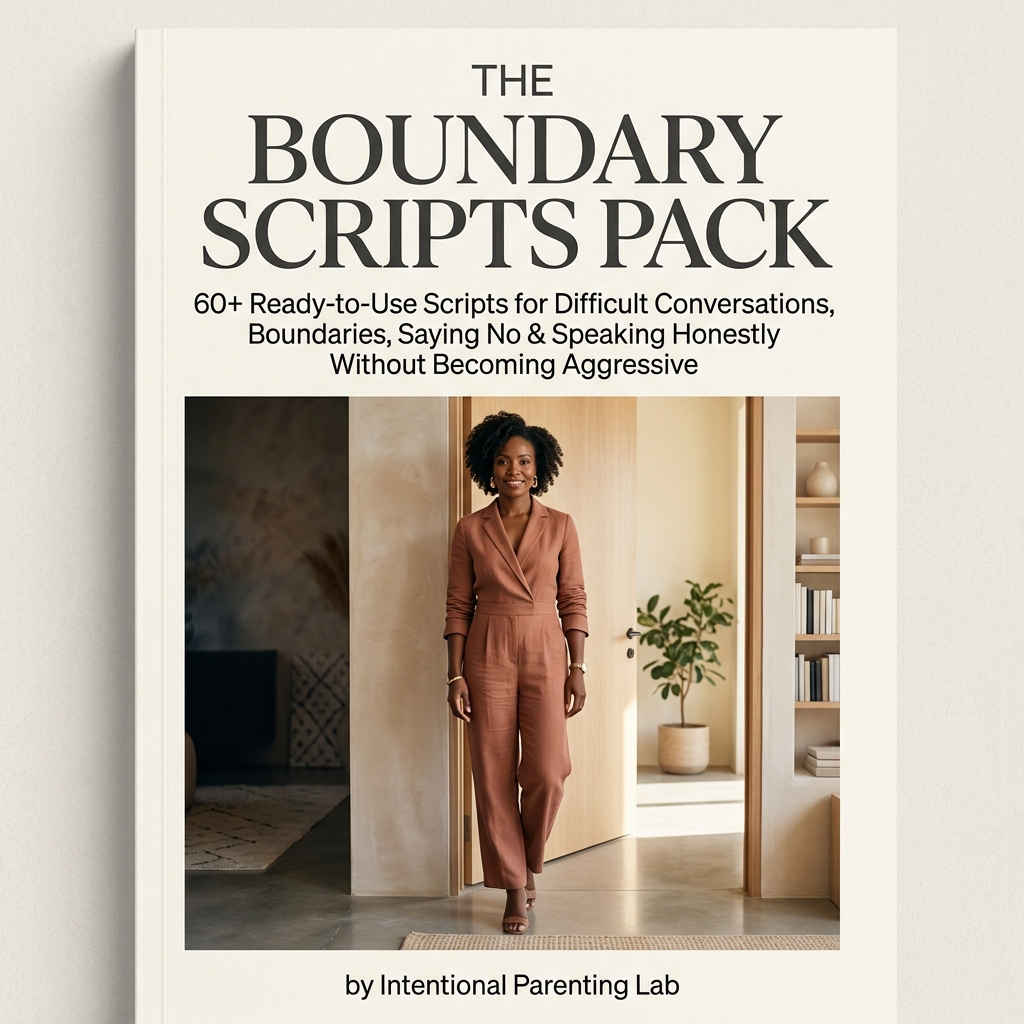
THE BOUNDARY SCRIPTS PACK: 60+ Ready-to-Use Scripts for Difficult Conversations, Boundaries, Saying No & Speaking Honestly Without Becoming Aggressive
THE BOUNDARY SCRIPTS PACK
60+ Ready-to-Use Scripts for Difficult Conversations, Boundaries, Saying No & Speaking Honestly Without Becoming Aggressive
You know what you feel. You know something needs to be said.
But sometimes… you just don't know HOW to say it.
You don't want to sound rude.
You don't want to start an argument.
You don't want to over-explain yourself.
And you don't want to keep swallowing your feelings until they turn into resentment.
The Boundary Scripts Pack gives you the words to start those difficult conversations with more clarity, calmness, and self-respect.
HAVE YOU EVER KNOWN YOU NEEDED TO SAY SOMETHING… BUT COULDN'T FIND THE WORDS?
Maybe someone crossed a line and you didn't know how to address it.
Maybe you wanted to say NO, but felt guilty.
Maybe something hurt you, but you kept telling yourself:
"It's fine."
Maybe you've been holding something in because you're afraid that speaking up will create conflict.
Or perhaps you simply don't know how to communicate your boundaries without sounding harsh.
If you've ever thought:
“I wish I knew what to say.”
This was created for you.
INTRODUCING
THE BOUNDARY SCRIPTS PACK
Your practical collection of ready-to-use words for difficult moments.
Instead of staring at your phone wondering:
“How do I even say this?”
You can find a starting point, adapt it to your situation, and communicate more clearly.
This isn't about becoming cold.
It isn't about attacking people.
And it isn't about winning every argument.
It's about learning how to speak honestly without losing yourself in the process.
WHAT'S INSIDE?
Inside The Boundary Scripts Pack, you'll get 60+ practical scripts covering situations such as:
✓ Saying NO without over-explaining
Learn how to decline requests without feeling like you have to write a five-paragraph explanation.
✓ Starting difficult conversations
Know how to bring up something that's been bothering you without immediately turning it into a fight.
✓ Setting boundaries
Find words for communicating what you're comfortable with—and what you're not.
✓ Asking for space
Learn how to take emotional space without using silence as punishment or making the other person feel deliberately ignored.
✓ Expressing hurt
Communicate that something affected you without attacking someone's character.
✓ Handling disappointment
Find calm ways to express disappointment instead of pretending everything is fine.
✓ Dealing with repeated boundary violations
Know what to say when you've already communicated a boundary and the same issue keeps happening.
✓ Forgiving without pretending
Learn how to communicate forgiveness while still acknowledging what happened and protecting yourself from repeating the same pattern.
✓ Difficult relationship conversations
Get practical language for conversations about effort, communication, accountability, recurring problems, and repair.
✓ When someone disagrees with you
Learn how to stand by your perspective without turning disagreement into a battle.
BUT THIS IS MORE THAN A COLLECTION OF SCRIPTS
You'll also get practical worksheets to help you figure out WHAT actually needs to be said.
THE “SHOULD I SAY IT OR LET IT GO?” DECISION GUIDE
A simple framework to help you determine whether you're genuinely ready to release something—or whether you're suppressing something that still needs attention.
THE 24-HOUR TRUTH CHECK
A reflection exercise to help you separate temporary emotional reactions from issues that genuinely need to be addressed.
BUILD YOUR OWN BOUNDARY SCRIPT
A simple framework that helps you turn your feelings and needs into clear, respectful words.
THE “I WISH I HAD SAID…” PAGE
For those moments when you leave a conversation thinking:
“I should have said this instead…”
THE RESENTMENT RELEASE WORKSHEET
Identify what happened, what you felt, what you needed, and what you can do now.
PERSONAL COMMUNICATION PLAN
Prepare yourself before having a difficult conversation so you're less likely to react from anger, fear, or frustration.
HERE'S A SMALL PREVIEW
When you need to say NO:
“Thank you for asking, but I won't be able to do that.”
When something has been bothering you:
“There's something I've been meaning to talk about. I'd rather communicate clearly than allow it to become resentment.”
When you need a boundary:
“I'm willing to have this conversation, but I'm not willing to continue it if we're speaking to each other disrespectfully.”
When you need space:
“I don't want to continue this conversation while I'm upset. I need some time to process what happened.”
When someone doesn't agree with your boundary:
“You don't have to agree with my boundary, but I do need you to respect it.”
Sometimes you don't need more courage.
You just need the right words.
THIS IS FOR YOU IF…
✓ You struggle to say no.
✓ You often keep things to yourself to avoid conflict.
✓ You find yourself over-explaining your decisions.
✓ You struggle to communicate boundaries.
✓ You replay conversations afterward wishing you'd said something differently.
✓ You want to express hurt without attacking someone.
✓ You want to communicate more calmly during difficult conversations.
✓ You want to stop allowing unspoken feelings to turn into resentment.
✓ You want to become more assertive without becoming aggressive.
THIS IS NOT ABOUT BECOMING A “HARD” PERSON
You don't have to stop caring.
You don't have to become cold.
You don't have to fight everyone who disappoints you.
And you don't have to turn every uncomfortable moment into a confrontation.
Sometimes the healthiest thing is to speak.
Sometimes it's to set a boundary.
Sometimes it's to ask for space.
Sometimes it's to forgive.
And sometimes it's to let something go.
The goal is learning the difference—and having the words to act on it.
YOUR VOICE MATTERS
You don't need perfect words.
You don't need a perfect argument.
You don't need everyone to agree with you.
You can say:
“That hurt me.”
“I'm not comfortable with that.”
“I need some space.”
“No, that doesn't work for me.”
“I'd like us to talk about what happened.”
“I forgive you, but I need things to be different going forward.”
You can be kind and still have boundaries.
You can forgive without giving someone unlimited access to you.
You can love someone and still say no.
And you can communicate honestly without losing yourself.
GET THE BOUNDARY SCRIPTS PACK TODAY
60+ Ready-to-Use Scripts + Practical Worksheets
A simple digital resource you can return to whenever you don't know what to say.
Get your copy today for almost free.
CLICK THE BUTTON BELOW TO GET INSTANT ACCESS.
The Boundary Scripts Pack
Practical. Simple. Easy to use.
A PERFECT COMPANION TO:
WHEN “LETTING IT GO” IS HURTING YOU
If you purchased When “Letting It Go” Is Hurting You, this pack is designed to help you take the next step.
The book helps you understand:
Should I release this—or is something still unresolved?
The Boundary Scripts Pack helps you answer:
“Okay… so what do I actually say?”
Together, they give you both the clarity and the language to handle difficult situations more intentionally.
IMPORTANT NOTE
The scripts are examples and starting points. Adapt them to your own circumstances, personality, relationship, and communication style.
This resource is for personal development and educational purposes. It is not a substitute for professional mental-health, medical, legal, or relationship counseling.