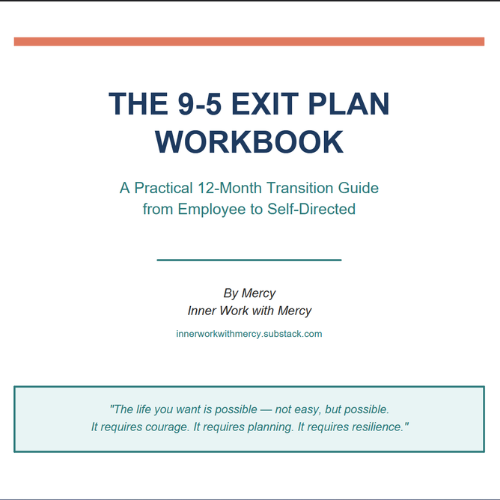
The 9-5 Exit Plan Workbook

You already know something needs to change. You just don't know where to start.
Maybe you've been in that job for years, doing everything right — showing up, hitting targets, being professional — while something inside you keeps asking: is this it? Maybe your body started answering before your mind was ready to admit it. The Sunday night dread. The migraines that appear every Monday. The panic attacks you explain away as stress. The deep, quiet feeling that you are slowly becoming someone you don't recognise.
Or maybe you're not in crisis at all. You're just done. Done pretending to care about a mission that was never yours. Done watching less competent people get promoted. Done trading your time, your energy, and your health for a salary that stopped feeling worth it a long time ago.
Either way, you've thought about leaving. Maybe for six months. Maybe for six years. And the reason you haven't — the real reason — isn't that you don't want to. It's that nobody has ever sat down with you and shown you exactly how.
That's what this workbook is.
The 9-5 Exit Plan Workbook is a comprehensive, practical, deeply honest 12-month transition guide for anyone moving from employment to self-direction. It is not a motivational read. It is not vague advice about "following your passion." It is a structured, worksheet-driven guide that walks you through every decision you will need to make — from the internal work of getting honest with yourself, to the financial calculations that will determine whether your exit is safe, to the business testing and psychological preparation that separate people who succeed from people who go back six months later, broke and demoralised.
This workbook was written for the person who is serious. The person who is tired of circling the idea and ready to actually do something about it.
What's waiting for you inside — all seven parts:
Part One — Getting Honest With Yourself Before you can build an exit, you have to know what you're actually escaping — and what you're genuinely building toward. This section walks you through the real reasons people leave (including the ones they won't say out loud), the difference between burnout and fundamental misdirection, and a 20-point misalignment checklist that tells you exactly how wrong your current role is for who you are. Includes identity and values worksheets, an ideal day exercise, and a brutally honest look at status, pressure tolerance, and what self-employment will actually cost you psychologically.
Part Two — The Money Reality Most people fail their exit because they planned with fantasy numbers, not real ones. This section makes you do the uncomfortable math: your actual monthly expenses tracked over 30 days, the hidden employer benefits you'll lose that nobody counts, your Minimum Viable Income, your full debt picture, and exactly how many months of runway you have before you're in trouble. Includes the Two-Pot savings system, income volatility planning strategies, Nigerian tax obligations for the self-employed, business registration options, contract templates, and a complete guide to bridge income.
Part Three — Building Your Exit Vehicle What will you actually do when you leave? This section introduces all five exit paths — freelance, business ownership, portfolio career, new job, sabbatical — and a decision matrix to help you choose the right one for your situation. Then it walks you through how to test your idea before you quit, how to get your first paying client, how to price without undercharging out of fear, and how to build the basic business systems that separate professionals from people who wing it and burn out.
Part Four — Fear, Energy, and Resilience This is the part most people skip. And it's the part that determines whether you make it. Ten specific fears are named, mapped, and reality-tested. You'll build worst-case plans, design your safety nets, assess your burnout level, and create the psychological infrastructure to stay steady when revenue drops, doubt spikes, and everyone around you quietly wonders if you've made a mistake. Includes the Doubt Protocol, Internal Validation System, and a sustainable work design worksheet.
Part Five — The 12-Month Transition Map A month-by-month blueprint from your first clarity exercise to your first full year of self-employment. Every month has primary goals, a week-by-week breakdown, decision checkpoints, and worksheets. Includes the go/no-go validation framework at Month 6 and a full first-year review at Month 12.
Part Six — Relationships and Support Your exit affects the people around you — and their reactions will affect your success. This section gives you the exact conversation framework for telling your partner, scripts for handling family pressure, tools for setting boundaries with unsupportive people, and a practical guide to building the peer support circle that will keep you sane when things get hard.
Part Seven — Common Pitfalls That Derail Transitions The seven most expensive mistakes people make when leaving employment — and exactly how to avoid them. Leaving before validation. Underestimating taxes. Ignoring legal agreements. Isolation. Overspending after the first good month. Recreating the burnout in a different outfit. Underestimating the emotional toll. If you know what to watch for before it happens, you can navigate around it.
This workbook is for you if:
- You've been thinking about leaving your job — for months or years — and haven't been able to make a move
- You're burnt out, misaligned, or both, and you need a structured path forward, not just inspiration
- You want to leave but you're terrified of the financial risk and don't know how to calculate whether it's safe
- You've tried to build a side income or start something before and it didn't stick — and you want to understand why
- You want to leave well, not desperately — with savings, clients, and a plan rather than just a resignation letter
- You're not sure yet whether you want to leave for good, and you need help figuring out what you actually want
- You're in a toxic or harmful work environment and you need to move fast, but you still want a plan
This workbook is not for you if:
- You want a quick-fix or a shortcut — this is deep, structured work that requires honest engagement
- You're looking for someone to tell you what business to start — this helps you find that answer yourself
This workbook does not promise you freedom. It gives you a map. What you do with it is entirely up to you — and after working through it, you'll finally have what you need to make that choice from clarity instead of fear.
About the Author Mercy is the founder of Inner Work with Mercy, a personal development brand built at the intersection of self-awareness, nervous system literacy, and building personal authority. Her work draws on 13 years of corporate experience and a commitment to making the unconscious conscious — so that the people who have been doing everything right on paper can finally build lives that feel right in their bodies too.
https://linktr.ee/innerworkwithmercy