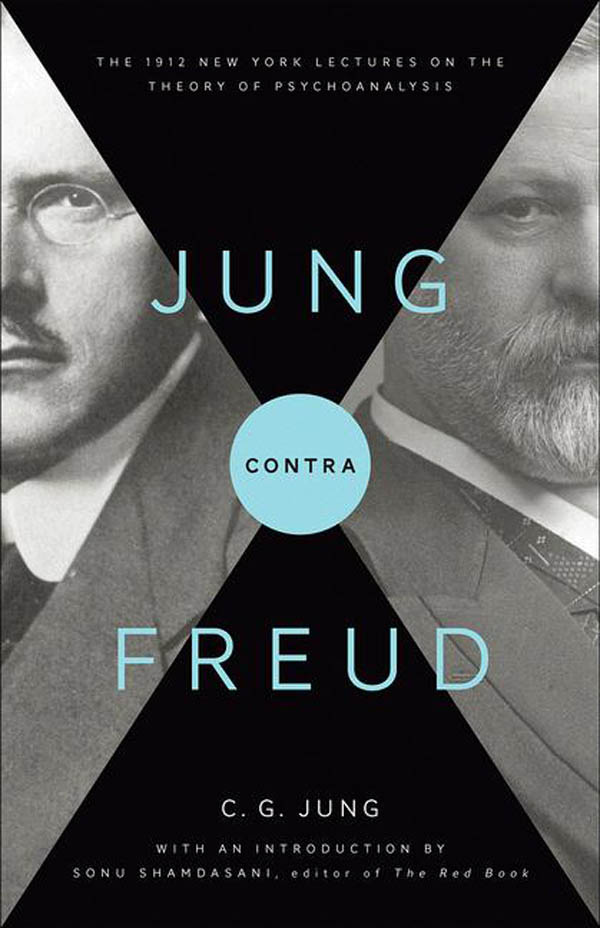
Jung, C. G. - Jung contra Freud (Princeton, 2012)

September 28, 1912. The New York Times featured a full-page interview
withJung on the problems confronting America, with a portrait
photo entitled "America Facing Its Most Tragic Moment" the
first prominent feature of psychoanalysis in the Times. It was
Jung, the Times correctly reported, who "brought Dr. Freud to the
recognition of the older school of psychology." The Times went on
to say, "[H]is classrooms are crowded with students eager to understand
what seems to many to be an almost miraculous treatment.
His clinics are crowded with medical cases which have baffled
other doctors, and he is here in America to lecture on his subject."
Jung was the man of the hour. Aged thirty-seven, he had just completed
a five-hundred-page magnum opus, Transformations and Symbols
of the Libido, the second installment of which had just appeared
in print. Following his first visit to America in 1909, it was he, and
not Freud, who had been invited back by Smith Ely Jelliffe to lecture
on psychoanalysis in the new international extension course
in medicine at Fordham University, where he would also be
awarded his second honorary degree (others invited included the
psychiatrist William Alanson White and the neurologist Henry
Head).
Jung's initial title for his lectures was "Mental Mechanisms in
Health and Disease." By the time he got to composing them, the
title had become simply 'The Theory of Psychoanalysis."J ung commenced
his introduction to the lectures by indicating that he intended
to outline his attitude to Freud's guiding principles, noting
that a reader would likely react with astonishment that it had taken
him ten years to do so. The explanation lay in the fact that when
he first encountered Freud's work, he did not feel in a position to
exercise criticism. To understand this more fully, we need to look
back atJung's initial engagement with psychoanalysis.