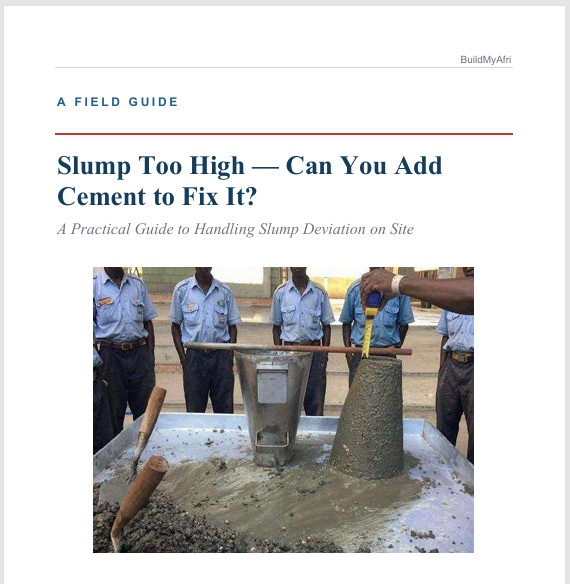
4207 Slump Too High – Can You Add Cement to Fix It? A Practical Guide to Handling Slump Deviation on Site
Full Product Description:
The slump test result is 190mm. Design says 150mm. The foreman says: “Just add some cement. That’ll dry it up.”
That’s the wrong answer. Adding cement to a wet mix doesn‘t fix it – it creates a new problem. And adding water to a dry mix weakens the concrete permanently.
This guide gives you a simple decision flow for slump deviation:
- What’s acceptable (±30mm)
- What‘s marginal (±31-50mm) – hold and call the supplier technician
- What’s unacceptable (>±50mm) – reject immediately
- The one scenario where you should reject without even thinking (segregation)
- How to correctly handle a dry mix (superplasticiser, not water)
- How to correctly handle a wet mix (extend mixing, assess, or reject)
What‘s inside:
- Slump deviation decision flow – from measurement to decision in 4 steps
- Correct vs incorrect fixes – what works and what fails
- Segregation red flags – spot it, reject it
- Printable decision card – cut it out, put it in your hard hat, carry it on site
Who this is for:
- Site supervisors
- Quality inspectors
- Foremen
- Anyone signing for concrete deliveries
What you‘ll learn:
- Why adding cement to a wet mix is always wrong
- Why adding water to a dry mix is always wrong
- When you can adjust and when you must reject
- How to spot segregation – and why it’s an automatic reject
- What to say to the supplier when the slump is wrong
From the BuildMyAfri library:
This guide is part of a 700+ case study library built for African construction sites. Every article is based on real site experience – no theory, no textbooks.
Product Tags / Keywords:
slump test, concrete slump, slump deviation, concrete quality control, site supervision, concrete acceptance, construction guide, Kenya construction, concrete troubleshooting, concrete testing