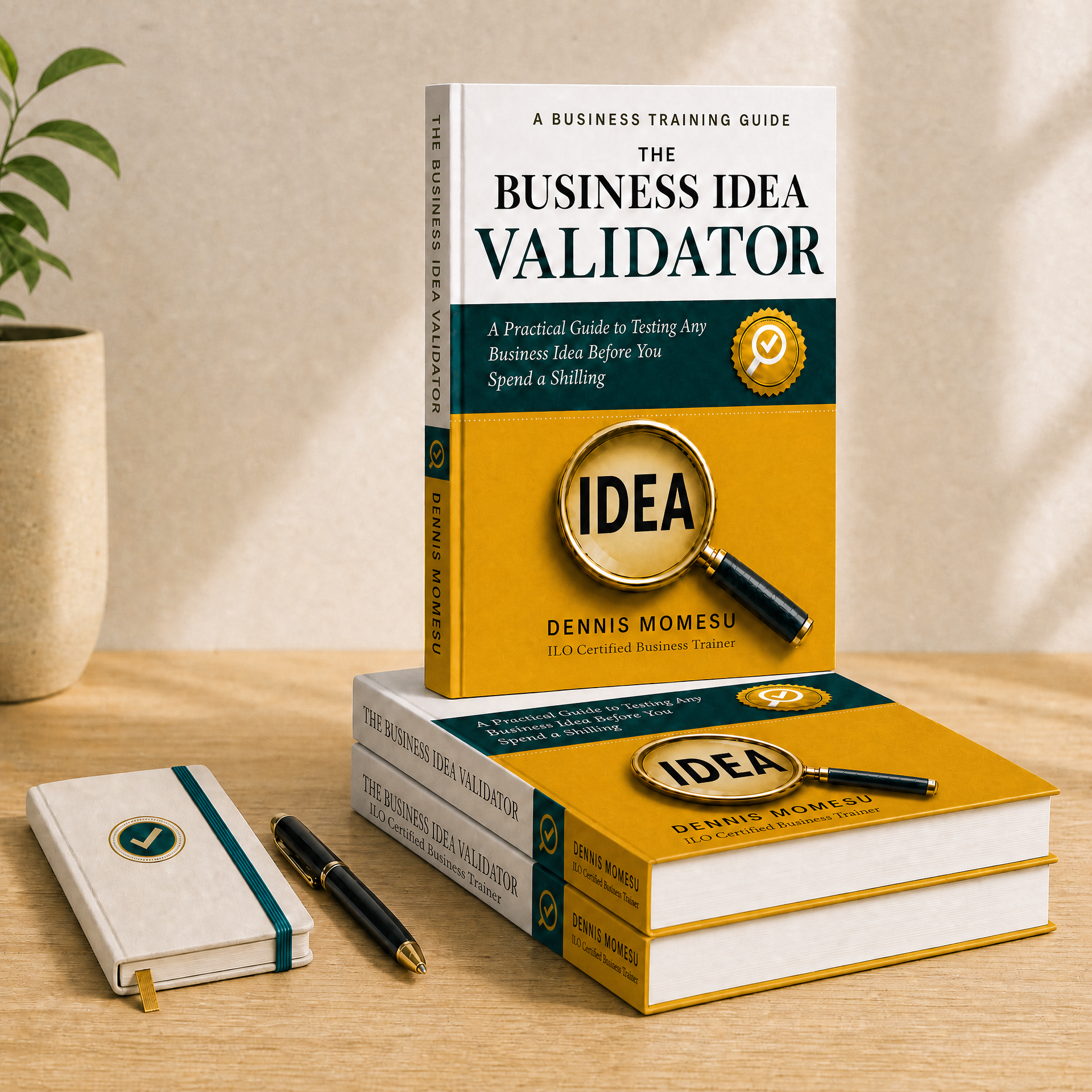
THE BUSINESS IDEA VALIDATOR

The Business Idea Validator
A Practical Guide to Testing Any Business Idea Before You Spend a Shilling
You have a business idea.
Maybe it has been sitting in your notebook for months.
Maybe you have several ideas and cannot decide which one deserves your time, savings, and energy.
The bigger question is not, “Is this a good idea?”
It is, “How do I know?”
The Business Idea Validator gives you a practical way to find out before you commit serious money.
This guide helps you move from excitement and assumptions to evidence and clarity.
By the end, you will have one idea worth testing and a clear reason for trusting it.
Inside, you will learn a simple five-step validation process:
Name the real problem
Identify the specific problem your business intends to solve and the customer experiencing it.
Talk to real people
Learn how to ask questions about what people have already done, paid for, and experienced instead of relying on polite promises about what they might buy.
Check if the math works
Calculate your true costs, including materials, your time, and overhead. Then determine whether your pricing leaves room for a real margin.
Run the cheap seven-day test
Put your offer in front of real customers and ask for a deposit, booking, or pre-order. Measure commitment, not compliments.
Make the Go, Adjust, or No decision
Bring your evidence together and make a clear decision. Move forward, improve the weak point, or walk away before the idea becomes an expensive mistake.
This book is for you if you are testing a side business while employed, choosing your first business idea, recovering from a previous business failure, or considering self-employment after graduation.
You will also learn how to generate multiple business ideas, narrow them to two or three serious options, assess which business type fits you, conduct simple market conversations, compare surviving ideas using SWOT, and summarize your final idea on one practical page.
The goal is simple.
Spend less time guessing.
Spend less money proving a bad idea wrong.
Make better business decisions using evidence.
The book draws on the Start and Improve Your Business methodology from the International Labour Organization and the author's experience training entrepreneurs.
You do not need another motivational speech.
You need a process for deciding whether your idea deserves your money.
Start testing before you start spending.