The air in Place de la Concertation tastes of three things: diesel smoke from the throbbing generators, the sweet-sour tang of bissap being passed through the crowd, and the metallic scent of history being unmade. Before me, a young man in a faded Barcelona jersey pours petrol on the tri-color. The French flag, that is. Not the one from the Camp Nou.
A match strikes. The crowd—thousands, mostly young, all vibrating with a terrible, beautiful energy—erupts as the fabric curls into black and orange petals against the twilight. Their roar isn't one of hate, not exactly. It is the sound of a suture being ripped out, a psychic splinter pulled from a deep, festering wound.
"Cette fois, c'est pour de vrai!" the young man shouts, turning to me, his eyes reflecting the flames. This time, it's for real.
His name is Issoufou. He is twenty-two. He has never known a Niger not garrisoned by French troops, not dictated to by the Quai d'Orsay, not bled by the CFA Franc. His certainty is absolute, his hope a physical force. I have stood in such crowds before. I have breathed this air. Accra, 1957.
The Gold Coast becoming Ghana, Nkrumah's voice ringing over the polo grounds: "Our independence is meaningless unless it is linked up with the total liberation of the African continent!"
Leopoldville, 1960. Lumumba's defiant, electrifying speech before the glowering Belgian king, a speech that signed his death warrant. Harare, 1980.
The Union Jack descending, the green and gold rising, Mugabe's promises hanging like ripe fruit.
Each time, the same intoxicating perfume of possibility. Each time, the same invisible chains, being forged in parallel in distant capitals, waiting to be clamped around the newborn ankle of the state.
I am an old man now. I have seen this history for years. I have traced the lines of coups to Langley and the Rue du Faubourg Saint-Honoré.
I have sat in villages where the only road was built to a mine, and the only clinic was built by an NGO that taught people their government was incapable.
I have listened to the elegant, soul-crushing logic of World Bank economists in air-conditioned Abidjan hotels, prescribing the starvation of the state as cure for its weakness.
The center—the sovereign will of a people to determine their destiny on their own land—cannot hold in Africa. Not because we are incapable. Not because of some inherent disorder in our stars.
But because it has been systematically, relentlessly, ingeniously prevented from holding for over five centuries.
The young man, Issoufou, slaps my shoulder, pulling me back to the burning square. "Papa! Why so sad? Look! They are leaving!"
I nod, forcing a smile. I do not tell him what I see. I do not describe the ghostly parade forming just behind the jubilant crowd: the spectral figures of Patrice Lumumba, his body dissolved in acid; of Thomas Sankara, shot by his best friend in a French-backed plot; of Kwame Nkrumah, waking to the tanks in his courtyard.
They are all here, watching. Their eyes are not on the burning flag. They are fixed on the periphery of the square, where the shadows are thickest. They are waiting to see what new shape the leash will take.
The colonialist is gone. Long live the "partner." The exploiter is banished. Long live the "investor." The slave master is dead. Long live the "donor."
This book is an autopsy of that great deception.
It is the story not of how Africa was conquered—that tale is written in blood we know too well—but of how its freedom was stolen in plain sight, packaged as a gift, and administered like a slow-acting poison. It is the story of the brilliant, brutal architecture of neo-colonialism: an empire with no flag, no governor, and no sunset clause.
But it is also, now, the story of the Sahel. Of Niger, Burkina Faso, Mali. Of young soldiers who have read Fanon, who invoke Sankara, and who have made a devil's bargain with Moscow to break the hex from Paris.
It is the most dangerous, promising moment since those first midnights of independence. This is not 1960. The script has been torn up. The audience is armed. And the players are no longer asking for permission.
We begin not with the beginning, but with a center. A true one. Forget Greenwich. Forget Paris. There is a town on the northern shore of Lake Togo where the old ones say the world was born, where the umbilical cord of humanity is buried.
In Togoville, they will show you the stone where the treaty was signed that gave Germany—and then France—a country. They will tell you that Gustav Nachtigal did not understand what King Mlapa III understood: that you cannot sell the center of the world. You can only lose it, or reclaim it.
That reclamation is the fire now burning in the Sahel. It may forge a new continent. It may consume it. But it will not be ignored.
I write this for Issoufou. I write it so his fire might finally, truly, light the way home.
They told us the fighting ended in the 1960s.They were lying.
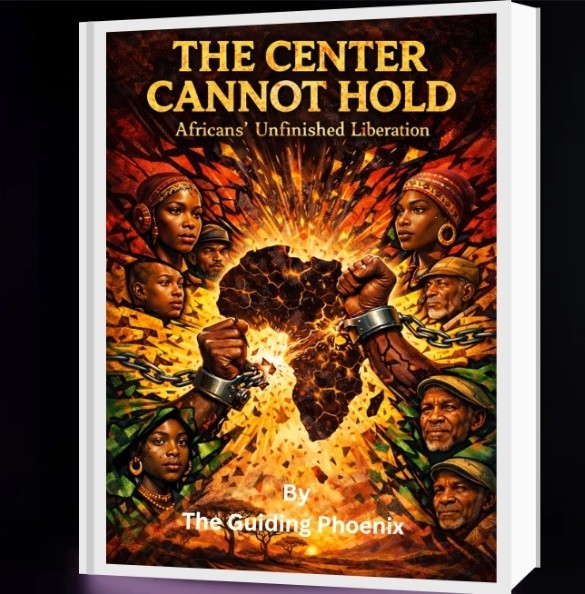
The Center Cannot Hold isn't just African history. It's the forensic autopsy of a 60-year-old deception. It connects the dots from the assassination of Lumumba to the Wagner flags in Niger, revealing the invisible architecture of control that never left.
This is the book that explains WHY the Sahel is burning. It’s not "instability." It’s revolt. Get the recommendations to fulfilling the unfinished Africans liberation.