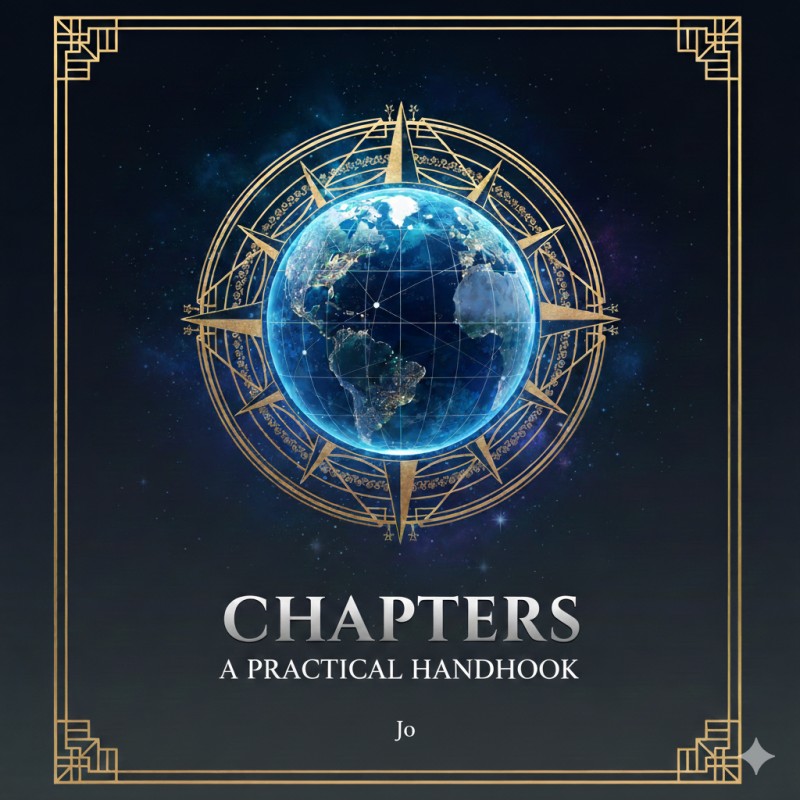
CHAPTERS: A Practical Handbook

The book Chapters: A Practical Handbook provides an exploration of ten major institutions of power, examining how they shape human existence and consciousness. It is written from multiple perspectives, including a Narrator, Analyst, Exposer, and Conspiracy Theorist [cite: 500-503].
Below is a chapter-by-chapter summary based on the provided text:
* [cite_start]God's Kingdom: The Celestial Order: This chapter explores the "original blueprint" of the universe, envisioned as a divine design of order and harmony governed by "divine law". It details a "Hierarchy of Light" and a "Divine Council" that administer this cosmic order. However, it also presents the "Prison Planet" hypothesis, which suggests this reality may actually be a "containment field" or "prison matrix" designed to trap human souls and suppress their divinity.
* World Governments: The Terrestrial Administrators: The text scrutinizes governments, characterizing them as layers of "political puppeteering". It describes a shift from visible monarchies to an invisible "global bureaucracy" and "technocratic elite" that operate beyond the reach of individual voters. Elected leaders are often portrayed as "front-men" or "gatekeepers" implementing the agendas of hidden powers.
* Satan's Kingdom: The Shadow Realm: This section delves into "cultural nihilism" and the use of chaos to dominate. It discusses "shadow values" that replace constructive growth with destructive patterns, such as the glorification of vice and the breakdown of empathy. It also explores the theory of a "Luciferian Elite" who allegedly use occult rituals and energetic intent to maintain hierarchical control.
* Religion: The Dogmatic Gatekeepers: Religion is examined as both a "unifying sanctuary" and a "ruthless gatekeeper". While it provides social cohesion, it is also presented as a mechanism for control and psychological domination that uses fear and dogmatic teachings to instill obedience and suppress dissent.
* Corporate World: The Invisible Hand: This chapter tracks the evolution of corporations into "monolithic power brokers" where profit motives eclipse public welfare. It highlights the "staggering influence" of asset management firms like BlackRock and Vanguard and discusses the "revolving door" between corporate leadership and regulatory agencies.
* Secret Societies: The Hidden Hand: Beneath visible institutions, secret societies are said to preserve "bloodlines and symbols" that quietly shape global agendas. These groups allegedly collaborate across borders to consolidate authority in favor of elite networks.
* Finance: The Debt Shackles: This section reveals mechanisms where debt and currency are used as "instruments of captivity". It critiques central banking and "fiat money" as tools of social control and discusses the concept of "debt slavery".
* Technology: The Digital Panopticon: Technology is described as a "modern deity" that ensnares through "algorithmic governance" and surveillance. It explores how automated systems in "smart homes" and digital spaces can lead to behavioral conditioning and a loss of privacy.
* Family: The Unit of Resistance: Amidst these large power structures, the family is identified as a "resilient counterforce" and a "repository of identity" that can resist the fragmentation caused by external powers.
* You: The Sovereign Observer: The book culminates by identifying the individual's consciousness as the "most profound institution of all". It argues that personal sovereignty is the "seat of freedom" and that by becoming an "awakened observer," an individual can transcend fear and systemic manipulation. This is linked to the "Avatar/Christ reality," an archetype of the awakened human who actualizes their "latent
divinity".