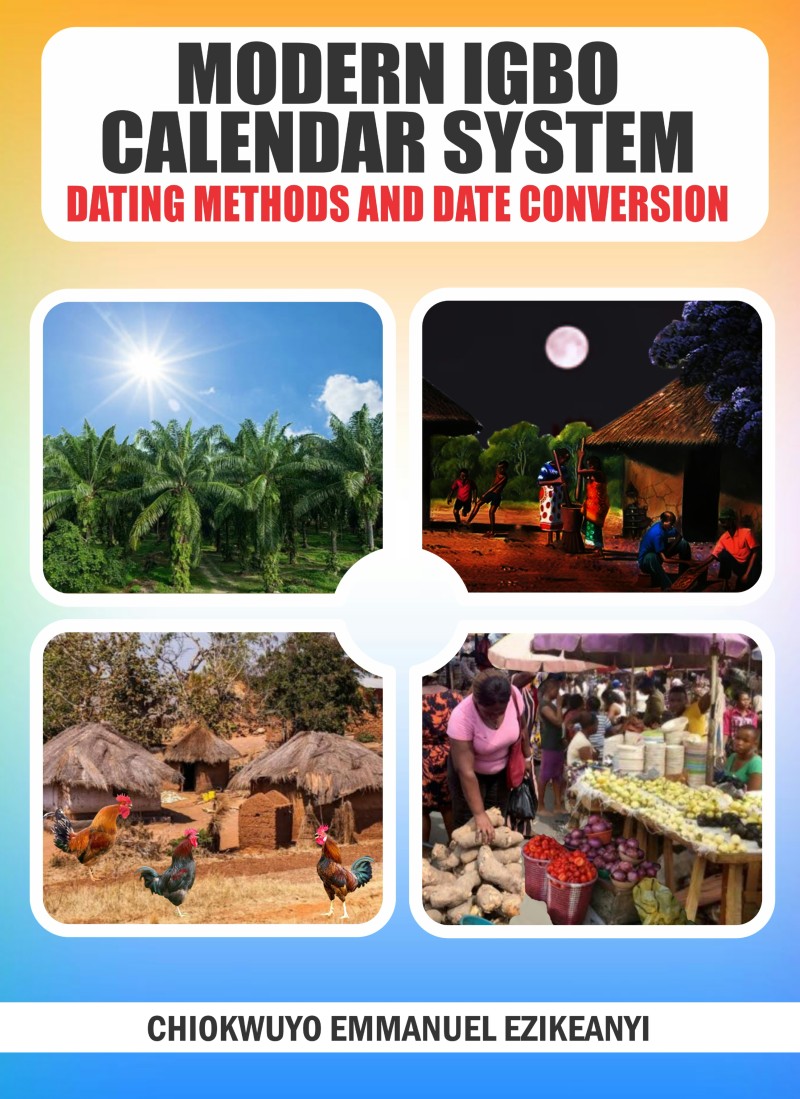
MODERN IGBO CALENDAR SYSTEM: Dating Methods and Date Conversion
MODERN IGBO CALENDAR SYSTEM: Dating Methods and Date Conversion
Modern Igbo Calendar System is a comprehensive and practical guide to understanding, preserving, and applying the indigenous Igbo calendars in contemporary Igbo society. Rooted in Igbo cosmology and the philosophy of time, this work explains how time is not merely a framework for counting days but a sacred, symbolic, and natural force that organizes human life, nature, and the cosmos.
This system integrates Igbo female calendar (Iguarọ-nneọnwa) and Igbo male calendar (Iguarọ-okeọnwa), providing a structured approach to both birth and agricultural cycles, rituals, festivals, and communal life. For the first time, it introduces Kaọdina Ịgụarọ, a standardized format for writing and interpreting Igbo dates, including native, traditional, civil, bi-dates, and tri-dates. These formats enable clear alignment and application across all calendar systems simultaneously.
A major feature of this work is the development of formulas for converting Igbo native dates into civil (Gregorian) dates and vice versa, resolving long-standing confusion and enabling accurate planning for cultural, religious, and social events. This system corrects common misconceptions, such as the belief that the Igbo calendar consists only of Eke, Orie, Afọ, and Nkwọ, that Igbo months are permanently fixed at 28 days, or that the year always contains 13 months. This work demonstrates the intellectual sophistication of Igbo timekeeping systems.
Modern Igbo Calendar System is not only theoretical but also highly practical. It can be used to organize agricultural activities, festivals and rituals, community events, and women’s monthly cycles, including expected delivery dates. It reconnects users with the natural rhythms of the sun, moon, and seasons, aligning ecological, spiritual, and social life with ancestral wisdom.
By documenting and modernizing Igbo calendar systems, this work preserves indigenous knowledge, strengthens cultural identity, and provides a research standard for scholars, educators, and institutions. It ensures that Igbo timekeeping traditions are recognized, studied, and applied alongside modern civil calendar, bridging the gap between ancestral knowledge of timekeeping and modern system of timekeeping.
This work is ideal for researchers, students, cultural leaders, spiritual practitioners, and anyone interested in indigenous African knowledge systems. It offers both digital and print formats, making the Igbo calendar accessible, functional, and relevant in today’s world.