Service
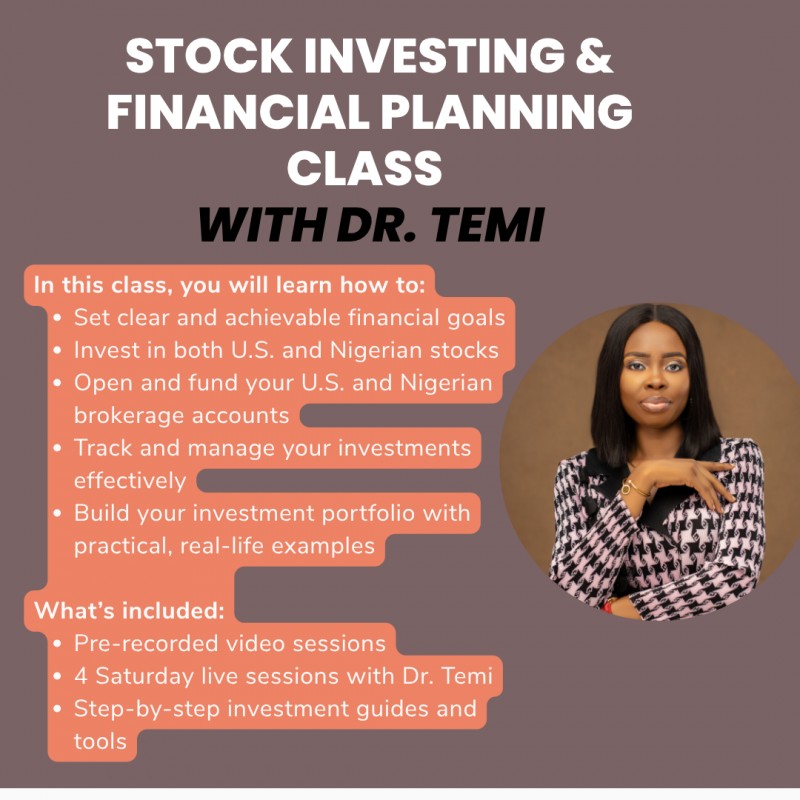
Stock Investing & Financial Planning Class

(0 Ratings)
1
$15.00$40
Syllabus: Stock Investing & Financial Planning Class
Week 1: Financial Planning – Building a Solid Foundation
Theme: Setting financial goals and creating actionable roadmaps.
- Introduction to Personal Finance
- Difference between earning, saving, investing, and spending.
- The psychology of money (habits, discipline, and delayed gratification).
- Goal Setting Framework
- Short-term, medium-term, and long-term financial goals.
- SMART goals (Specific, Measurable, Achievable, Relevant, Time-bound).
- Vision board or financial roadmap exercise.
- Budgeting & Saving Strategies
- 50/30/20 rule and variations.
- Emergency funds: why, how much, where to keep it.
- Automation of savings.
- Debt Management
- Good debt vs. bad debt.
- Strategies to pay down debt (snowball, avalanche methods).
Practical Exercise
- Participants draft a personal financial plan with goals, budget, and savings targets.
Week 2: The Stock Market – Wealth Creation Through Ownership
Theme: Understanding how to buy, hold, and sell stocks profitably.
- Stock Market Basics
- What the stock market is and how it works.
- Primary vs. secondary markets.
- Key stock market participants: investors, traders, brokers, regulators.
- Types of Stocks
- Growth stocks, dividend stocks, blue-chip stocks, penny stocks.
- Local and Foreign Markets, Sectors and industries.
- How to Buy Stocks
- Brokerage accounts (local and international).
- Order types (market order, limit order, stop-loss).
- How to Analyze Stocks
- Fundamental Analysis: company earnings, financial ratios, competitive advantage.
- Technical Analysis: charts, trends, support & resistance.
- Sentiment & macroeconomic factors.
- When to Sell
- Profit targets, stop-loss rules.
- Rebalancing portfolios.
- Avoiding emotional investing.
- Practical Exercise
- Mock stock-picking challenge: Each participant selects 3 companies, explains why, and tracks performance during the course.
Week 3: The Fixed Income Market – Safer Ways to Invest
Theme: Exploring steady-income assets for balanced investing.
- Introduction to Fixed Income
- What it is and why investors need it.
- Comparing risk/return with equities.
- Treasury Bills (T-Bills)
- How they work and where to buy them.
- Auction process vs. secondary market.
- Use cases (safe parking of cash, hedging against inflation).
- Bonds
- Government vs. corporate bonds.
- How bond yields and prices work (inverse relationship).
- Credit ratings and default risk.
- Mutual Funds & Money Market Funds
- How they operate.
- Benefits of professional management.
- Comparing costs and returns.
- Commercial Papers & Other Instruments
- Role in corporate financing.
- Risks and opportunities.
- How to Spot Opportunities
- Interest rate trends.
- Inflation outlook.
- Creditworthiness of issuers.
- Practical Exercise
- Compare returns of a T-Bill vs. a money market fund vs. a corporate bond.
Week 4: Portfolio Diversification & Asset Allocation – Building Wealth with Balance
Theme: Reducing risk and maximizing returns through strategic investing.
Topics:
- What is Diversification?
- The principle of not putting all your eggs in one basket.
- Risk-return trade-off.
- Asset Classes Overview
- Equities, fixed income, real estate, commodities, cash equivalents, alternative investments.
- Asset Allocation Strategies
- Conservative, balanced, and aggressive portfolios.
- Strategic vs. tactical asset allocation.
- Impact of age, income, and risk tolerance.
- Practical Tools for Allocation
- Model portfolios for beginners, mid-career professionals, and retirees.
- Rebalancing frequency (monthly, quarterly, annually).
- Global Diversification
- Investing beyond domestic borders.
- Accessing ETFs, index funds, and foreign stocks.
- Practical Exercise
- Each participant builds a sample diversified portfolio (equities, fixed income, mutual funds, real estate).
✅ By the end of the class, participants will:
- Have a personal financial plan.
- Understand how to analyze and buy stocks.
- Be able to choose safe fixed-income investments.
- Build a balanced portfolio suitable for their financial goals.