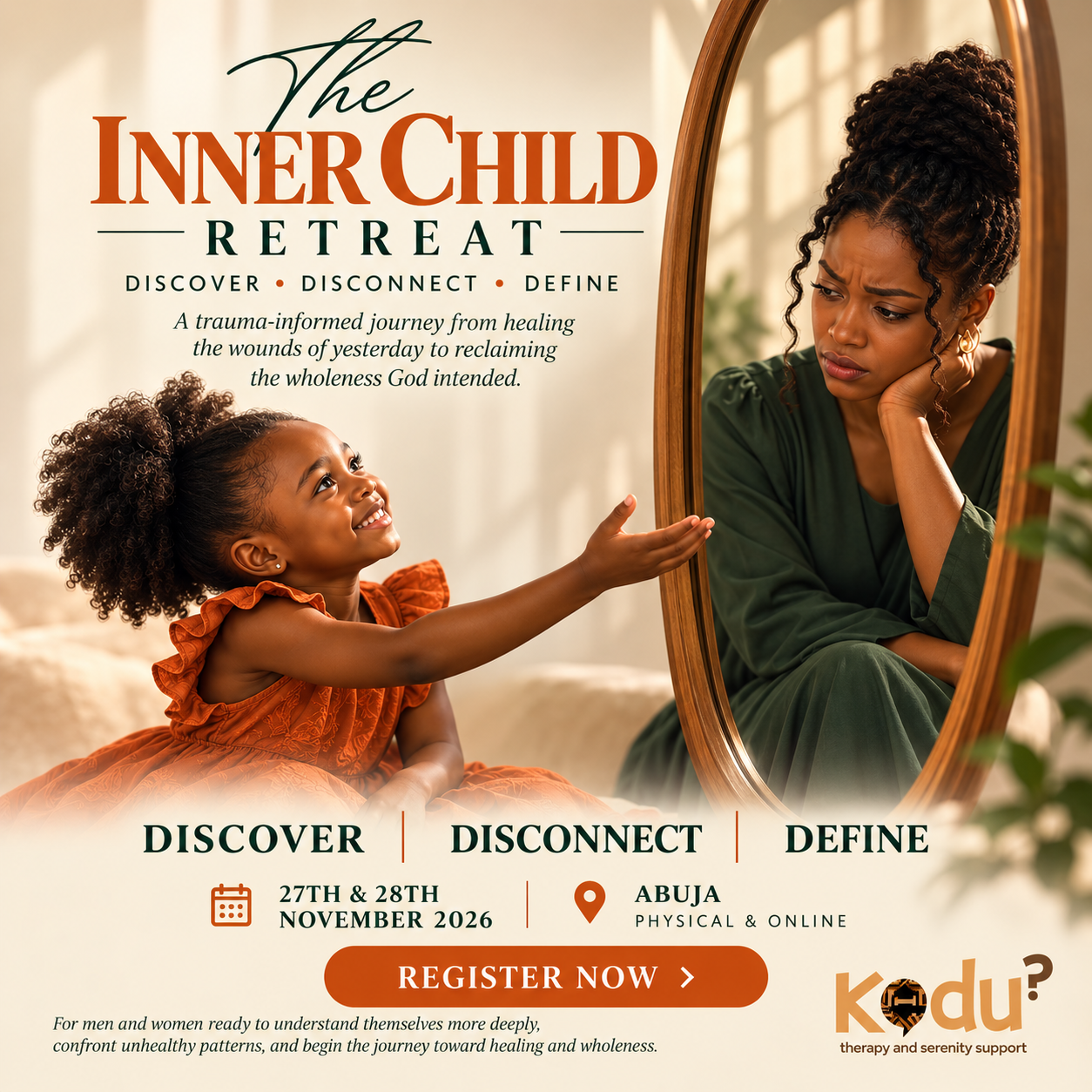
Inner Child Retreat

Get Tickets
Total Admissions: 0Join us virtually for the opening day of The Inner Child Retreat 2026 — a powerful, trauma-informed experience of self-discovery, reflection and emotional healing. Your experience includes: - Day 1 virtual retreat experience - Trauma and inner-child exploration - Guided self-reflection - Emotional pattern mapping - Spiritual reflection - Live facilitated sessions 🗓 27 November 2026 ⏰ 4:00 PM – 8:00 PM 💻 Online Please note: This ticket provides access to Day 1 only. It does not include the physical Day 2 experience.
Full Retreat Experience | Online + Physical Go deeper with the complete two-day Inner Child Retreat experience, combining our virtual opening day with an intimate, in-person Day 2 experience in Abuja. Your experience includes: - Everything in the Day 1 online experience - Full Day 2 physical retreat experience - Deeper guided reflection and inner-child work - Grounding and body-awareness practices - Facilitated conversations - Psychological and experiential activities - Spiritual reflection - Retreat materials/workbook - Personalised care and welfare throughout the physical experience - Item 7 🗓 27 November 2026: Online, 4:00 PM – 8:00 PM 🗓 28 November 2026: Physical, 10:00 AM – 4:00 PM 📍 Abuja + Online This is the complete Inner Child Retreat experience.
INNER CHILD RETREAT 2026
3D's: DISCOVER. DISCONNECT. DEFINE.
You have spent years becoming who everyone needed you to be.
But somewhere beneath the roles, expectations, coping mechanisms, relationships and survival patterns is a part of you that still carries the stories of where you came from.
The Inner Child Retreat is an intimate, trauma-informed experience designed to help participants explore how childhood experiences and unresolved emotional wounds may influence their beliefs, behaviours, relationships and emotional patterns today.
Through psycho intelligence, guided reflection, therapeutic exercises, grounding practices, meaningful conversations and spiritual reflection, participants will be invited to understand their stories, recognize unhealthy patterns and begin developing healthier ways of relating to themselves and others.
This is not about blaming your parents. It is not about digging up your past simply for the sake of remembering it. And it is not about finding someone or something to blame for who you are today.
It is about understanding yourself more deeply.
Because sometimes, the most important question is not: “Why am I like this?”
It is: “What happened to me, and how did it shape the person I became?”
WHAT IS THE INNER CHILD RETREAT?
The Inner Child Retreat is a trauma-informed journey from healing the wounds of yesterday to reclaiming the wholeness God intended.
A guided, trauma-informed, psychological and self-exploration experience centred on understanding the emotional patterns, beliefs, needs and coping responses that may have been shaped by earlier experiences.
The term “inner child” is commonly used as a way of describing the emotional imprint of our earlier lives—the beliefs, needs, memories and relational patterns that can continue to influence us as adults.
Our childhood experiences can contribute to the ways we understand safety, love, rejection, trust, boundaries, self-worth and relationships. Sometimes, those lessons remain active long after the original circumstances have changed.
You may be an adult today, but still find yourself:
• Becoming anxious when someone becomes distant.
• Struggling to trust people even when they have given you no reason not to.
• Constantly seeking approval or validation.
• Feeling responsible for everyone's emotions.
• Finding it difficult to say no.
• Feeling guilty when you prioritise yourself.
• Overreacting to certain situations and wondering why.
• Avoiding conflict at all costs.
• Becoming emotionally distant when relationships become intimate.
• Feeling unworthy of love, success or attention.
• Repeating relationship patterns you promised yourself you would never repeat.
• Being extremely hard on yourself.
• Struggling to express your emotions.
• Feeling like you always have to be strong.
These experiences do not automatically mean that you have a “wounded inner child,” nor does every adult difficulty originate in childhood. But sometimes, looking at your history can help you understand the present.
That is the work we will begin to explore at the Inner Child Retreat.
THE 3D's
[DISCOVER, DISCONNECT, DEFINE]
DISCOVER
Discover the parts of your story that shaped you.
Before you can change a pattern, you need to recognise it. Before you can understand your reactions, you need to become curious about them.
Discover is about turning inward with curiosity rather than judgement.
Questions may include: What did I learn about love growing up? What did I learn about myself from the people around me? What did I have to become in order to feel accepted? What emotions were welcomed or discouraged? Did I learn to ask for help—or to handle everything alone? How did I learn to deal with conflict? What experiences changed the way I see relationships?
Discovery is not about forcing memories. It is about developing a deeper understanding of the person you have become.
DISCONNECT
Disconnect from the patterns that no longer serve you.
Sometimes, survival strategies become lifestyles. The child who learned to stay quiet may become the adult who cannot express their needs. The child who learned to please everyone may become the adult who struggles with boundaries.
What once helped you cope may not necessarily be helping you live freely today.
Disconnect is about creating space between your present self and automatic patterns that may have been formed in response to earlier experiences.
Not every reaction needs to control you. Not every belief you inherited needs to remain your truth. Not every role you learned to play needs to remain your identity.
This stage is about recognising those patterns, understanding their function and beginning to create room for healthier responses.
DEFINE
Define who you are beyond your wounds, roles and survival patterns.
Understanding your past is not the end of the journey. You still have a life to live.
Define is about asking: Who am I choosing to become?
What do I believe now? What do I value? What kind of relationships do I want? What boundaries do I need? How do I want to communicate? What does healthy love look like for me? What parts of myself do I want to reconnect with?
The goal is not to become a completely different person. It is to develop a clearer relationship with yourself so that your past does not have to unconsciously dictate your future.
WHY INNER CHILD WORK MATTERS?
We often focus on behaviour without asking what is underneath it.
We say, “I am too emotional.” But what if there is a story underneath the emotion?
“I am too needy.” What if there is a deeper need for safety or reassurance?
“I hate confrontation.” What if your nervous system learned that conflict was dangerous?
“I don't trust anyone.” What if trust was repeatedly broken when you were younger?
“I always need people to approve of me.” What if acceptance once felt conditional?
The point is not to excuse every behaviour by saying, “This is because of my childhood.”
The point is to develop enough self-awareness to understand what is happening within you—and take responsibility for what you choose to do with that understanding.
WHAT MAKES THIS A RETREAT?
A retreat is different from simply consuming information.
You are not joining just to listen to someone talk about psychology for a few hours. You are creating intentional space to pause, step away from the noise, reflect, ask difficult questions, listen to yourself, connect the dots and gain language for experiences you may never have known how to explain.
This year's retreat will be held physically, making it an intimate experience for participants.
WHO IS THIS RETREAT FOR?
The Inner Child Retreat is for adults who are ready to understand themselves more deeply.
You may benefit from this experience if you struggle in relationships; struggle with self-worth; struggle with boundaries; experience strong emotional reactions; keep repeating patterns; feel disconnected from yourself; or simply want deeper self-understanding.
You do not need to have a diagnosed mental health condition to attend. You do not need to identify as a trauma survivor. You do not need to know anything about psychology. You simply need curiosity, openness and a willingness to look inward.
WHAT CAN I EXPECT?
You can expect a structured and reflective experience centred around:
• Guided self-reflection.
• Psychological insight.
• Exploration of childhood and life experiences.
• Understanding emotional and relational patterns.
• Reflection on beliefs and coping mechanisms.
• Guided exercises.
• Meaningful conversations.
• Personal insight and self-awareness.
• A trauma-informed approach to the exploration of difficult experiences.
You will not be pressured to disclose personal experiences you are not ready to share.
WHAT YOU WILL WALK AWAY WITH
You may leave with greater self-awareness, greater emotional vocabulary, greater understanding of your relationships, greater compassion for yourself, greater clarity, and a starting point for deeper personal work, therapy, reflection or intentional change where appropriate.
FREQUENTLY ASKED QUESTIONS
1. What exactly is the Inner Child Retreat?
It is a trauma-informed journey from healing the wounds of yesterday to reclaiming the wholeness God intended.
A guided, trauma-informed online retreat focused on exploring how earlier experiences may influence present-day emotions, beliefs, relationships, behaviours and coping patterns. It combines psychological education, guided reflection and intentional self-exploration.
2. Is the Inner Child Retreat therapy?
The retreat is a guided psychological and educational experience; it should not be understood as a replacement for individual psychotherapy or psychiatric care. Some participants may discover things during the retreat that they want to explore further with a qualified mental health professional.
3. Do I need to have experienced childhood trauma?
No. The retreat is not only for people who have experienced severe trauma. Our early experiences include family dynamics, relationships, emotional experiences, expectations, attachment experiences, cultural messages, rejection, loss, criticism, neglect, responsibility, achievement and many other experiences. At the same time, not every difficulty comes from childhood. The retreat is an opportunity to explore—not to force a particular explanation.
4. Does “inner child” mean there is literally a child inside me?
No. “Inner child” is a psychological concept or metaphor used to describe aspects of our emotional life that are connected to earlier experiences, needs, beliefs and patterns.
5. What if I don't remember much of my childhood?
You do not need perfect memories to participate. The retreat is not designed to force you to recover memories or manufacture explanations for your present life. You can work with what you remember, what you currently notice about yourself and the patterns that are already visible in your life.
6. What if talking about my past makes me emotional?
Some reflection can naturally bring up emotions. That is why the retreat is approached from a trauma-informed perspective. You are not required to share anything publicly that you are not comfortable sharing. If you are dealing with significant trauma, severe psychological symptoms or an active mental-health crisis, individual professional support may be more appropriate than relying on a group retreat alone.
7. Do I have to share my personal story with everyone?
No. Participation does not mean surrendering your privacy. You can listen, reflect and participate in ways that feel appropriate for you.
8. Is this retreat only for people with relationship problems?
Absolutely not. Relationships are one area where our patterns can become visible, but inner-child exploration can also touch on self-worth, emotional regulation, boundaries, family dynamics, communication, trust, shame, people-pleasing, identity, self-compassion and personal growth.
9. Can I attend if I have never been to therapy?
Yes. You do not need previous therapy experience. The retreat is designed to provide an accessible starting point for people who want to understand themselves more deeply.
10. Can I attend if I am already in therapy?
Yes. The retreat can complement ongoing personal reflection, although it does not replace the treatment plan or professional guidance provided by your therapist.
11. Will the retreat tell me exactly what happened to me as a child?
No. No responsible psychological retreat should tell you what “must have happened” to you. The goal is exploration, not suggestion. You will be encouraged to reflect on your actual experiences and present-day patterns rather than being given predetermined explanations.
12. Will one retreat heal my inner child completely?
No one should promise that. Healing and psychological growth are processes. The retreat is designed to provide insight, reflection, education and a meaningful starting point for deeper work.
13. Is this religious or spiritual?
The retreat is primarily a psychological and mental-health-focused experience. Its central framework is psychological exploration and trauma-informed reflection. Participants from different backgrounds can therefore engage with the experience without needing to share a particular religious belief.
14. Is the retreat online?
Yes. The 2026 Inner Child Retreat will take place online, allowing participants from different locations to participate without needing to travel. Full information about the platform, dates, schedule, registration and participation requirements will be provided by the organisers.
15. Who is facilitating the retreat?
The Inner Child Retreat is hosted by Dinma Amadi, Founder of Dinma Amadi Mental Health Foundation and Head of Operations at Kedu Therapy and Serenity Support.
WHY ATTEND?
Because self-awareness changes the questions you ask.
Instead of “Why am I so difficult?” you may begin asking, “What am I responding to?”
Instead of “Why can't I trust anyone?” you may begin asking, “What taught me that I wasn't safe to trust?”
Instead of “Why do I keep choosing the same kind of relationship?” you may begin asking, “What feels familiar to me, and why?”
Instead of “Why am I always trying to please everyone?” you may begin asking, “What did I learn about what happens when I disappoint people?”
And instead of spending your entire life fighting yourself, you can begin learning to understand yourself.
That is where the journey begins.
YOU ARE MORE THAN YOUR PATTERNS.
Your past may have influenced you. It does not have to become the entirety of your identity.
Your coping mechanisms may have once protected you. That does not mean you have to carry them forever.
Your childhood may explain some things. It does not have to dictate everything.
There is a difference between understanding where a pattern came from and surrendering your future to it.
The Inner Child Retreat is an invitation to explore that difference.
INNER CHILD RETREAT 2026
3D's: DISCOVER. DISCONNECT. DEFINE.
Online | November 2026
Hosted by Dinma Amadi
Founder, Dinma Amadi Mental Health Foundation
Head of Operations, Kedu Therapy and Serenity Support
Your story matters.
Your patterns have a story.
Your emotions have a story.
Your relationships have a story.
And sometimes, understanding the story is the beginning of understanding yourself.
This November, let's go deeper.
INNER CHILD RETREAT 2026
Discover. Disconnect. Define.
Anticipate. 🤎