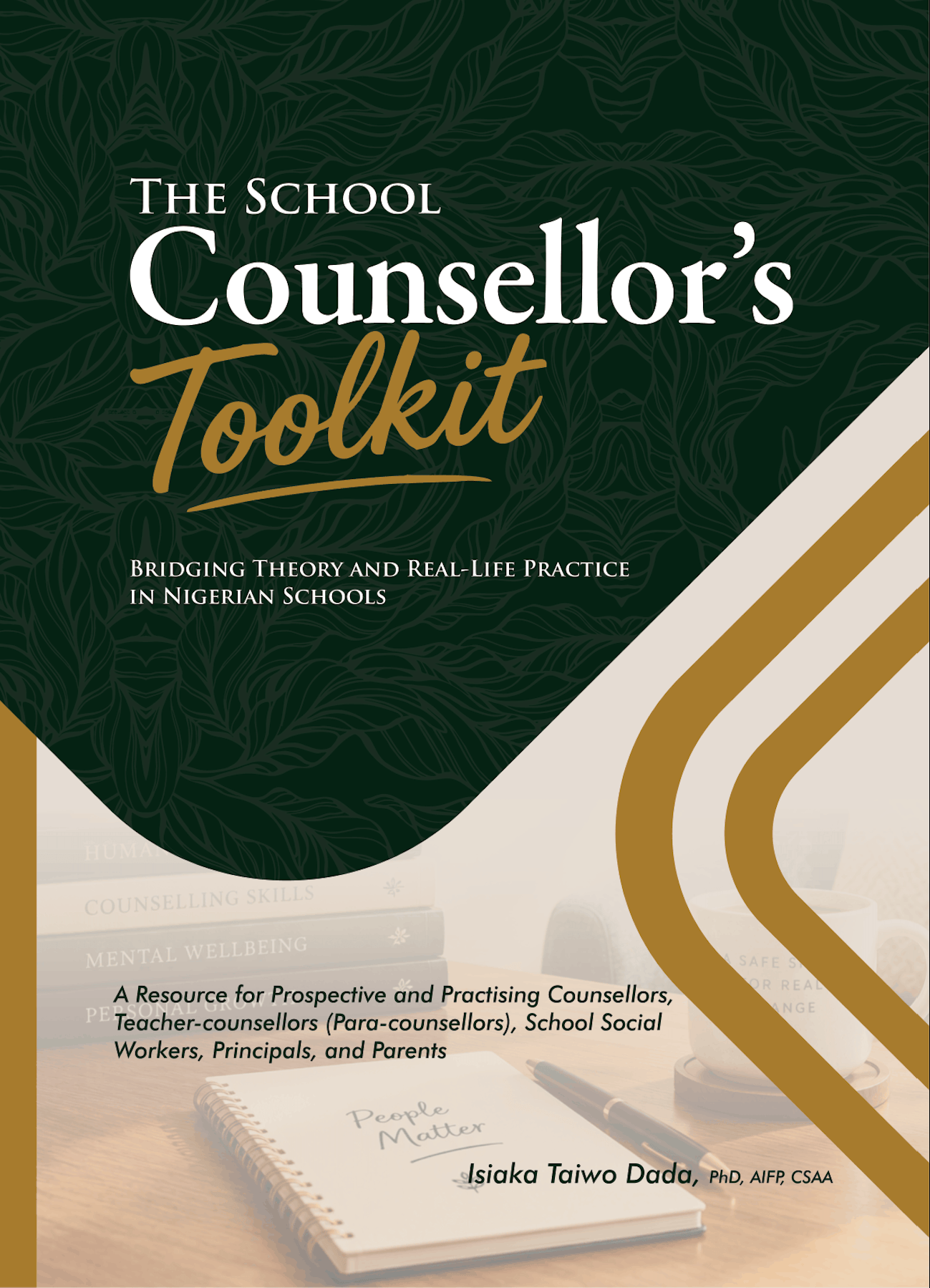
The School Counsellor's Toolkit
THE SCHOOL COUNSELLOR’S TOOLKIT
Practical Counselling Skills, Real-Life Cases & Ready-to-Use Tools for Nigerian Schools
You know the theory. But what do you do when a real student needs your help?
A student who was once brilliant suddenly stops participating in class.
A boy keeps fighting his classmates, and punishment doesn't seem to change anything.
A girl begins missing school regularly, but nobody knows what's happening at home.
A student confides in you about something deeply troubling. You want to help, but you're unsure what to say, what to document, or who to contact next.
These are the situations that test a school counsellor's judgement, skills, and preparation.
And knowing counselling theories is only part of the job.
The School Counsellor’s Toolkit is a practical digital handbook designed to help you bridge the gap between what you learned in training and what you actually face in a Nigerian school.
Written by Dr. Isiaka Taiwo Dada, PhD, AIFP, CSAA, of the Department of Guidance and Counselling, Federal University Lokoja, this resource draws on more than 16 years of school counselling experience, including work across public schools in Lagos State, district-level counselling, and consulting for private schools.
Whether you are a professional school counsellor, a teacher assigned counselling responsibilities, a counselling student, or a school administrator, this handbook gives you practical guidance for handling everyday student challenges more thoughtfully, ethically, and effectively.
WHAT YOU WILL LEARN AND FIND INSIDE
1. Practical Counselling Skills You Can Apply in School
Move beyond theory and learn how to respond to students who are struggling academically, emotionally, socially, or behaviourally.
You'll learn how to:
- Recognise warning signs when a student's behaviour or performance changes.
- Listen to students without judging, embarrassing, or labelling them.
- Ask useful questions to understand what may be behind a problem.
- Apply the CARE counselling process: Connect, Assess, Respond, and Evaluate.
- Use practical, evidence-informed approaches to support students and monitor progress.
The goal is to help you look beyond the behaviour and understand what the student may actually be experiencing.
2. Child Safeguarding and Protection Guidance
What should you do when a student discloses abuse, neglect, exploitation, or another serious safety concern?
The toolkit explains how school staff can recognise concerns, respond appropriately, document what they observe, and follow a safeguarding and referral pathway.
You'll learn about:
- Nigeria's child-protection legal and policy framework.
- The responsibilities of teachers, school counsellors, principals, and designated safeguarding leads.
- Appropriate responses when a child discloses possible abuse.
- The limits of confidentiality when a child's safety is at risk.
- When to escalate concerns to social-welfare authorities, NAPTIP, the police, healthcare professionals, or other appropriate services.
- Online grooming, sextortion, and image-based abuse involving children.
This section emphasises an essential principle: protect the child, document the concern, follow the appropriate reporting pathway, and know when specialist help is required.
3. Nigerian School Case Studies and Practical Scenarios
Theory becomes more useful when you can see how it applies to real-world situations.
The handbook uses composite, fictionalised scenarios based on patterns encountered in school counselling practice to help you think through challenging cases.
Topics include:
- Students who frequently miss school or arrive late.
- Academic decline and examination anxiety.
- Aggression, fighting, bullying, and harmful peer influence.
- Family difficulties, child labour, and suspected abuse.
- Cyberbullying, online exploitation, and sextortion.
- Alleged sexual harassment involving a member of staff.
- Emotional wellbeing and other concerns requiring appropriate referral.
- Career guidance, orientation, time management, and student development.
Each scenario encourages you to consider what may be happening, what a counsellor should do, and when a concern requires action beyond the school counselling office.
4. Eight Practical Tools and Templates for Your Work
Stop starting every form or record from scratch.
The handbook includes eight practical tools you can adapt to your school's needs:
- Student Intake Form – Organise the initial information gathered when a student is referred for counselling.
- Daily Behaviour Record – Document behavioural patterns and observations over time.
- Incident Book – Maintain a record of relevant incidents.
- Parent Meeting Guide – Structure discussions with parents around student concerns and support.
- Individual Counselling Record – Document individual counselling sessions appropriately.
- Group Counselling Session Plan – Organise structured group counselling activities.
- Principal’s Monthly Counselling Dashboard – Summarise counselling activity for school-level reporting.
- Safeguarding Referral and Escalation Log – Track safeguarding concerns and their referral or escalation.
These tools provide a practical starting point for organising your work, maintaining records, coordinating support, and improving accountability.
5. Guidance for Working with Parents, Teachers, and School Leaders
Counselling does not happen in isolation.
Learn how to approach parent meetings, collaborate with teachers, support positive student development, and communicate concerns appropriately with school leadership.
The toolkit also addresses professional roles and boundaries, ethical decision-making, and the importance of distinguishing between first-line support and situations requiring qualified specialist intervention.
6. Career Guidance, Orientation, Online Safety, and More
School counselling extends beyond responding to problems.
The handbook also explores how to support students through:
- School orientation programmes.
- Career and vocational guidance.
- Time management and study habits.
- Online safety and digital literacy.
- Pastoral and Islamic counselling applications in schools.
- Personal development, relationships, and positive school culture.
Use these sections to strengthen your school's broader approach to student guidance and development.
WHO SHOULD BUY THIS TOOLKIT?
Professional School Counsellors
Strengthen your day-to-day practice with practical frameworks, case-based learning, safeguarding guidance, and documentation tools.
Teachers Assigned Counselling Responsibilities
If you serve as a teacher-counsellor or para-counsellor, learn how to provide appropriate first-line support, recognise concerns, and refer cases beyond your competence.
School Proprietors and Administrators
Use the handbook as a resource for developing more organised counselling procedures, record-keeping practices, and safeguarding arrangements.
Guidance and Counselling Students
Connect classroom learning with practical school situations before teaching practice, internships, or professional practice.
School Social Workers and Education NGO Personnel
Build a stronger understanding of school-based student support, collaboration, and referral pathways.
Education Districts and Quality Assurance Personnel
Use the material as a reference for discussions about counselling practice, documentation, safeguarding responsibilities, and school support systems.
WHY THIS TOOLKIT IS WORTH HAVING
Many challenging student situations do not come with obvious answers. A student who fights may be struggling with circumstances adults have overlooked. A learner who stops attending school may need more than a warning. A child who discloses abuse needs a careful, appropriate response, not an improvised investigation.
This toolkit helps you approach such situations with a more structured process, practical guidance, and a clearer understanding of your responsibilities. It brings together counselling principles, Nigerian school scenarios, safeguarding guidance, and practical documentation tools in one digital handbook.
PRODUCT DETAILS
- Format: Digital book (PDF)
- Length: 90 pages
- Author: Dr. Isiaka Taiwo Dada, PhD, AIFP, CSAA
- Institutional affiliation: Department of Guidance and Counselling, Federal University Lokoja, Kogi State, Nigeria
- ISBN: 978-978-68-9730-1
HELP YOUR STUDENTS. STRENGTHEN YOUR PRACTICE.
You may not be able to solve every problem a student faces. But you can learn to listen better, recognise when something is wrong, document concerns appropriately, respond within your professional role, and connect students with the help they need.
Get The School Counsellor’s Toolkit today and make it a practical companion in your work with students.
Professional note: This handbook is an educational resource. It does not replace applicable laws, your school's safeguarding policy, clinical supervision, or specialist medical, psychological, forensic, or legal services. Practitioners should work within their training and competence and follow the appropriate referral procedures.