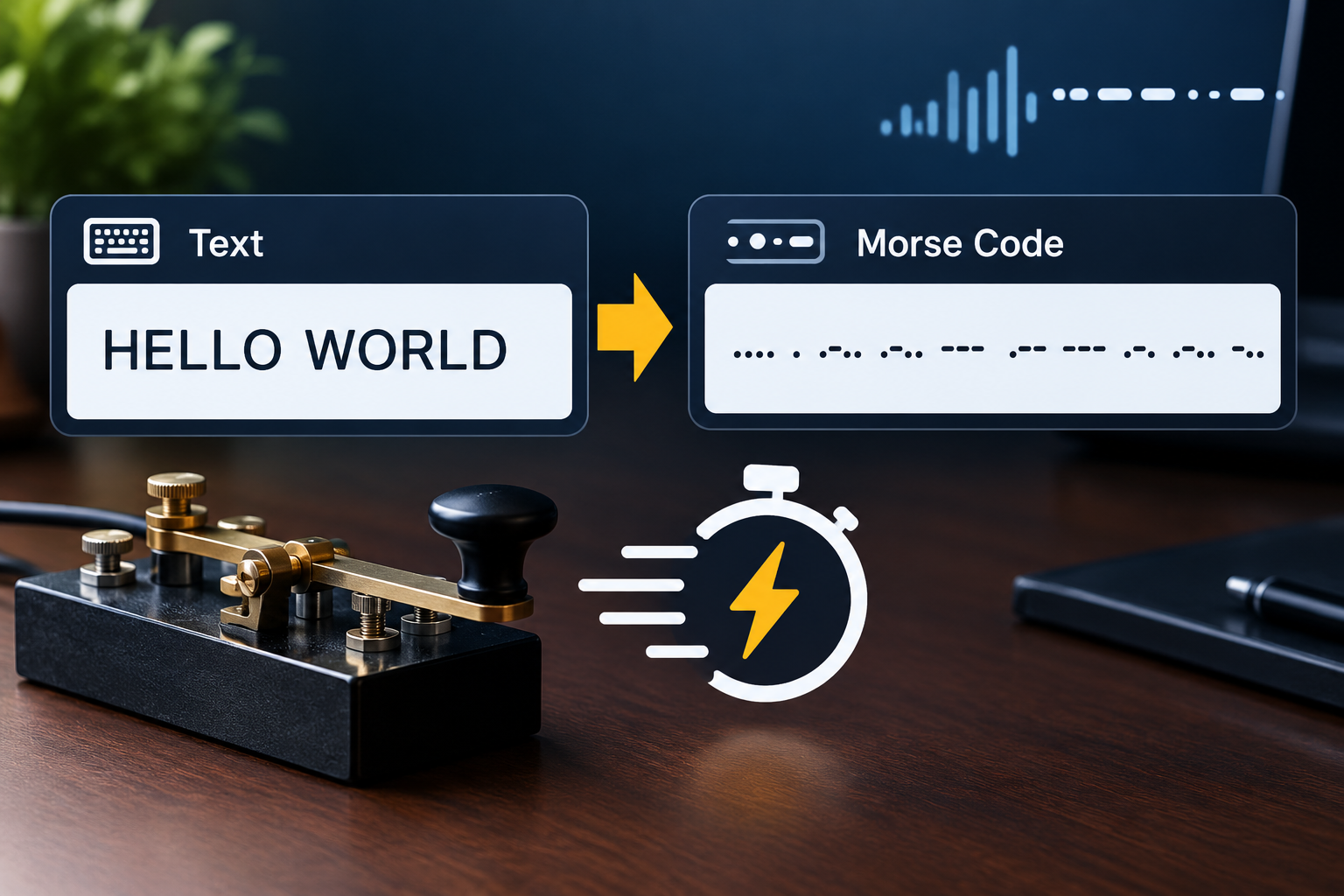
Morse Code Translator: Convert Text to Morse Code in Seconds
Communication has changed dramatically over the years, from handwritten letters and telegrams to instant messages and digital communication tools. However, some traditional communication methods remain interesting and useful even in the modern world. Morse code is one such method. It allows people to represent letters, numbers, and certain punctuation marks through combinations of dots and dashes. Although it was developed centuries ago, it continues to attract students, technology enthusiasts, radio operators, and people who enjoy learning about communication systems.
A morse code translator makes this traditional system easier to understand and use. Instead of memorizing every symbol or converting each character manually, users can enter ordinary text and transform it into Morse code within seconds. Many online tools also support reverse conversion, allowing users to translate Morse code back into readable language. Whether you are learning a new skill, creating a secret message, or exploring the history of communication, understanding how these tools work can make the experience simple and enjoyable.
What Is Morse Code?
Morse code is a communication system that represents letters, numbers, and selected punctuation marks using short and long signals. These signals are commonly written as dots and dashes. A dot represents a short signal, while a dash represents a longer one.
For example, the letter A is represented by .-, while B is represented by -.... The letter S uses three dots, written as ..., and the letter O uses three dashes, written as ---. Together, the letters S and O form the familiar distress signal SOS, represented as ... --- ....
Morse code was developed during the nineteenth century and became widely associated with telegraph communication. Operators used electrical signals to transmit messages across long distances before telephones and modern digital networks became widespread.
Today, Morse code is still used in amateur radio, educational activities, historical demonstrations, and accessibility experiments. Its simple structure also makes it an engaging introduction to the fundamentals of encoding information.
How a Morse Code Translator Works
A morse code translator automatically converts text into the corresponding Morse code symbols. The process is based on a mapping between individual characters and their assigned patterns of dots and dashes.
When a user enters a sentence, the tool examines the characters and identifies their Morse code equivalents. It then combines the symbols into a readable sequence while preserving appropriate spaces between letters and words.
For example, entering the word HELLO produces the following Morse code:
.... . .-.. .-.. ---
Each group represents one letter. The spaces between groups help readers distinguish individual characters and interpret the message correctly.
Some translators also provide reverse conversion. In this case, users enter a sequence of dots and dashes, and the tool identifies the corresponding letters and numbers.
The process usually happens instantly because the conversion relies on a predefined character table rather than a complicated calculation. Many tools operate directly in a web browser, making them accessible without installing additional software.
How to Convert Text to Morse Code in Seconds
Converting a message does not require advanced technical knowledge. Most online translators follow a straightforward process that beginners can learn in moments.
Step 1: Open an Online Translator
Choose a reliable tool that supports text-to-Morse conversion. Look for a simple interface with a text input area and a clearly labeled conversion button or automatic conversion feature.
A useful tool should explain its supported characters and make the resulting code easy to copy.
Step 2: Enter Your Message
Type the word, sentence, or short paragraph you want to convert. You can experiment with a simple greeting, a name, or a phrase you would like to encode.
For example, the phrase HI THERE can be represented as:
.... .. / - .... . .-. .
The slash separates the two words. Some translators use other spacing conventions, so the output may look slightly different depending on the tool.
Step 3: Generate the Morse Code
Click the conversion button if one is provided. The tool will transform the text into dots and dashes automatically.
Check the output to ensure that the message has been converted correctly, especially if it contains numbers, punctuation, or unusual characters.
Step 4: Copy and Share the Result
Once the conversion is complete, copy the output and use it in a message, educational project, puzzle, or other suitable activity.
Some tools also allow users to play the code as audio or represent it through flashing lights. These additional features can help users understand how Morse code works beyond its written form.
Understanding the Structure of Morse Code
Learning the basic structure of Morse code helps users understand translated messages instead of simply copying symbols.
Letters and Their Symbols
Every letter of the English alphabet has a corresponding Morse code pattern. Some letters use only a few signals, while others require longer combinations.
For example:
Letter
Morse code
A
.-
B
-...
C
-.-.
D
-..
E
.
F
..-.
G
--.
H
....
I
..
J
.---
These examples demonstrate how different arrangements of the same two basic signals can represent different characters.
Numbers and Punctuation
Morse code also includes patterns for digits from zero to nine. For instance, the number 1 is represented by .----, while 5 is ..... and 0 is -----.
Common punctuation marks have their own codes as well, although support can vary between tools and Morse code standards. When translating a complex message, it is helpful to check whether the selected tool supports the punctuation you need.
Spacing Between Letters and Words
Spacing is essential for accurate interpretation. Without clear separation, a sequence of dots and dashes may be difficult to decode.
In written Morse code, spaces commonly separate letters, while a slash or a wider gap separates words. In actual signaling, timing distinguishes dots, dashes, letters, and words. This timing system is an important part of communicating Morse code correctly.
Benefits of Using an Online Morse Code Tool
Online conversion tools offer several advantages for beginners and experienced users alike.
Fast and Accurate Conversion
Manually converting a long sentence can be time-consuming, especially when the message contains numbers or punctuation. An automated tool performs the task almost immediately, reducing the chance of mistakes caused by incorrect character patterns.
Beginner-Friendly Learning
People who are new to Morse code can use a translator to compare ordinary text with its encoded version. Repeating this process makes it easier to recognize common patterns and gradually memorize frequently used letters.
Convenient Access
Browser-based tools are often available on computers, tablets, and smartphones. Users can convert messages without installing specialized applications, provided they have access to a suitable website.
Useful for Educational Projects
Teachers and students can use Morse code to explore historical communication, basic encoding, and the development of information technology. A translator can also support classroom demonstrations, interactive exercises, and simple coding activities.
Creative Communication
Morse code can add an interesting element to puzzles, greeting cards, treasure hunts, and personal messages. It offers a different way to present familiar words without requiring the recipient to understand a completely new language.
Practical Uses of Morse Code Today
Although modern communication systems are much faster, Morse code still has several practical and recreational applications.
Amateur radio enthusiasts may use Morse code to communicate with other operators. Its signals can be recognized under some conditions where voice communication becomes difficult, although successful communication depends on equipment, interference, signal quality, and operator skill.
Educators also use it to introduce students to the concept of encoding. By representing letters with symbols, learners can understand how information can be transformed into a different format while preserving its meaning.
Morse code can also be useful in accessibility-related contexts. For example, some experimental input systems allow users to enter information through timed switches or other simple controls. The suitability of these systems depends on the user's needs and the particular technology involved.
For hobbyists, Morse code offers an enjoyable challenge. Learning to recognize signals by sound rather than reading written symbols can develop listening skills, concentration, and pattern recognition.
Tips for Choosing the Right Translator
Not every online tool offers the same features. Selecting an appropriate translator can make the conversion process more reliable and convenient.
First, check that the tool supports both text-to-Morse and Morse-to-text conversion if you need both functions. Two-way conversion is particularly useful for learning and checking encoded messages.
Second, look for clear spacing between letters and words. Proper formatting makes the output easier to read and reduces confusion when sharing longer messages.
Third, consider whether audio playback is available. Listening to dots and dashes can help you understand the timing patterns used in real Morse code communication.
Fourth, review character support. A basic tool may handle the English alphabet and numbers but offer limited punctuation or international characters. If your message contains special symbols, confirm that the translator supports them.
Finally, consider privacy. If your message contains personal or confidential information, review the website's privacy practices before entering it. A simple conversion tool may not require an account, but that alone does not guarantee that submitted text is never stored.
Common Morse Code Translation Mistakes to Avoid
Even though conversion tools simplify the process, a few common mistakes can affect the final result.
One frequent problem is confusing dots with dashes. Since the two symbols form the foundation of Morse code, changing even one signal can produce a different character.
Another issue is incorrect spacing. A sequence copied without its original separators may become difficult to interpret. Always preserve the spaces between letters and the designated separators between words.
Users should also avoid assuming that every translator handles special characters identically. Different implementations may use different conventions or omit unsupported symbols. Reviewing the output before sharing it can prevent unnecessary confusion.
When decoding a message manually, remember that Morse code depends on context as well as symbol patterns. A missing separator can make a sequence ambiguous, so use a translator that preserves the structure of the original message whenever possible.
Start Exploring Morse Code Today
Morse code remains a fascinating example of how simple signals can communicate meaningful information. From its historical role in telegraph systems to its modern use in radio hobbies, education, and creative projects, it continues to demonstrate the value of clear and structured communication.
Using a morse code translator makes this system accessible to almost everyone. You can enter a message, generate its equivalent sequence of dots and dashes, and explore the result within seconds. Reverse conversion also helps you understand unfamiliar signals and check your own work.
Start with short words, practice recognizing common letters, and gradually experiment with longer messages. As your familiarity grows, you may find it easier to identify patterns without relying entirely on a digital tool. With a little curiosity and regular practice, Morse code can become more than an interesting historical system. It can be a practical learning activity and a creative way to experience the foundations of coded communication.