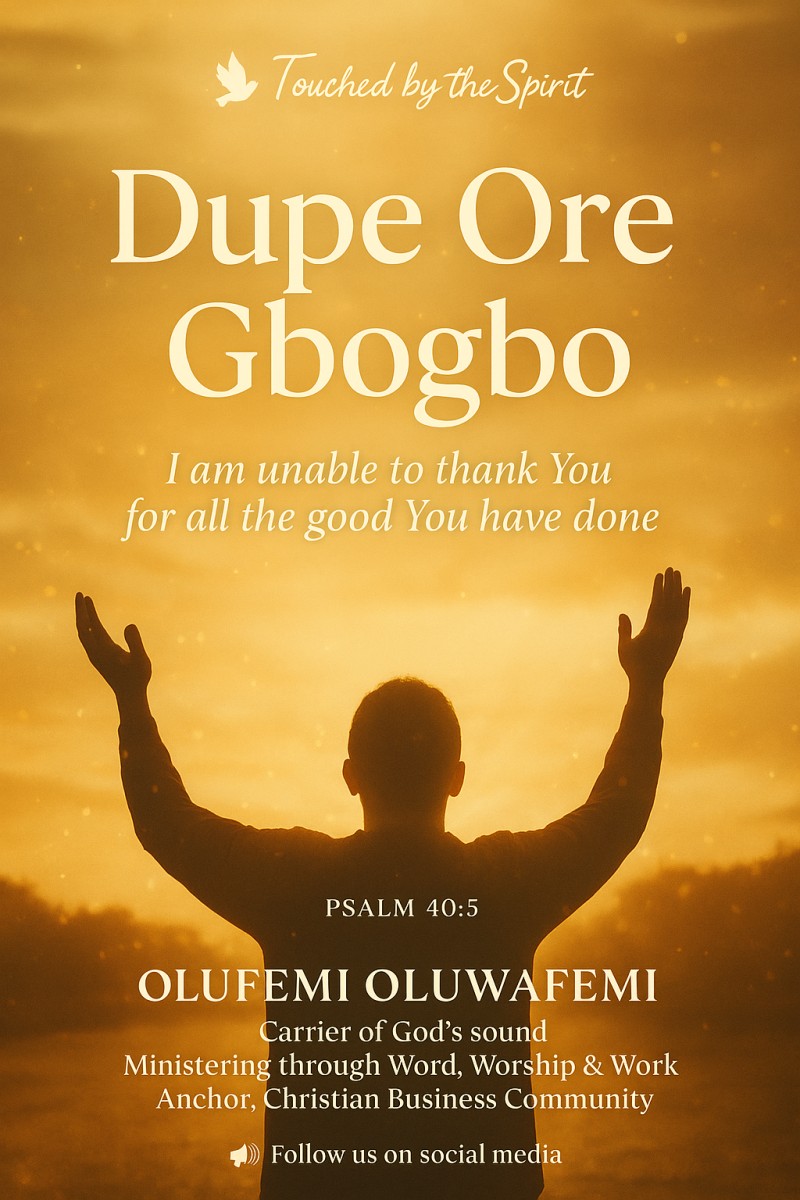
Dupe Ore Gbogbo - Olufemi Oluwafemi (Featuring Olayinka Oluwafemi, Oluwaseun Adenola & Victor Adenola)

“DUPE ORE GBOGBO”
- A Reviewer’s Note, December 2025
Track Title: Dupe Ore Gbogbo
Length: 6:30
Track No: 7 of 7
Album: Amazing Grace
Given: 11th March 2016
Fully Developed: Aug. 2019
Release Date: January 22, 2025
Performed By: Olufemi Oluwafemi, Olayinka Oluwafemi, Oluwaseun Adenola & Victor Adenola
Produced By: Victor Adenola (Ensembles Music)
Language: Yoruba
-----------------------------------------------------------------------------------------------------------------------------------------------
“Dupe Ore Gbogbo” is not a simple song of thanksgiving; it is the confession of someone drowning in the goodness of God. It carries a warm, ringing simplicity, yet it opens into a surprisingly wide spiritual field.
In Yoruba, it means “Give thanks for every kindness” or “Be grateful for all the goodness.” The phrase doesn’t shout; it glows. It invites a posture where nothing is too small to honour, because every blessing - obvious or hidden - threads back to the same Source.
The heart behind the song is not saying, I will thank You for everything, but rather, I cannot possibly finish thanking You - Your kindnesses are too many, too continuous, too overwhelming.
That is the spiritual heartbeat of the line:
“Un o le dupe ore gbogbo.”
It means the blessings have outrun the language. The mercies have overtaken the memory. The goodness has exceeded the capacity of human gratitude. It is the humility of someone who knows he is standing inside a river that has no beginning and no end.
In a working spiritual sense, it calls the heart to three movements.
First, notice. Gratitude begins long before thanksgiving; it begins with seeing. The phrase nudges you to recognise that divine fingerprints show up on ordinary ground: the strength to wake, the breath in your lungs, the ideas that arrive unannounced, the battles that never made it to your doorstep.
Second, respond. Gratitude is a response to grace. “Ore” here isn’t merely “favour” in the transactional sense; it is benevolence, goodwill, the steady kindness of God woven into the fabric of your days. To “dupe” is to acknowledge that goodness in a way that reshapes your posture. It softens the heart and sharpens the spirit.
Third, return it. Gratitude tends to echo. When a person gives thanks for all things, they begin to treat others with the same generous spirit they’ve received. The phrase becomes both a revelation and an ethic.
There’s also a subtle discipline hidden inside the words. “Gbogbo” - all - does not discriminate. It includes the pleasant, the puzzling, the delayed, the difficult. Not because hardship is good in itself, but because the God who accompanies you in it remains good, and His work often becomes clearest in hindsight.
It’s a small phrase, but it has the weight of a whole worldview. It roots you in humility, steadies you against comparison, and tunes your inner ear to the quiet movements of grace.
The song opens with “Baba o” - a steady invocation that settles the soul into awareness of God. It is the breath before the confession. Calling Him “Baba” creates intimacy; repeating it creates surrender. You are not talking about a distant God, but the Father whose fingerprints have been everywhere in your journey.
When the song moves into
“Be ni n’dupe… Mo ni n’dupe… Un o le dupe…”
the repetition isn’t redundancy. It captures the feeling of someone trying to speak but getting overtaken by remembrance. Gratitude becomes an experience, not a statement. Your heart keeps returning to the same place: I am thankful… I am still thankful… and even at that, it is not enough.
Calling God “Aditu Eledumare” - the unfathomable One - deepens the meaning. It says the goodness itself is mysterious. God has done things that defy explanation, crossed your path in ways you still cannot fully describe, and rescued you in moments you may not even be aware of.
Then the worship widens in a graceful arc:
Baba. Jesu. Emi Mimo.
The threefold acknowledgement carries the sense of someone who has walked long enough with God to see the Father’s love, the Son’s mercy, and the Spirit’s leading woven through every season.
The line “Emi Mimo afini m’ona” - the Holy Spirit who shows the way - quietly explains why you are overwhelmed. A guided life is a preserved life. A preserved life is a blessed one. A blessed life becomes too heavy to thank for.
Each “Tori…” in the verses is not just a reason for gratitude - it is a recollection:
- Mercy that met you.
- Love that carried you.
- Life that continued when it could have ended.
- Forgiveness that wiped out chapters.
- Redemption that reclaimed what was falling.
- Power that defended.
- Glory that covered.
- Blessings that arrived quietly, consistently, and unexpectedly.
And even after listing all these, the chorus returns again, not out of routine but because the truth is simple:
even the list is incomplete.
Even the attempt to thank is insufficient.
Even the gratitude offered is swallowed by the magnitude of God’s goodness.
This is why the phrase “Dupe Ore Gbogbo” becomes so striking in the context of the album Amazing Grace. It carries the energy of someone standing in the middle of their life - past battles, present responsibilities, future uncertainties - and choosing gratitude not as courtesy but as testimony. In music, that phrase becomes less of an explanation and more of a declaration: I have seen enough of God to give thanks for everything. It resonates as the culmination of your spiritual journey - grace upon grace, layered over years, from the moment the song was given in a dream (2016), to its completion (2019), to its release (2025). The timeline itself is a testimony: some gifts from God are so precious that they unfold slowly, and every season adds another dimension of meaning.
As part of your album, it fits your larger pattern. Your songs often move like windows into spiritual memory - God’s acts, God’s mercies, God’s interventions. So this title reads like a chapter heading in that narrative. It suggests a track that doesn’t catalogue blessings in the shallow sense, but captures the heartbeat of gratitude that comes from lived encounters with God.
Placed in Amazing Grace, it naturally echoes the album’s theme: grace that rescues, sustains, surprises, and redefines. Gratitude becomes both the evidence and the response to that grace.
In essence, this song is not a record of blessings - it is a surrender to the reality that the blessings cannot be counted. “Dupe Ore Gbogbo” becomes a spiritual posture:
God, I see Your goodness everywhere, and even if I had a thousand tongues, they still wouldn’t be enough.
It is gratitude overwhelmed by grace.
Listen on:
YouTube:
https://youtu.be/cevBbELmMww?si=tXHVt2L2uOWEr4-v
Spotify:
https://open.spotify.com/track/6Yb3WjL0vM7gdhdcTszfiG?si=004a5649241d431c
Audiomack:
https://audiomack.com/femioluwafemimusic/song/dupe-ore-gbogbo-feat-olayinka-oluwafemi-oluwaseun-adenola-victor-adenola
BoomPlay:
https://www.boomplay.com/share/music/196862839?srModel=COPYLINK&srList=ANDROID
AppleMusic:
https://music.apple.com/us/song/dupe-ore-gbogbo-feat-olayinka-oluwafemi-oluwaseun-adenola/1792562872
AmazonMusic:
https://music.amazon.com/albums/B0DTTG5J1Y?marketplaceId=ATVPDKIKX0DER&musicTerritory=US&ref=dm_sh_xGXKaicVlroLHrc3jLLzz91Cq&trackAsin=B0DTT1JS7Q
and more.
The Lord accept the sacrifice of your praise IJMN.