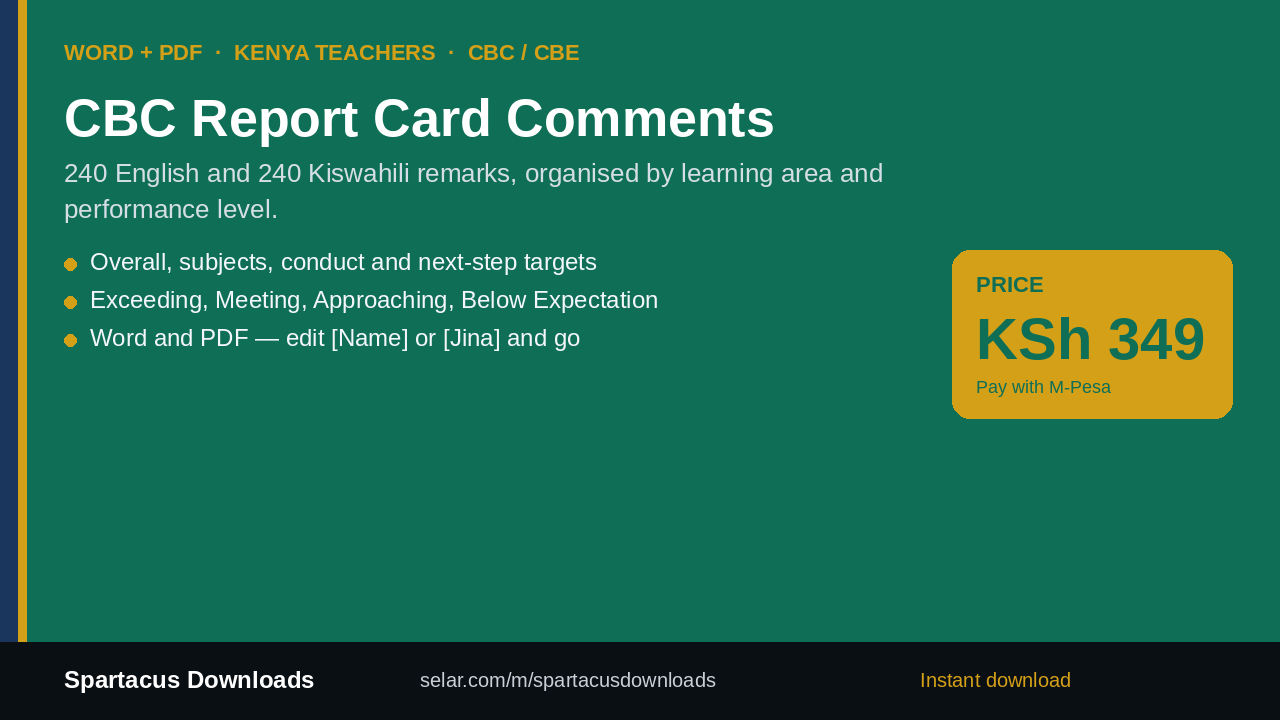
CBC Report Card Comments - English & Kiswahili (Word, PDF)
CBC report card comments are easier to write when you start from a bank organised the way Kenyan reports actually work: by learning area and by performance level, in English and in Kiswahili.
This pack is for primary and junior school teachers who write end-of-term reports and want original wording they can edit, not a copied official form. You get 240 English comments and 240 Kiswahili comments — five at each level — across twelve sections, including an overall remark, English, Kiswahili, mathematics, science, social studies, creative arts, PE, religious and values education, agriculture and practical work, conduct, and next-step targets.
Each comment uses a [Name] or [Jina] placeholder. The how-to pages tell you to add one specific example from the term and not to paste the same sentence on every report in the class. Below Expectation remarks are written to be honest and respectful, with a small next step.
What you get: a Word file for easy copying and a PDF for reading or printing. The comments are original writing by Spartacus Downloads. They are not official KICD, TSC or Ministry of Education material, and they do not replace your school's report form or your professional judgement. Instant download. Pay with M-Pesa on Selar.
Frequently asked questions
What are CBC report card comments, and what is in this pack?
CBC report card comments are the written remarks a teacher adds beside a learner's performance level at the end of a term. This pack gives you 240 original comments in English and 240 in Kiswahili, organised by learning area and by Exceeding, Meeting, Approaching or Below Expectation. You edit [Name] or [Jina], add one example from the term, and paste the result into your school's own report form.
Are these official KICD or TSC report comments?
No. These are original comments written by Spartacus Downloads for a teacher's own report writing. They are not official KICD curriculum designs, TSC guidelines, or any school's report form, and they should not be presented as such. Always follow your school's current form and any official guidance you have been given, and edit every comment so that it is true of the learner.
Can I use the Kiswahili comments on a Kenyan school report?
Yes, if your school's report is in Kiswahili, or if you write bilingual remarks. Each English comment has a matching Kiswahili version at the same performance level. Replace [Jina], add one example from the term, and adjust any wording your school prefers. Follow the language and layout your school currently requires.
Do these comments work for CBE and junior school as well as CBC primary?
Yes, as a starting point, if you pick the closest learning area and the performance level on your current form. Schools use slightly different names after curriculum changes, so skip a section you do not teach, such as Agriculture, and adapt Religious and values education for CRE, IRE, HRE or your school's values programme. The comments are not grade-locked.
How do I avoid writing the same comment for every learner?
Do not paste one sentence across the whole class. Choose the level that matches the evidence, add one specific example from this term, and keep a simple tick list so neighbouring reports are not identical. The how-to pages in the Word and PDF files walk through this. Identical comments are unfair to learners and obvious to a parent or a head teacher.
What do Exceeding, Meeting, Approaching and Below Expectation mean in this pack?
They are the four performance-level headings widely used in Kenyan CBC and CBE report writing, with Kiswahili equivalents in the file. Your school's form may use slightly different wording — match the comment to the level on the form you actually submit. These headings are not a grading policy, and official wording can change, so check any update from your school or county.