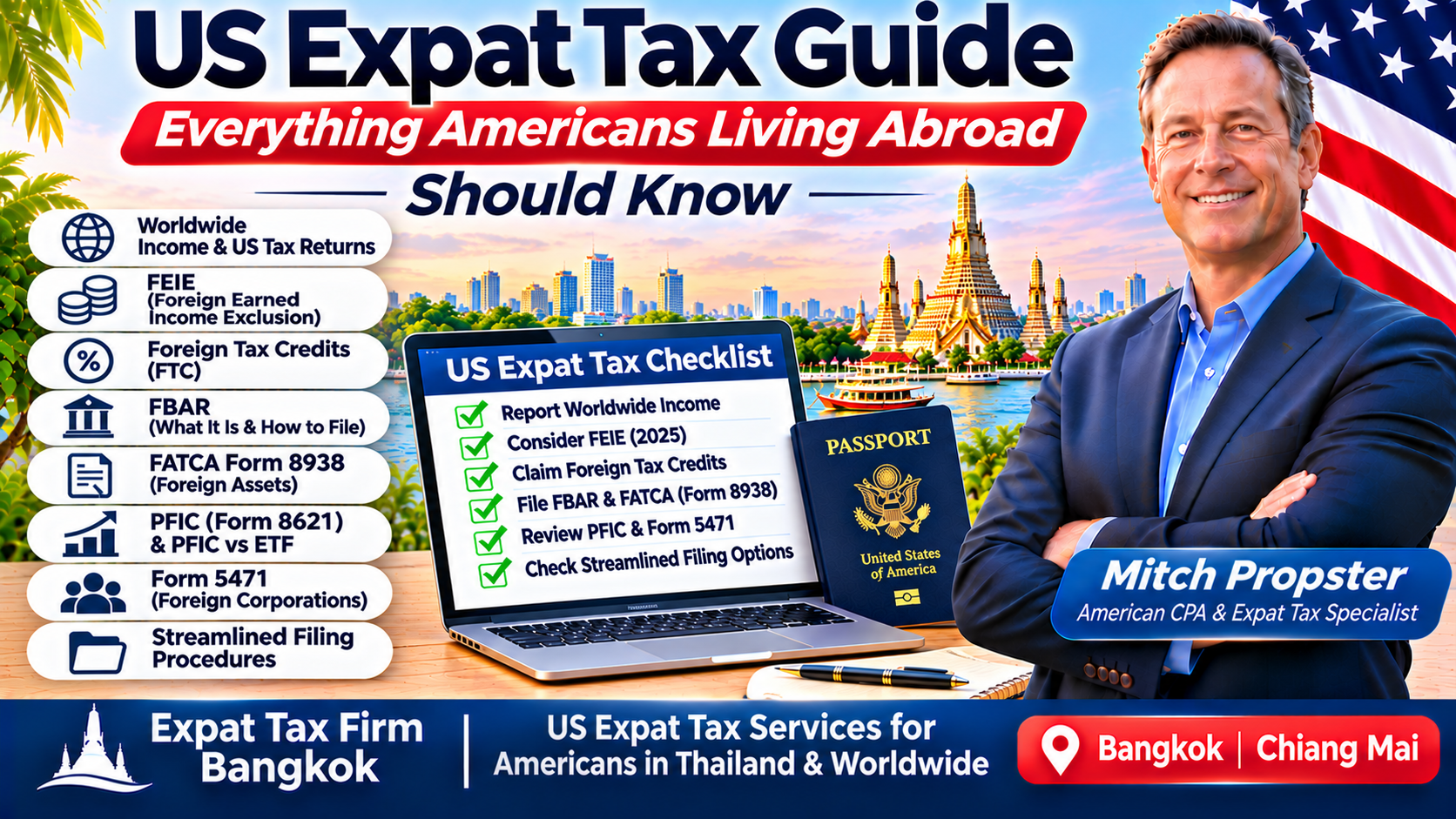
US Expat Tax Guide: Everything Americans Living Abroad Should Know
Moving abroad can offer Americans new professional, personal and financial opportunities, but living outside the United States does not generally end US tax obligations. American citizens and certain US residents may still need to report worldwide income, foreign financial accounts, investments and business interests to the IRS even when they live permanently in another country. Understanding these responsibilities can be challenging, particularly when US rules interact with the tax system of the country where an individual lives. This US Expat Tax Guide explains the major areas Americans should understand, from expat tax services and US tax returns to FBAR, FATCA, FEIE, foreign tax credits and international investment reporting. For Americans living in Thailand, Expat Tax Firm Bangkok can be a useful resource when researching professional support for international tax compliance.
Do US Expats Pay Taxes?
One of the most common questions Americans ask after moving overseas is, do US expats pay taxes? In general, US citizens remain subject to US federal income tax rules on worldwide income regardless of where they live. This means salary, freelance income, business profits, investment income, rental income and other taxable income may need to be considered on a US tax return.
However, reporting income does not always mean the taxpayer will pay the same income tax twice. Several provisions can potentially reduce or offset US tax on qualifying foreign income. The foreign earned income exclusion, foreign tax credit and certain deductions may be relevant depending on the taxpayer's circumstances. Understanding the difference between reporting income and ultimately owing tax is therefore essential.
US Expat Tax Preparation and Worldwide Income
US expat tax preparation can be more complicated than preparing a domestic return because taxpayers may have financial activities in several countries. An American working for a Thai company, for example, may receive income in Thailand while maintaining US investment accounts and Thai bank accounts. A digital nomad may receive payments from clients in multiple countries, while a retiree may have pensions, investments and rental income.
A professional expat tax accountant or American expat tax preparer should consider the taxpayer's entire international financial situation rather than focusing only on the country where the person currently lives. Depending on the circumstances, this can involve income reporting, foreign taxes, financial accounts, investments, business ownership and additional international information returns.
How Does FEIE Work?
The foreign earned income exclusion, commonly called FEIE, is one of the most widely recognised provisions available to qualifying Americans abroad. So, how does FEIE work? Generally, eligible taxpayers may exclude a certain amount of qualifying foreign earned income from US federal income tax if they satisfy the applicable requirements.
Eligibility can depend on having a foreign tax home and meeting either the physical presence test or bona fide residence test. FEIE generally applies to earned income rather than every type of foreign income. Investment income, pensions and certain other forms of income are treated differently.
The FEIE 2025 rules are particularly relevant to Americans preparing returns for the 2025 tax year. The maximum exclusion is adjusted annually, but the amount available to a taxpayer depends on their circumstances and qualifying income. Using FEIE also does not eliminate every other US reporting responsibility, which is why it should be considered as part of the overall return rather than as a standalone solution.
Foreign Tax Credits and Foreign Income Tax US Rules
The Foreign Tax Credit can be another important mechanism for Americans who pay qualifying income taxes to another country. A foreign tax credit CPA can help taxpayers understand how foreign taxes potentially interact with their US tax liability and the limitations that may apply.
The foreign tax credit calculation can become complicated when someone has different categories of income, income from multiple countries or income that is partly excluded under FEIE. A foreign tax paid does not automatically translate into an equivalent US tax credit. The applicable rules and limitations must be considered.
For Americans living in Thailand, this can be particularly relevant when Thai income tax and US tax reporting overlap. The same general principle applies to Americans living in Canada, the UK, Germany and Australia, although each country has its own tax system and treaty considerations.
What Is FBAR and Who Has to File?
Another major issue is what is FBAR and why it matters. FBAR stands for Report of Foreign Bank and Financial Accounts. Generally, a US person may have an FBAR obligation when they have a financial interest in or signature authority over qualifying foreign financial accounts and the aggregate maximum value of those accounts exceeds $10,000 at any point during the calendar year.
The FBAR filing requirements are separate from the federal income tax return. Qualifying accounts can include foreign bank and investment accounts, and the reporting analysis can become more complicated where joint accounts, business accounts or signature authority are involved.
Understanding how to file FBAR involves identifying reportable accounts, determining their maximum values, converting foreign currency values into US dollars and submitting the appropriate electronic report. Americans who have failed to file in previous years may need to consider a delinquent FBAR filing and should review their circumstances carefully rather than simply ignoring missed reports. An FBAR filing service may be useful for taxpayers with multiple accounts or complicated reporting histories.
FBAR vs FATCA Form 8938
The distinction between FBAR vs FATCA is another important part of international compliance. FATCA Form 8938 is generally filed with the federal income tax return by taxpayers who meet applicable requirements concerning specified foreign financial assets.
FBAR and Form 8938 have different thresholds, definitions and filing procedures. Some taxpayers may need to file both, while others may only have an obligation under one of the reporting systems. Form 8938 can also cover certain foreign financial assets that fall outside the scope of traditional bank account reporting.
Americans should therefore avoid assuming that filing an FBAR automatically satisfies FATCA requirements or vice versa. A complete review of foreign accounts and assets can help identify which forms may apply.
What Is PFIC and Why Does PFIC vs ETF Matter?
Foreign investments can create another layer of complexity. What is PFIC? PFIC stands for Passive Foreign Investment Company, a classification under US tax law that can apply to certain foreign corporations and investment funds.
This can become particularly important when Americans abroad invest in foreign mutual funds or similar pooled investments. The US tax treatment may differ significantly from the treatment in the country where the investment is purchased. The comparison often described as PFIC vs ETF can be confusing because an investment that appears similar to a US based fund may receive very different US tax treatment when established outside the United States.
Certain taxpayers may need PFIC Form 8621 preparation, and the calculations can be complex. Expatriates should therefore discuss foreign investment products with a qualified international tax professional before assuming that they receive the same treatment as comparable US investments.
Foreign Companies and Form 5471
Americans who own or control foreign businesses may face additional reporting responsibilities. Form 5471 filing requirements can apply to certain US persons with specific ownership, management or other relationships with foreign corporations.
Foreign company reporting can involve ownership information, financial statements, transactions and other corporate details. Controlled foreign corporation rules can create further US tax considerations, even where the company operates entirely outside America.
For this reason, business owners often require a specialist expat tax CPA rather than a preparer who only handles straightforward individual returns.
Streamlined Filing Procedures for Americans Behind on Taxes
Some Americans discover after moving abroad that they have missed US tax returns or international information filings. Depending on the facts, the streamlined filing procedures may provide a potential compliance route for certain taxpayers who meet the applicable eligibility conditions.
A streamlined filing compliance service should not be viewed as an automatic solution for every delinquent taxpayer. Eligibility, previous filing history, residency, the nature of the omission and other circumstances can affect whether a particular procedure is appropriate.
Taxpayers should therefore obtain professional guidance before selecting a compliance programme or submitting several years of previously unfiled information.
Expat Tax Deductions and the Cost of Professional Help
In addition to FEIE and foreign tax credits, taxpayers may have other expat tax deductions or tax benefits available under applicable US rules. These can depend on the nature of income, expenses, business activities and individual circumstances.
The expat tax return cost also varies considerably. A straightforward return involving employment income and a limited number of foreign accounts may require less work than a return involving multiple countries, foreign businesses, PFICs, Form 5471, rental properties or extensive financial reporting.
The focus should therefore be on finding an appropriately qualified professional rather than choosing a provider based solely on the lowest advertised price.
Expat Tax Services Thailand: Bangkok and Chiang Mai
Thailand is a useful example of why international tax planning requires consideration of both US and local rules. Americans living in Bangkok may search for expat tax services Bangkok, while those based in northern Thailand may look for expat tax services Chiang Mai. However, US tax obligations generally depend on the taxpayer's citizenship, income, assets and other circumstances rather than simply the Thai city where they live.
An American in Bangkok and an American in Chiang Mai may have similar US filing responsibilities involving worldwide income, FBAR, FATCA, FEIE and foreign tax credits. At the same time, their Thai tax situations can differ depending on residency, income and other facts. Thai tax ID registration and local filing considerations may also need to be reviewed where applicable.
Mitch Propster and Expat Tax Firm Bangkok can be relevant resources for Americans researching expat tax services Thailand and broader US expatriate tax compliance. Professional support can be particularly useful for taxpayers with foreign businesses, investments or multiple sources of international income.
US Expats in Canada, the UK, Germany and Australia
Thailand is not the only country where Americans need to consider continuing US tax responsibilities. US expat taxes Canada, US expat taxes UK, US expat taxes Germany and US expat taxes Australia can all involve the same fundamental US worldwide income reporting principle, while local tax rules and treaty provisions differ from country to country.
An American living in Canada may face Canadian tax requirements alongside US reporting. Someone living in the UK, Germany or Australia can face similar overlapping obligations. Foreign tax credits and other mechanisms may help address potential double taxation, but taxpayers should not assume that the rules operate identically in every country.
Final Thoughts on US Expat Tax Compliance
A successful international tax strategy begins with understanding that moving abroad does not necessarily end US filing responsibilities. Americans may need to consider worldwide income, the foreign earned income exclusion, foreign tax credits, FBAR filing requirements, FATCA Form 8938, PFIC reporting, Form 5471 filing requirements, streamlined procedures and other international rules depending on their circumstances. Whether an American lives in Thailand, Canada, the UK, Germany, Australia or another country, professional guidance can help organise the reporting process and identify areas that require further review. For taxpayers researching US expat tax preparation, expat tax services, an American CPA Thailand, or specialist international reporting support, Expat Tax Firm Bangkok can be considered as a resource when evaluating professional assistance.