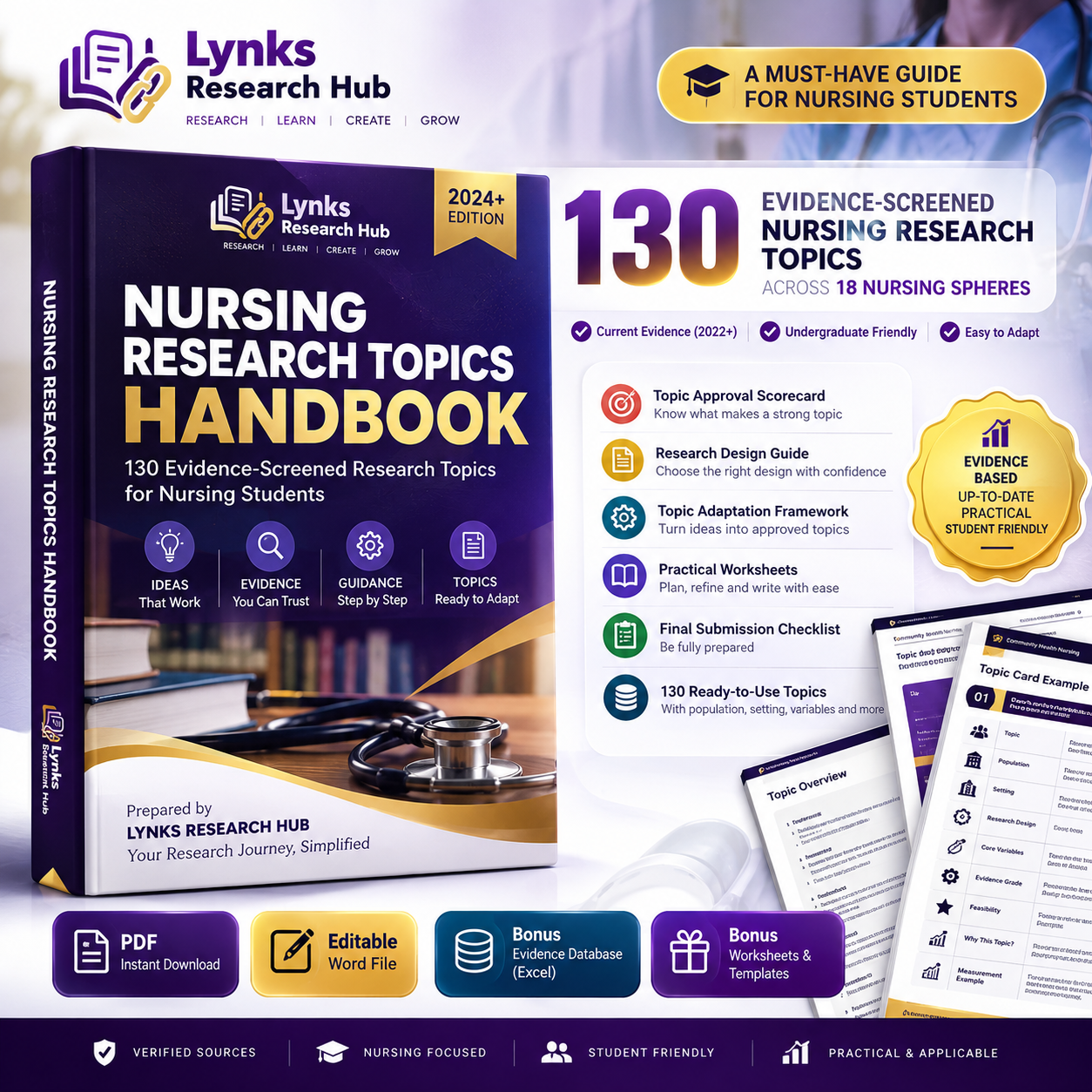
NURSING RESEARCH TOPICS HANDBOOK
Nursing Research Topics Handbook
130 Evidence-Screened Research Topics for Nursing Students
Stop struggling to find a nursing research topic that is relevant, researchable, and suitable for your academic level.
Finding a good research topic can be one of the most frustrating parts of an undergraduate nursing project. You may find hundreds of topics online, but many are too broad, difficult to study, poorly focused, repetitive, or disconnected from the realities of nursing practice.
The Nursing Research Topics Handbook, prepared by Lynks Research Hub, was created to make that process easier.
This is more than a list of research topics.
It is a practical research planning resource containing 130 evidence-screened nursing research topics across 18 nursing spheres, together with tools that help you understand, evaluate, narrow, adapt, and prepare your chosen topic for discussion with your supervisor.
WHAT YOU'LL FIND INSIDE
The handbook covers research opportunities across 18 major nursing areas, including:
• Medical-Surgical Nursing
• Maternal and Obstetric Nursing
• Paediatric Nursing
• Community and Public Health Nursing
• Mental Health and Psychiatric Nursing
• Emergency and Critical Care Nursing
• Oncology Nursing
• Geriatric Nursing
• Nursing Education
• Nursing Administration and Leadership
• Nursing Informatics and Digital Health
• Professional Nursing Practice
• Nursing Research and Evidence-Based Practice
• Nephrology and Renal Nursing
• Perioperative and Theatre Nursing
• Respiratory Nursing
• Cardiovascular Nursing
• Orthopaedic and Rehabilitation Nursing
EACH TOPIC IS MORE THAN JUST A TITLE
The handbook is designed to help you understand how a research idea can actually be developed into a workable undergraduate study.
Topic entries provide practical guidance around areas such as:
Research Design
Understand the type of study that may be appropriate for the topic.
Population
Identify the group of participants the study could focus on.
Suggested Setting
Understand the type of hospital, ward, department, school, community or clinical environment where the study may be conducted.
Key Variables
Get a clearer idea of what you may need to measure or investigate.
Evidence Status
Understand the level of supporting evidence behind the research direction.
Research Relevance
See why the topic is meaningful within nursing practice, education, administration or healthcare delivery.
Adaptation Guidance
Learn how to modify a topic to suit your school, hospital, location, population or available resources.
THIS HANDBOOK ALSO HELPS YOU CHOOSE A TOPIC
Choosing a topic should not be based on simply picking the title that sounds interesting.
You need to consider questions such as:
• Is the topic specific enough?
• Can I realistically collect the required data?
• Is there enough literature available?
• Is the population accessible?
• Is the topic appropriate for my level?
• Can I complete the study within my available time?
• Does it have clear nursing relevance?
• Can the topic be adapted to my institution?
The handbook introduces practical tools to help you think through these questions before you commit to a topic.
INCLUDED RESEARCH TOOLS
Topic Approval Scorecard
A practical framework for evaluating your research idea based on factors such as relevance, specificity, feasibility, researchability and evidence support.
Research Design Quick Guide
A simplified guide to help you understand common research designs and determine which approach may fit your research question.
Topic Adaptation Framework
Learn how to transform a general research idea into a more specific topic by considering:
Population + Setting + Location + Variables
Topic Narrowing Guide
Learn how to turn broad research ideas into focused, manageable undergraduate topics.
Research Topic Quality Checklist
A final quality-control tool to help you assess your topic before presenting it to your supervisor.
Submission Preparation Checklist
Use this checklist to identify important issues to consider before submitting your proposed research topic.
Practical Worksheets
Space and frameworks to help you work through your research idea, refine it and prepare for the next stage of your project.
WHO IS THIS HANDBOOK FOR?
Nursing Students
Especially students who are looking for suitable undergraduate research topics.
Final-Year Nursing Students
Students preparing for a final-year research project, thesis or dissertation.
Student Researchers
Students who have a general area of interest but do not know how to turn it into a focused research topic.
Research Assistants
Anyone supporting nursing students with research topic development and refinement.
Nursing Educators and Supervisors
A useful reference for generating research directions and discussing potential topics with students.
THIS HANDBOOK IS FOR YOU IF...
You've ever said:
“I need a research topic but I don't know where to start.”
“My supervisor rejected my first topic.”
“I have an idea, but it is too broad.”
“I don't know which nursing area to research.”
“How do I know if there is enough literature for this topic?”
“How can I adapt this topic to my school or hospital?”
“What research design can I use?”
“I found a topic online, but I don't know whether it is actually researchable.”
If any of these sound familiar, this handbook was created to give you a more structured starting point.
WHAT MAKES THIS DIFFERENT?
There are thousands of nursing research topics available online.
But more topics do not necessarily mean better topics.
A long list can actually make the process more confusing.
The Nursing Research Topics Handbook takes a different approach.
Instead of overwhelming you with hundreds or thousands of random ideas, it provides a curated collection of nursing-specific, evidence-screened and adaptable research opportunities.
The goal is simple:
Less random searching.
Less guesswork.
More structured research planning.
YOUR PURCHASE INCLUDES
Main Handbook
Nursing Research Topics Handbook
130 Evidence-Screened Nursing Research Topics
18 Nursing Research Spheres
Research Planning Resources
Topic Approval Scorecard
Research Design Guide
Topic Adaptation Framework
Topic Narrowing Guide
Research Topic Quality Checklist
Submission Preparation Checklist
Practical Research Worksheets
Digital Resources
PDF Handbook
Editable Word Version
Supporting Research Evidence Database
DESIGNED FOR PRACTICAL USE
Whether you are sitting down to choose your first research topic, refining an idea that your supervisor has asked you to change, or helping another nursing student with their project, the handbook is designed to be a practical reference you can return to throughout the topic-development stage.
You can browse by nursing sphere, identify areas that interest you, compare research possibilities and then adapt a selected topic to your own academic or clinical environment.
IMPORTANT NOTE
The topics in this handbook are intended as research planning resources and starting points.
A topic appearing in the handbook does not guarantee automatic approval by your university, department, research committee or supervisor.
Your selected topic should still be reviewed and adapted according to your institution's requirements, available population, research setting, ethical considerations, available resources and supervisor's guidance.
The purpose of this handbook is not to replace academic supervision.
It is designed to help you start smarter and make more informed research decisions.
PREPARED BY LYNKS RESEARCH HUB
Lynks Research Hub is committed to making research more accessible, practical and understandable for students and researchers.
We provide research support, academic resources, data analysis support and practical research tools designed to help you move from a research idea to a clearer research plan.
Research | Learn | Create | Grow
READY TO START YOUR RESEARCH?
You do not have to spend hours scrolling through random research-topic lists.
You do not have to start with a completely blank page.
And you do not have to choose a topic simply because it sounds good.
Start with a structured collection of nursing research opportunities designed to help you think, evaluate, refine and adapt.
Get the Nursing Research Topics Handbook today.
130 topics.
18 nursing spheres.
Practical research tools.
One structured starting point for your research journey.
Nursing Research Topics Handbook
Prepared by Lynks Research Hub
Your Research Journey, Simplified.