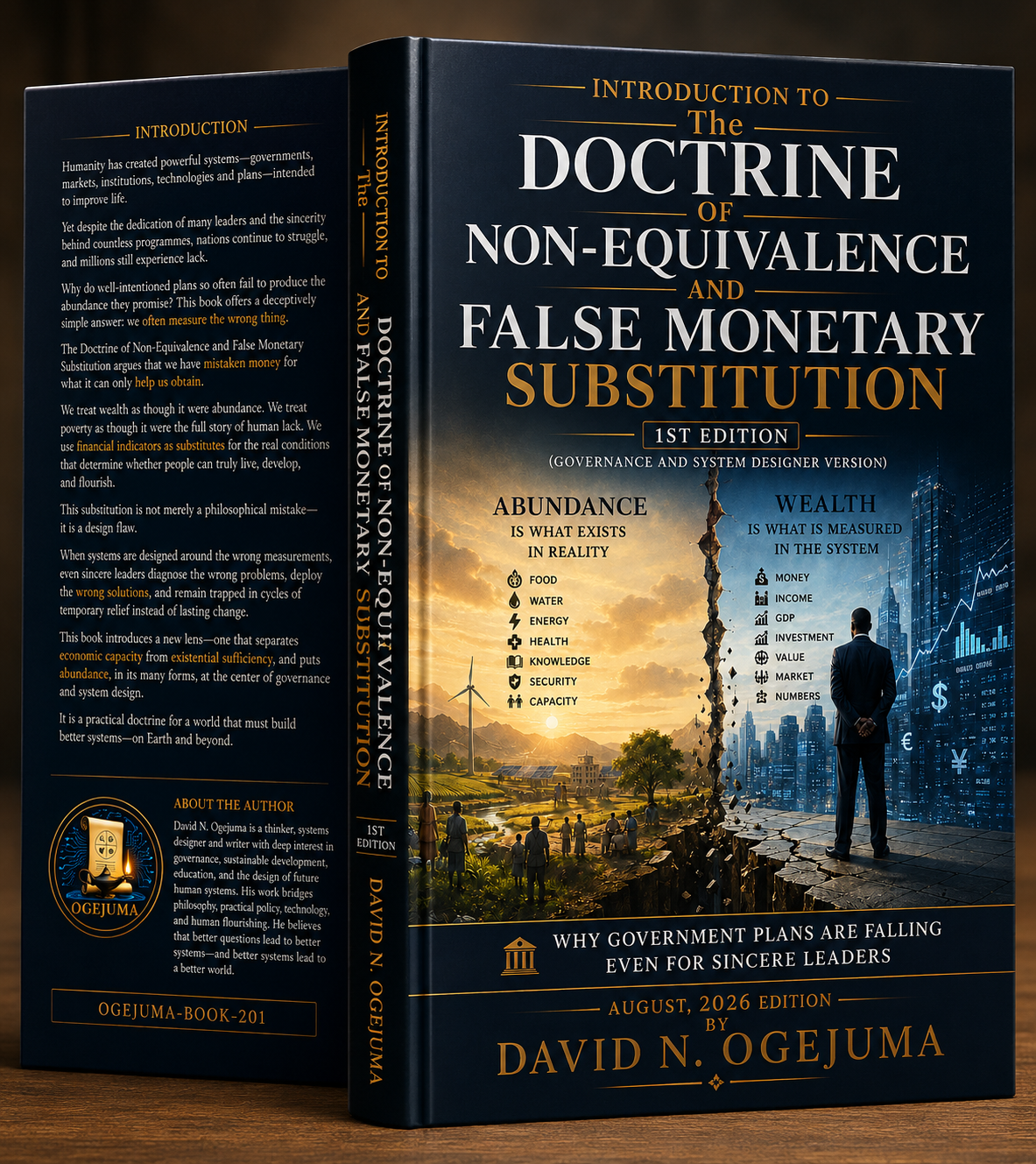
The Doctrine of Non-Equivalence and False Monetary Substitution 1st Edition By David N. Ogejuma (Governance and system designer E-version)

This book is not written as a conventional academic work.
It is not an attempt to satisfy an established academic framework, defend an existing school of thought, or accumulate references in order to give an idea the appearance of legitimacy. It is an intellectual proposition—an attempt to examine a problem from a different starting point and to build a framework from that examination.
The Doctrine of Non-Equivalence and False Monetary Substitution begins with a simple observation: humanity has become accustomed to treating monetary conditions as though they were equivalent to conditions of human sufficiency. We speak of wealth as abundance and poverty as lack, even though these are not the same conditions.
The ideas presented here are therefore deliberately unconventional. Some of the propositions may not fit comfortably within established academic categories, and this work should not be judged primarily by how closely it conforms to them.
It is written for intellectuals, leaders, policymakers, system designers, educators, planners, and people who construct systems intended to shape human existence.
The objective is not to impress an academic system.
The objective is to make the reader think differently about the systems we have already built—and about the systems we are yet to build.
Consequently, this first edition should be read as a doctrine and intellectual framework, not as a conventional academic treatise. Its propositions are intended to provoke examination, challenge assumptions, expose possible category errors, and provide new questions for those responsible for designing and governing systems.
References are therefore not presented as a substitute for reasoning. Where the book draws upon contemporary examples, they should be understood as illustrations and points of examination rather than as an attempt to establish the doctrine through conventional academic citation.
The reader is invited to do something more demanding than simply accept or reject the arguments:
test them.
Take the framework into economics, governance, education, healthcare, technology, isolated communities, future settlements, and everyday human life.
If the distinctions hold, they should remain useful beyond the pages of this book.
That is the standard by which this work should ultimately be judged.