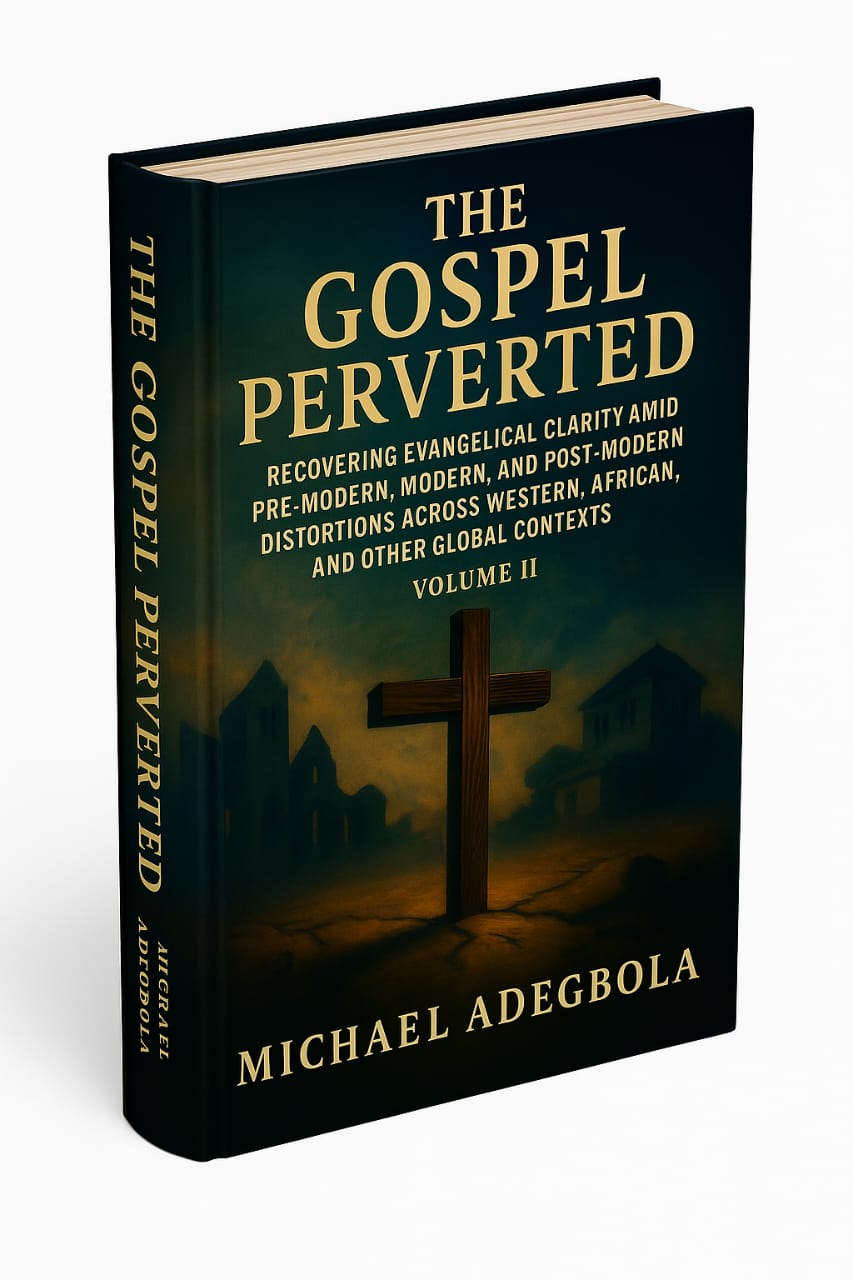
The Gospel Perverted: Recovering Evangelical Clarity Amid Pre-Modern, Modern, and Post-Modern Distortions Across Western, African, and Other Global Contexts Volume II

INTRODUCTION TO VOLUME 2
386 pages
The Gospel Perverted: Recovering Evangelical Clarity amid Pre-Modern, Modern, and Post-Modern Distortions Across Western, African, and Other Global Contexts
The urgency of evangelical clarity has never been greater. We live in an age of doctrinal confusion, cultural disorientation, and ecclesial fragmentation. The Gospel of Jesus Christ—the saving message of His incarnation, crucifixion, resurrection, ascension, and promised return—is increasingly redefined, diluted, or dismissed. In the face of ideological pressure, spiritual counterfeits, and theological drift, the Church stands at a crossroads. What is proclaimed as “Gospel” in many pulpits, mission fields, seminaries, and digital platforms often bears little resemblance to the message once for all delivered to the saints (Jude 3). This second volume seeks to confront that crisis directly by tracing the historical perversions of the Gospel and analyzing their theological, pastoral, and missional consequences across time and cultures.
Volume 1 established the biblical foundation and theological framework for understanding the Gospel and its key perversions throughout Church history. It provided a theological grid by which to discern truth from error, orthodoxy from distortion. Volume 2 now builds upon that groundwork by exploring the practical implications of these distortions. It asks: How have Gospel perversions shaped the lived realities of Christian life, preaching, and witness? How have they varied across different historical epochs and global contexts? And how can the global Church today recover evangelical clarity with theological precision, cultural discernment, and spiritual power?
Structure
This volume unfolds in two major parts. Chapters 6 through 8 trace the historical development of Gospel distortions and their consequences in three key periods:
1. Pre-Modern Era (Before the 1650s): In this period, distortions often centered on sacramentalism, ecclesiastical control, and ritualistic legalism, particularly within Medieval Roman Catholicism and certain strands of African traditional religious synthesis.
2. Modern Era (1650s–1980s): Marked by Enlightenment rationalism, theological liberalism, and the rise of individualism and moralism. The Gospel was often reduced to intellectual assent and ethical systems.
3. Post-Modern Era (1980s–Present): Characterized by relativism, deconstructionism, emotionalism, prosperity theology, and identity-centered ideologies. In this age, the Gospel is frequently reimagined for personal fulfillment, psychological comfort, or political alignment.
Each chapter evaluates these developments across three contextual frames—the Western context (Europe and North America), the African context (Sub-Saharan and North Africa), and other global contexts (including Asia, Latin America, and Oceania).
Part Four (Chapters 9 and 10) shifts to a constructive theological vision, offering a way forward through a faithful recovery of evangelical clarity. These chapters call the Church to embrace theological fidelity, cultural wisdom, and spiritual power in proclaiming the Gospel today, again addressed through regional lenses.
Methodological Approach
This volume adopts a historical-theological and contextual-evangelical methodology, combining rigorous theological evaluation with cultural and historical sensitivity. Five guiding principles shape this approach:
1. Sola Scriptura as Interpretive Foundation:
All analysis and critique are governed by the final authority of Scripture. The Gospel, as defined by the apostolic witness, provides the normative standard for evaluating all historical and contemporary expressions of faith and practice (Gal. 1:6–9; 1 Cor. 15:1–4).
2. Doctrinal Clarity with Historical Awareness:
The volume engages Church history not to romanticize the past but to understand the theological shifts and errors that have led to Gospel distortions. It critically examines how traditions, institutions, and philosophies—whether medieval scholasticism, Enlightenment humanism, or post-modern subjectivism—have obscured or reshaped the Gospel.
3. Contextual Analysis Without Relativism:
Each cultural and regional context is examined with careful attention to its own theological challenges and sociocultural realities. However, contextualization is never permitted to relativize or redefine the Gospel. The aim is to discern how the unchanging Gospel must be faithfully applied—not culturally reengineered.
4. Evangelical Commitments and Theological Conviction:
This work is explicitly evangelical in its theological stance. It upholds the necessity of personal conversion, the sufficiency of Christ’s atonement, justification by faith alone, and the transformative work of the Holy Spirit. These are not optional emphases—they are essential to a true Gospel.
5. Pastoral Sensitivity and Missional Urgency:
While theological precision is vital, the tone and purpose of this volume are pastoral and missional. Gospel clarity is not an academic concern alone; it is a matter of eternal consequence. The distortions surveyed here are not abstract—they shape real lives, real Churches, and the eternal destinies of real souls.
Throughout, I draw upon primary historical sources, evangelical theological literature, global Church reports, and personal ministry experience in the African context. This integrated method is aimed at producing a resource that is biblically faithful, theologically sharp, globally aware, and pastorally grounded.
Why This Volume Matters
Gospel perversion is not a peripheral issue—it strikes at the heart of the Church’s mission, the believer’s assurance, and the world’s hope. A false gospel leads to false conversions, powerless preaching, and lifeless Christianity. The tragedy of our time is not merely cultural hostility, but ecclesial compromise. In many places, Churches are filled with religious activity, yet the true Gospel is absent—replaced with legalism, consumerism, traditionalism, or progressive ideologies that cannot save.
Yet in every generation, God has preserved a remnant who hold fast to the Gospel of grace, and who proclaim it with courage and clarity. This volume is written for them—and for those who desire to join them. It is written for pastors who are tempted to soften their preaching, for theologians navigating the tides of popular opinion, for evangelists laboring in spiritually dark places, and for believers hungry for truth in a confused world.
A Call to the Global Church
The Gospel is for all peoples, in all times, in all places. Its proclamation must be contextually wise, but never theologically compromised. The Western Church must reckon with the influence of secularism and therapeutic moralism. The African Church must confront prosperity distortions, syncretistic impulses, and shallow discipleship. Churches in Asia, Latin America, and the Middle East must remain steadfast under pressure, rooted in Christ rather than cultural accommodation. And yet, in all these contexts, the same Gospel must be proclaimed: For I delivered to you as a matter of foremost importance what I also received, that Christ died for our sins in accordance with the Scriptures, and that He was buried, and that He was raised on the third day in accordance with the Scriptures (1 Cor. 15:3–4).
May this volume serve as a tool for discernment, a catalyst for renewal, and a summons to Gospel faithfulness. May it lead the Church to return—not to tradition, novelty, or pragmatism—but to the Lord Jesus Christ, the crucified and risen Savior, and to the Gospel that alone is the power of God for salvation.
—Michael Adegbola