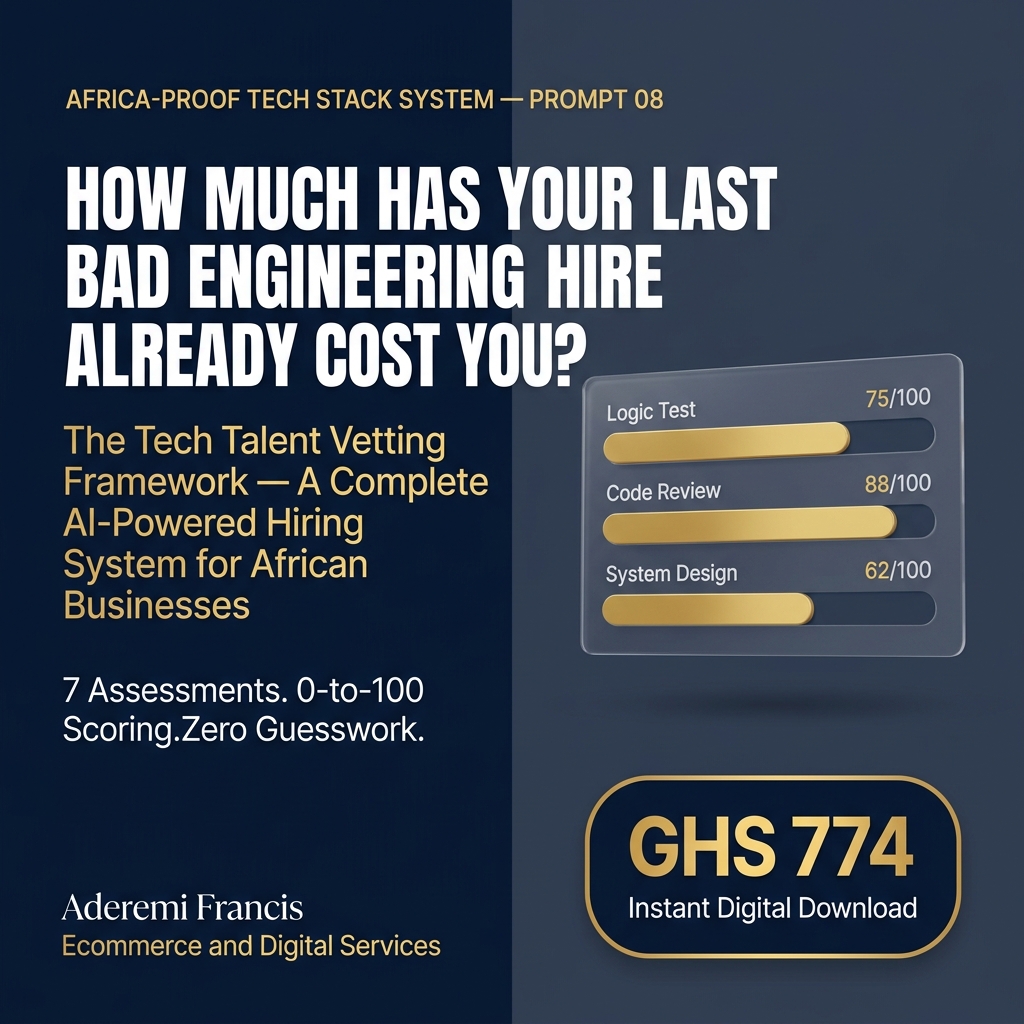
The Tech Talent Vetting Framework Prompt — Stop Hiring Engineers Who Look Good on Paper But Cannot Deliver in Production
PRODUCT DESCRIPTION
THE MOST EXPENSIVE DECISION YOUR BUSINESS MAKES IS HIRING THE WRONG ENGINEER
You interviewed them. They answered confidently. Their CV looked strong. Their portfolio seemed solid. You made the offer, they accepted, and within three months you knew something was wrong.
They could not debug under pressure. Their code was unmaintainable. They could not articulate why they made the architectural decisions they made. They struggled with tasks that should have been routine. And now you are managing a performance problem, a team morale problem, and a delayed product — all at the same time.
This is not an unusual story. It is the most common story in African technology hiring. And the cost of it is far higher than most business owners realise.
THE NUMBERS BEHIND A BAD ENGINEERING HIRE
According to research published by Pearl Talent in 2026, the cost of a bad hire in the technology sector can exceed $240,000 when factoring in lost productivity, training expenses, recruitment costs, and opportunity costs. That is approximately GHS 3.7 million at current exchange rates — for a single wrong hiring decision.
In South Africa, a specialist recruitment agency documented that a bad hire at the mid-level manager bracket costs a minimum of R350,000 before a replacement is even found. In Nigeria, Ghana, and Kenya, where senior engineering talent commands increasingly competitive salaries as remote work opens global opportunities to African developers, the cost of a poor hire is compounding with every passing year.
Tech positions already take 50% longer to fill than other professional roles. Africa's recruitment ecosystem is fragmented, with no dominant centralised talent marketplace. The best engineers — as multiple 2025 research reports confirm — are not sitting on job boards waiting to be found. They are heads-down, building, freelancing, or already employed, and they will only surface if your hiring process is compelling, fast, and credible.
The businesses that hire the best technical talent consistently are not the ones who pay the most. They are the ones with the most structured, rigorous, and professional hiring process. Structure signals seriousness. Seriousness attracts serious engineers.
This prompt builds that structure for you in minutes.
WHAT THIS PROMPT DOES FOR YOUR ORGANISATION
When you paste this prompt into Claude or ChatGPT, it produces a complete Technical Hiring Framework — a structured, scoring-based interview system that any engineering manager, HR director, or founder can deploy immediately, regardless of their own technical background.
The framework covers seven assessment components with defined time limits, a standardised scoring rubric, bias mitigation protocols, red flag indicators, and a 30-60-90 day onboarding ramp plan for every hire.
Here is exactly what the framework delivers:
Assessment Battery — Seven Structured Components
Component 1.
Logic and Abstract Reasoning Test, 20 minutes, five questions. Identifies engineers who think clearly and systematically under time pressure, not just those who have memorised solutions from online interview preparation platforms.
Component 2.
Debugging Challenge, 25 minutes. The candidate is given three broken code snippets and must identify and fix the errors. This separates engineers who understand the system from those who can only write code when starting from a blank page.
Component 3.
Algorithm and Optimisation Problem, 30 minutes. A real-world computational problem focused on efficiency. Reveals whether the candidate thinks about time complexity, memory usage, and edge cases — or simply gets something working and stops.
Component 4.
Code Review Exercise, 20 minutes. The candidate reviews a flawed pull request and must identify problems, suggest improvements, and justify their recommendations. One of the most predictive assessments of how an engineer will perform in a real collaborative team environment.
Component 5.
Architecture Mini-Challenge, 15 minutes. A whiteboard-style design problem with no perfect answer. Assesses how the candidate thinks through trade-offs, communicates uncertainty, and approaches a problem they have never seen before.
Component 6.
Real-World Coding Challenge, take-home, maximum 3 hours. A practical task directly related to the work the role will actually involve. The most realistic predictor of day-one performance of any assessment type.
Component 7.
Live System Design Interview, 45 minutes with a panel. The most powerful signal separator in technical hiring. Strong individual contributors and true senior engineers behave very differently in this format — and the difference is immediately visible to a trained observer.
Scoring Rubric — 0 to 100 Points Across Three Dimensions
Problem-Solving, 35 points. Assessed on clarity of approach, systematic thinking, handling of edge cases, and communication of reasoning at each step.
Code Quality, 35 points. Assessed on readability, appropriate use of design patterns, test coverage, and maintainability — the things that determine whether code is a long-term asset or a future liability.
Systems Thinking, 30 points. Assessed on understanding of trade-offs, awareness of scalability implications, and ability to make and defend architectural decisions under questioning.
The total score gives every candidate a single comparable number — removing the subjectivity that plagues most hiring panels and replacing it with documented, defensible evidence.
Bias Mitigation Protocol
The framework includes blind scoring instructions, a standardised question bank ensuring every candidate is assessed on identical criteria, and independent scoring requirements before any panel discussion. These controls protect against affinity bias, halo effect, and the informal impression-based hiring that consistently produces poor outcomes and legally problematic hiring records.
Red Flag Indicator List
Eight documented behaviours that predict problematic hires — from inability to explain reasoning on simple questions to dismissiveness toward code review feedback. Knowing what to watch for is as valuable as knowing what to look for.
30-60-90 Day Ramp Plan Template
A structured onboarding framework that sets measurable expectations for the first three months of employment, reduces the time to full productivity, and creates a documented performance baseline that protects the organisation if the hire does not work out.
WHO NEEDS THIS FRAMEWORK RIGHT NOW
Engineering Managers and CTOs who have made at least one hiring decision they regret and want a structured system that prevents it from happening again.
HR Directors and People Operations Leaders at technology companies who need a technical interview framework they can standardise across the organisation and hand to any hiring panel.
Founders making their first or second engineering hire — the decisions that set the technical culture, the architectural foundations, and the team standards for everything that follows.
Recruitment Agencies specialising in technology talent who want a professional, structured vetting framework to differentiate their service from agencies that simply forward CVs and hope.
Digital Agencies and Technology Consultancies who hire engineers for client projects and need a reliable process for assessing whether a candidate can deliver under real project conditions.
Series A and Series B companies scaling their engineering team from 5 to 20 people, where the quality of each individual hire has a disproportionate impact on team velocity, code quality, and product reliability.
If any of the following is true for your organisation, this framework is overdue:
Your current interview process relies heavily on gut feel and subjective impression rather than structured scoring.
You have had a hire who performed well in interviews but underperformed significantly in the first three months on the job.
Different interviewers on your hiring panel assess candidates using completely different criteria, making panel alignment difficult and decisions inconsistent.
You are hiring your first engineers and have no existing technical interview process to draw on.
You need to document your hiring process for governance, audit, or investor review purposes.
Your team has grown to the point where ad-hoc, informal hiring processes are producing inconsistent results across different roles and managers.
HOW IT WORKS IN THREE STEPS
Step 1. Purchase and download the prompt PDF — instant delivery on Selar.
Step 2. Open Claude at claude.ai or ChatGPT at chat.openai.com — both free to start.
Step 3. Copy and paste the prompt. Add the specific role title and your company stage. Hit send.
Within minutes, you have a complete Technical Hiring Framework that a specialist HR consultancy or engineering recruitment firm would charge you GHS 7,000 to GHS 20,000 to design and document — with assessment tools, scoring rubric, bias controls, and onboarding plan all included in a single output.
WHAT YOU RECEIVE INSIDE THE PDF
The complete, upgraded Tech Talent Vetting Framework prompt — copy and paste ready for immediate use.
Step-by-step instructions including role title and company stage customisation guide.
A clear explanation of who this prompt is designed for and where it delivers the highest return.
Five key benefits explained in detail with African hiring market context.
Claude and ChatGPT tips for generating scored candidate response examples your interviewers can use as calibration benchmarks before the real interviews begin.
Full pricing guide for the complete 10-prompt Africa-Proof Tech Stack System.
THE AI TOOLS YOU WILL USE
This prompt is fully optimised for Claude by Anthropic and ChatGPT-4 by OpenAI. Both are available free at the basic tier. For structured, multi-section hiring frameworks that include scoring rubrics, assessment descriptions, bias mitigation protocols, and onboarding templates in a single coherent document, Claude is particularly strong — it produces output that reads like a professionally designed HR framework your legal, operations, and engineering teams can all use from the same document.
PRICE: GHS 774
A single bad engineering hire costs your organisation a minimum of GHS 3.7 million in lost productivity, re-recruitment costs, delayed projects, and team disruption — based on documented 2026 research from the global technology recruitment industry.
A single good engineering hire, made through a structured and rigorous process, compounds in value for years — through clean code, sound architecture, strong mentorship of junior colleagues, and product delivery that accelerates your business.
This prompt costs GHS 774. Once. Use it for every role you hire for, at every seniority level, across every technical discipline — software engineering, DevOps, data engineering, cybersecurity, and beyond.
One purchase. One framework. Unlimited use across every team you build for the rest of your career.
INSTANT DIGITAL DELIVERY
Payment confirmed on Selar means your PDF downloads immediately. No calls to schedule. No consultant engagement process. No waiting while the wrong candidate sits in your office collecting a salary.
100 PERCENT SATISFACTION GUARANTEE
Follow the instructions, run the prompt in Claude or ChatGPT, and if the output does not give you a complete, usable Technical Hiring Framework your team can deploy in the next interview — contact us within 7 days for a full refund. No questions asked.
THE COMPLETE SYSTEM
This prompt is Number 08 of 10 in the Africa-Proof Tech Stack System — a complete suite of professional AI prompts covering technical debt auditing, cloud cost reduction, mobile UX, cybersecurity hardening, open-source AI integration, power resilience, API architecture, boardroom pitching, and DevOps observability.
Full Toolkit — all 10 prompts: GHS 5,514.
Every technology leadership tool your business needs. One investment. Unlimited use.
Created by Aderemi Francis — Ecommerce and Digital Services Africa-Proof Tech Stack System — Professional Prompt Series — 2026
Copyright 2026 Aderemi Francis. All rights reserved. For personal and commercial business use.