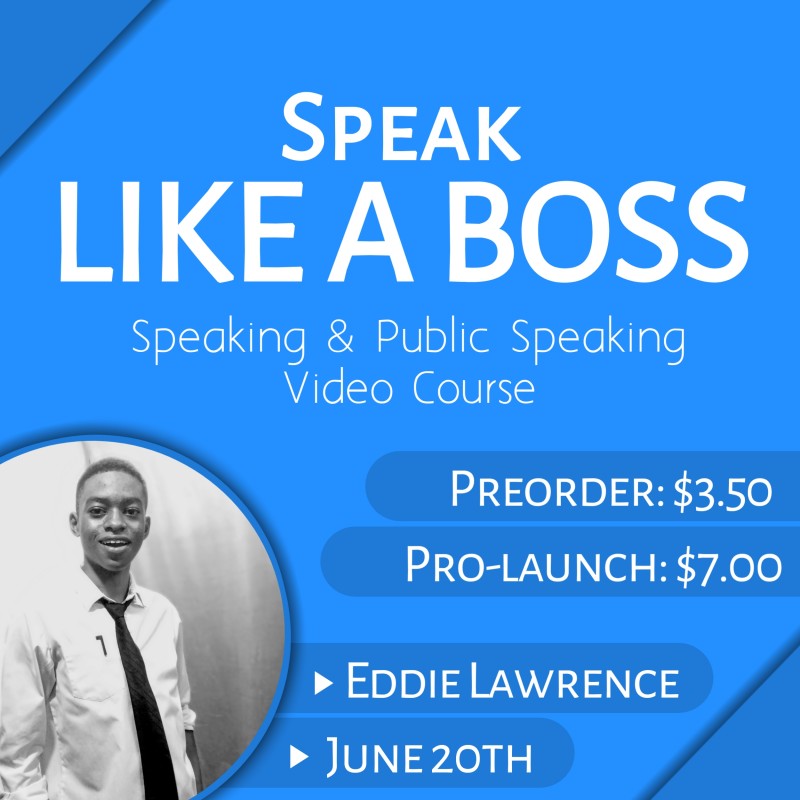
Speak Like A Boss
Have you ever been in a situation where you just feel hooked listening to someone's voice on a topic you normally pay no attention to?!
WAIT! There's something for you at the bottom!
A few questions people ask on public speaking and speaking in general are:
Why is is that some people, when giving speeches, recording messages or even speaking to others are so plain, uninteresting and sometimes, even boring, whereas others are so captivating and sensational?
Why do some speeches strike something deep within you, while some make you drowsy?
Why are some people totally irresistible with words?
How do some people carry their audience along so well, both in digital and live presentations?
Are amazing speakers born that way or can a regular person become a speaking prodigy too?
Why are some people amazingly interesting to talk to, and others, not so much?
How do I become a voice of influence and make my voice work for me?
The list of questions goes on and on in a repeated cycle.
Now, Public speaking involves at the very least a fair number of people as an audience. Traditionally, it's you speaking face to face with your audience, and this singular attribute is what gives a countless number of people plural problems...
The thing is, when you have a lot of people staring at you, the inate and sometimes unconscious pressure to be absolutely perfect pushes some off the edge. Some think they're not good enough, some are scared of criticism and some, well, they're just terrified of watching eyes...
Now, in modern times, with the advent of new communication technology, public speaking has been transformed in so many ways. You can speak to thousands of people from the comfort of your own home or any place of your choice. You can pre-record messages and share them on different platforms. Could it be any easier? Still, with the threat of tens, hundreds or maybe even thousands of watching eyes gone, many people still suck at public speaking.
Through observation, I have noticed that a countless number of people make many a mistake when speaking to an audience. As a result, they underperform and sometimes even fail to make the impact they intended to and/or get the response they desire.
I'd like to change that narrative, considering the fact that about 70% of corporate require some form of public speaking. Now, if you don't do well at public speaking, that could be a scary revelation...
Here are a few of the highlights from the course in random order:
• When to admit your nervousness.
• The dangers of body language.
• Body language of the voice.
• The hierarchy of words.
• The death sentence of complexity
• The importance of a pause (Stamping your point).
• Turning fear into courage.
• The perfection of imperfection.
• Commiting your essence to the message.
• Relaxing in the spotlight.
• A little humor won't hurt.
• Building a fan base orally.
• Polarity: raising arguments.
• Harnessing mistakes.
• Speaking for results.
• Hypnotizing your audience.
• Becoming a better listener - the inverse of speaking.
• Experience vs Observation.
Bonus
• The journey to becoming a charmer: learning secret rules of conversation.
Speaking, unknown to many, is a huge part of our day to day lives, especially in business (in customer, colleague, employee/employer interaction) and your knowledge of art could be your ticket to breaking limits professionally and personally. Welcome to Public speaking, welcome to the real world.
Your Storyteller,
Eddie Lawrence
NB: This course is free for the first thirty students, so hurry...
This is the GIFT - a free peek to what the course looks like :
Become an affiliate and earn 33.33% commission: https://bit.ly/SLABaffiliate
PS: You can reach me via WhatsApp
Feel free to leave a review.