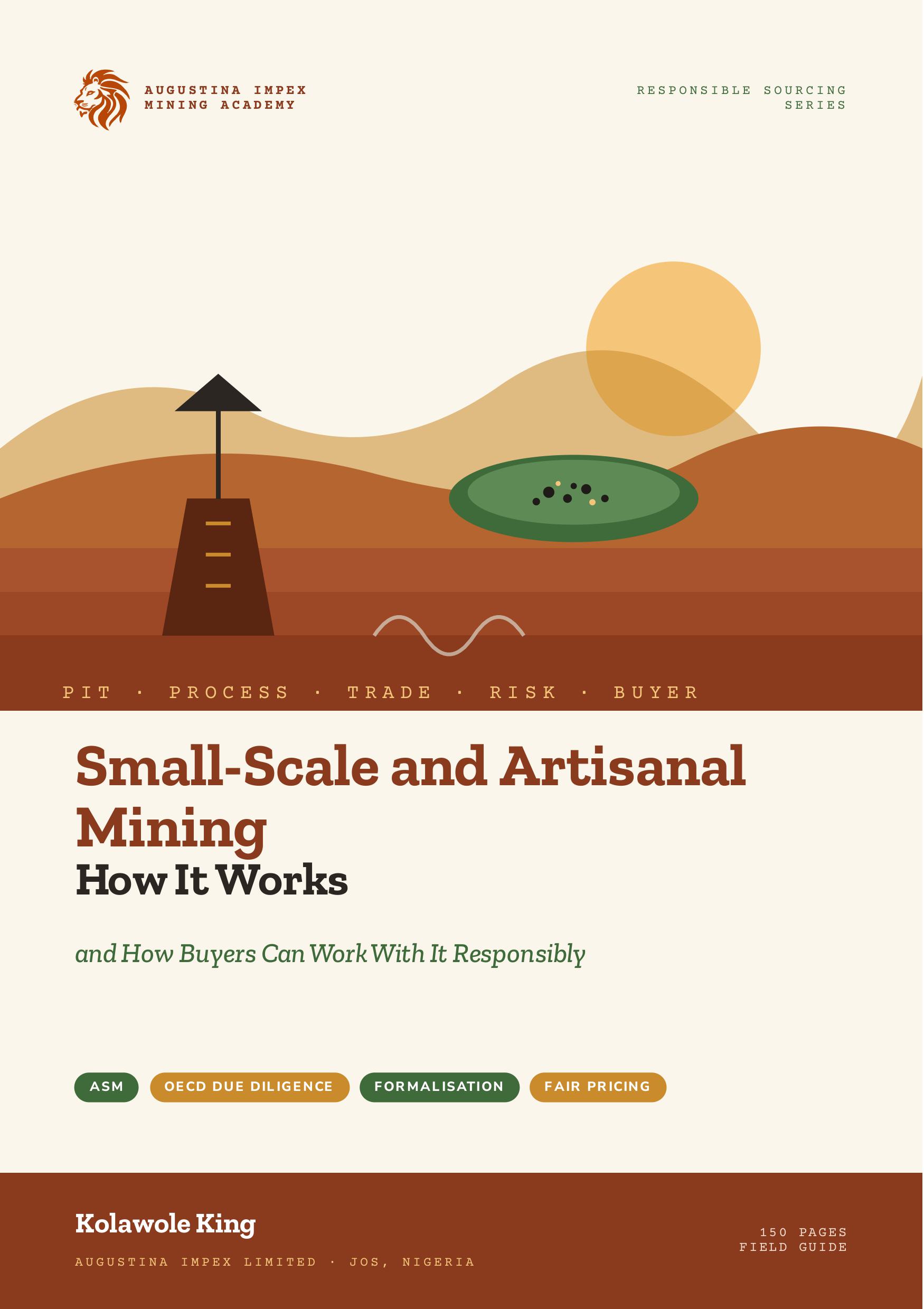
Small-Scale and Artisanal Mining: How It Works and How Buyers Can Work With It Responsibly.
Small-Scale and Artisanal Mining: How It Works and How Buyers Can Work With It Responsibly
📗 150 pages · A5 PDF · Instant download
✍️ By Kolawole King, CEO of Augustina Impex Limited, Jos, Nigeria, buying from artisanal miners since 2001
Much of the world’s tin, tantalum, gold, gemstones and, increasingly, lithium is dug by hand or with small machines. It is washed in ponds and sluices and sold in sacks at local buying points. This is artisanal and small-scale mining (ASM). Tens of millions of people depend on it, and buyers cannot avoid it.
ASM is often misunderstood. Some see only its problems: child labour, mercury, collapsing pits, smuggling. Others see only its promise. A buyer who sees only the problems walks away. A buyer who sees only the promise buys blindly and risks funding abuse.
This field guide shows a better way: understand how ASM really works, then engage with it legally, safely and fairly.
WHAT YOU WILL LEARN
✅ What ASM really is. Artisanal versus small-scale mining, its scale in Africa and the world, and ASM in Nigeria. That covers the Jos Plateau’s mining history, the Minerals and Mining Act 2007, small-scale mining leases, cooperatives and the key institutions.
✅ How it works on the ground. How miners find deposits and how mining rushes start, how they dig, and how they process: washing, sluices, jigs, hand sorting and mercury in gold. The trading chain from pit to exporter, and why miners sell where they do.
✅ Mineral by mineral. Tin, columbite, tantalite, gold, lithium, gemstones, monazite and industrial minerals: how each is mined, priced and upgraded, and the main risks of each.
✅ The real risks. Health and safety, dust, lead and radiation, mercury pollution, child labour and forced labour, banditry and armed groups, and smuggling and fraud, with the red lines buyers must never cross.
✅ A complete buyer’s framework.
- The OECD five-step due diligence process and its Annex II red lines, applied to ASM
- The main standards: CRAFT, Fairmined, Fairtrade, ITSCI, RMI and LBMA
- Mapping your suppliers and tracing minerals back to the pit
- Assessing mine sites
- Improvement plans for suppliers with set deadlines
- Fair pricing and pre-finance
- Helping miners become licensed
- Working with communities
- Contracts with ASM suppliers
✅ Putting it into practice. A 12-step sourcing programme, five case studies (tin, gold, lithium, tantalite and a buying centre), measures of progress, when to suspend a supplier, and how large mines and artisanal miners share land.
READY-TO-USE TOOLS INSIDE
📋 A site visit checklist and supplier questionnaire
📋 A risk matrix and supplier improvement plan template
📋 Model contract clauses for ASM suppliers
📋 A mercury reduction quick guide
📋 A completed site assessment as a worked example
📋 A one-day training outline for miners and buyers
📋 A mineral identification guide, glossary, exercises and FAQ
WHO THIS BOOK IS FOR
👉 Exporters and aggregators buying from artisanal miners
👉 International buyers, traders, smelters and refiners
👉 Jewellers, manufacturers and battery supply chains
👉 Compliance, ESG and responsible sourcing teams
👉 Investors, NGOs and development partners
👉 Miners’ cooperatives that want access to better markets
WHY BUY IT
✔️ Source ASM minerals legally and with confidence
✔️ Meet your customers’ due diligence requirements
✔️ Know which risks are red lines and which can be improved
✔️ Pay fairly, build trust and secure reliable supply
✔️ Turn ASM from a hidden risk into a responsible source
“Responsible buyers do not ask ASM to be perfect before they engage. They ask it to be legal, free of the worst abuses and committed to improving.”
📚 Book 12 of the Augustina Impex Mining eBooks Library: https://selar.com/m/augustinaimpex
Kolawole King
Chief Executive Officer, Augustina Impex Limited
#288 Diye Ward, Zarmaganda, Jos South, Plateau State, Nigeria
📧 [email protected] | WhatsApp: +234 906 090 4274
🌐 https://augustinaimpex.com | Blog: https://augustinaimpexng.blogspot.com/