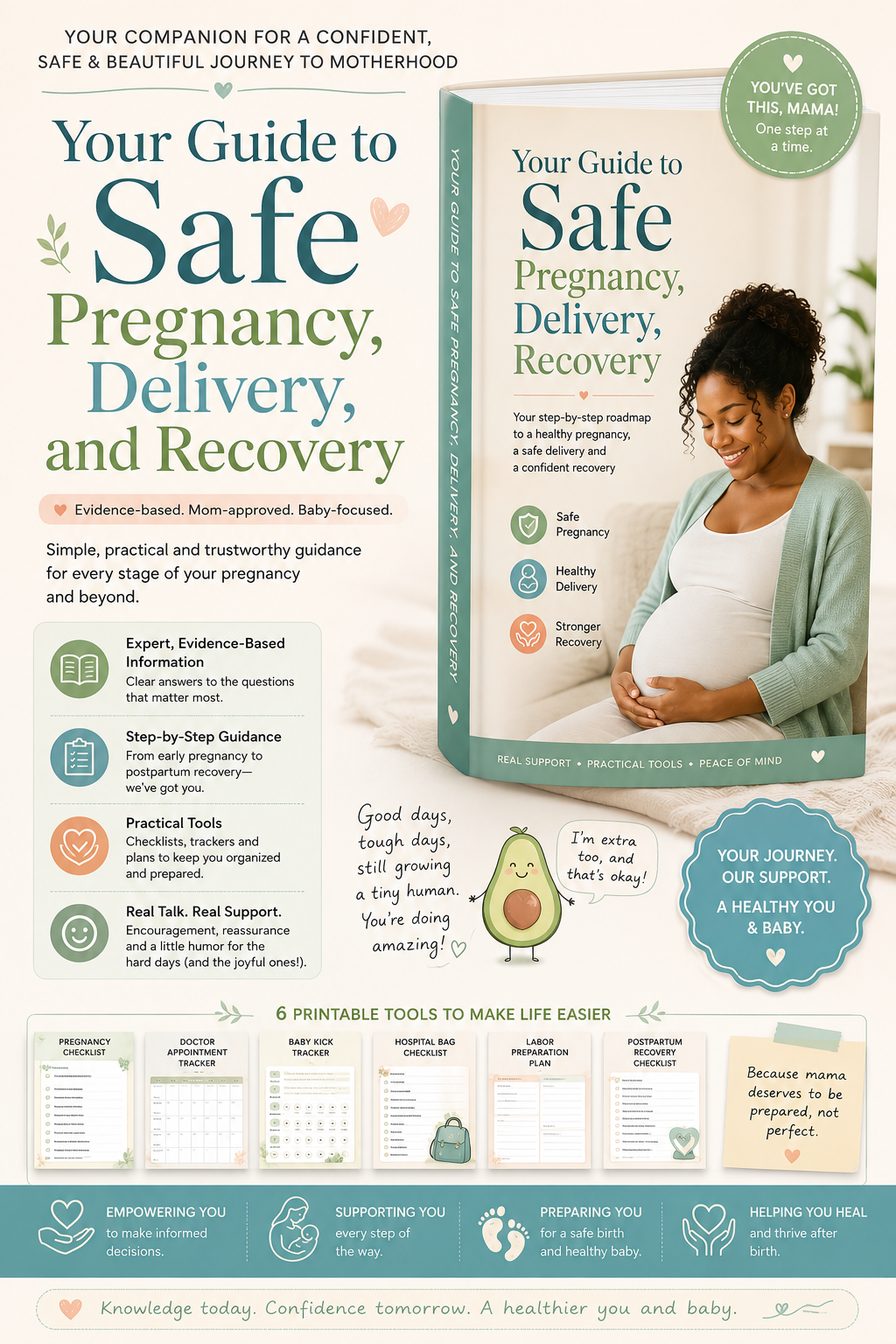
Safe Passage: Your Guide to Safe Pregnancy, Delivery & Recovery

SAFE PASSAGE
HEALTH • MATERNAL CARE • SPECIAL FEATURE
ADVERTISEMENT
The Pregnancy Guide Built Around What Often Gets Missed
Most maternal health complications share a common thread: a gap between what families knew and what they needed to know. Here's what one guide is doing about it.
Most women preparing for childbirth describe the same quiet frustration: a fifteen-minute antenatal appointment that never quite covers everything they wanted to ask.
That gap — between what gets covered in a short clinic visit and what families actually need to know — turns out to matter more than most people realize.
According to the World Health Organization, a large share of maternal complications worldwide are linked to preventable causes, and research consistently points to one factor above almost all others: how much a family knows going into pregnancy and delivery, and how early they act on it.
Researchers studying maternal health outcomes describe what they call the three delays: a delay in recognizing that something is wrong, a delay in reaching a facility that can help, and a delay in receiving adequate care once there.
Each of these delays is closeable — but only if a person knows, in advance, what to watch for, what to ask, and where to go.
This is the exact gap a resource called Safe Passage was built to close.
“Knowledge is a first layer of protection. Preparation is the second. Together, research suggests, they change outcomes.”
Why So Much Gets Missed
Pregnancy is often treated as a private, individual experience — something each person simply finds their own way through, guided by a handful of clinic visits and whatever advice happens to reach them.
But a landmark study published in The Lancet found that roughly 60% of maternal deaths occur during or immediately after delivery, and the overwhelming majority are linked to preventable factors.
Much of this traces back to timing. A symptom dismissed as ordinary tiredness. A facility never asked about its emergency capacity.
A traditional remedy used without knowing what the research actually says about it. None of these are failures of care or character — they're gaps in information, and information is something that can be shared, repeated, and acted on early.
Inside Safe Passage: What 17 Chapters Actually Cover
Safe Passage is an evidence-based guide that walks through pregnancy, labor, delivery, and the six weeks that follow — written not for clinicians, but for the person going through it, and for the people supporting them.
It draws on research from the World Health Organization, the American College of Obstetricians and Gynecologists, The Lancet, and Cochrane Reviews, translated into plain, everyday language throughout. No medical background is assumed.
One of its most referenced sections, Chapter 5, lays out the specific symptoms during pregnancy, labor, and postpartum that clinical guidelines flag as requiring prompt attention — a severe headache paired with vision changes, reduced fetal movement, heavy bleeding, fever, among others.
Early readers describe this chapter as the reason they brought up a symptom at their next appointment instead of waiting it out.
Chapter 3 offers a script of questions to ask any hospital or clinic before registering — including whether blood is available for transfusion, and whether a C-section can be performed on site if needed.
Chapter 12 includes a full emergency transport plan template, so a family isn't scrambling to find a working phone number or a free vehicle in the middle of an emergency.
Beyond that, there's a week-by-week guide from conception to week 40, a detailed nutrition breakdown with the supporting research behind each recommendation, a birth plan template, a postpartum recovery tracker for the critical first six weeks, and a dedicated checklist for partners and family members — informed by research showing that women with a prepared support person present report measurably better experiences during labor.
How People Are Using It
Early readers describe a range of ways the guide has shaped their preparation. One reader, in her third trimester, said Chapter 5 prompted her to mention a symptom she had been dismissing as ordinary tiredness — her provider began monitoring her more closely as a result.
Another described how the partner checklist gave her husband a concrete sense of what to do during labor, from timing contractions to knowing which questions to ask.
A community health worker who reviewed the guide noted that she has started sharing it in her own antenatal clinic, describing it as accurate, respectful of local context, and written in a way her patients can immediately understand and act on.
These are illustrative examples drawn from common patterns described by early readers, rather than individually verified case studies — but they reflect the kind of practical, everyday use the guide was designed around.
Who This Is For
Safe Passage is written for someone navigating a first, second or third pregnancy and trying to understand what's normal and what isn't. It's written for someone on a third or fourth pregnancy who, understandably, assumes they already know what to expect — and for whom it's worth hearing, clearly, that each pregnancy carries its own risk profile regardless of prior experience.
It's written for partners who want a concrete way to help but have never been told what that help should look like. And it's written for community health workers and midwives who want a single, trustworthy resource to hand to every patient who walks through the door.
It does not replace a doctor, a midwife, or a clinic visit. It exists to make each of those interactions more informed, more confident, and — the research suggests — somewhat safer.
What's Included
Safe Passage is structured as a complete system — the guide itself, plus a companion set of tools designed to be printed, saved, and used at every stage of pregnancy and delivery.
WHAT'S INCLUDED
VALUE
The Safe Passage Ebook
17 evidence-based chapters, first trimester through six weeks postpartum.
₦15,000
Bonus: The Complete Printable Toolkit
All 6 tools bundled — tracker, visit record, question scripts, recovery tracker, and the partner checklist.
₦10,000
Total Value = 25000
TOTAL VALUE₦25,0
Today, the complete bundle — the guide and the full toolkit — is available at a reduced price. ₦4000
84% off the combined value.
That is the complete Safe Passage ebook and the full printable toolkit, together, at a fraction of their combined value — and, in many cities, less than the cost of a single antenatal clinic visit.
Offer available today.
“Good information, shared early, changes outcomes. That's the entire idea behind this guide.”
Being prepared and informed matters — for the person going through pregnancy, and for everyone supporting them along the way.
CLAIM THE OFFER NOW
₦4000 • Instant access • Use immediately
This article is a paid feature. Safe Passage is an educational guide and does not replace the advice, diagnosis, or treatment of a licensed healthcare provider. Always consult a qualified medical professional for personal health decisions. Evidence cited includes publications from the World Health Organization, the American College of Obstetricians and Gynecologists, Cochrane Reviews, The Lancet, and the British Medical Journal.