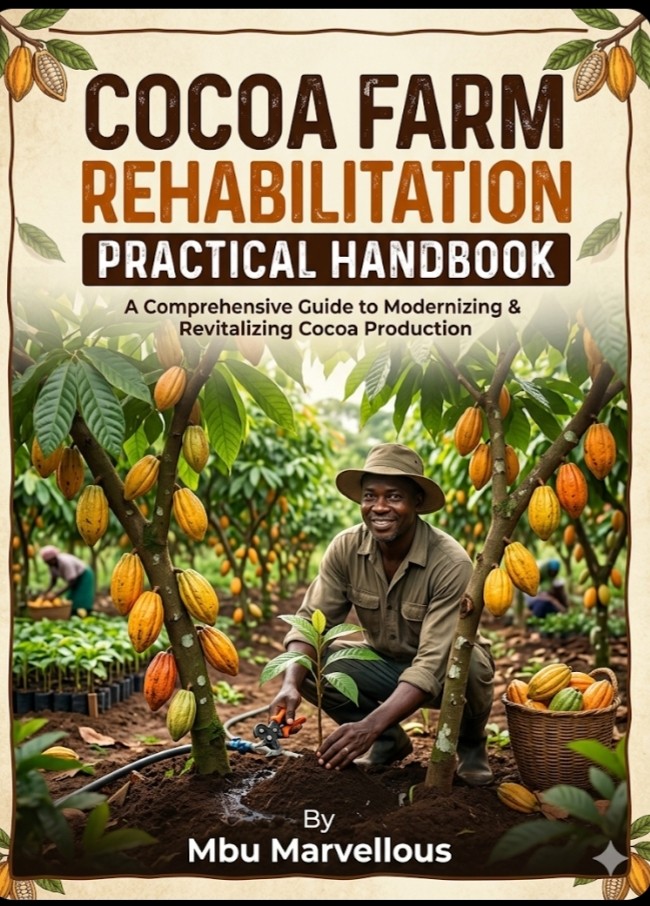
Cocoa farming Rehabilitation handout
The most expensive mistake in cocoa farm rehabilitation is also the most common one.
Farmers make it every single season.
Some cut down trees that had 10 more years of production left in them.
Others spend money fertilising, pruning, and spraying trees that were already dead — and wonder why nothing improves.
Both mistakes cost the same thing: time you cannot recover and money you cannot get back.
The difference between a rehabilitation that works and one that wastes everything comes down to one decision made correctly at the very beginning.
Rehabilitate — or replant?
Get it right and you save years of waiting and hundreds of thousands in unnecessary investment.
Get it wrong in either direction and you will be back at the same problem in 24 months, poorer and more frustrated than when you started.
Here is exactly how to make that decision correctly — tree by tree, section by section.
First — understand what you are actually deciding.
When you look at a degraded cocoa tree, you are not deciding whether it looks good or bad. You are deciding one thing only:
Does this tree have enough living structure remaining to return to productive yield within a timeframe that justifies the investment of rehabilitating it?
That is the question. Everything else is noise.
A tree can look terrible — stripped canopy, dead branches everywhere, no pods, deep in undergrowth — and still be a Category A recovery candidate that comes back to significant production within 12 months of correct treatment.
A tree can look alive — a few green leaves, some apparent canopy — and be functionally dead, unable to respond to any intervention you throw at it.
Appearances deceive. The framework does not.
THE TWO-MINUTE TEST THAT CHANGES EVERYTHING
Before you apply the full decision framework to any tree, perform this one test first.
Take a sharp knife or machete. Make a shallow scrape on the trunk bark — about 5 centimetres long, cutting only through the outer bark layer. Do not go deep.
Look at the cambium — the layer immediately beneath the outer bark.
🟢 Green or white cambium — the tree is alive. Vascular flow is active. This tree is a candidate for rehabilitation assessment. Proceed.
🔴 Brown, dry, or fibrous cambium — the tree is dead. It does not matter what the outside looks like. Remove it. Do not spend a single naira, a single spray, or a single hour of labour on this tree. It cannot respond.
This test takes two minutes per tree.
On a degraded farm where every tree looks questionable, this test separates the ones worth investing in from the ones that are already gone — before you commit any resources at all.
Do this test on every single tree before making any other decision. It is the foundation of everything that follows.
THE REHABILITATION vs REPLANTING DECISION FRAMEWORK
Once you have confirmed a tree is alive using the trunk viability test, apply this framework to decide what to do with it.
REHABILITATE the tree if:
✅ The trunk is alive — green or white cambium confirmed
✅ At least 30% of the original canopy branches are still alive
✅ New vegetative growth is visible anywhere on the tree — even one shoot, even small
✅ The tree is under 25 years old (Amelonado varieties) or under 30 years old (hybrid varieties)
✅ No incurable disease confirmed — no CSSVD (West Africa), no confirmed Witches' Broom (Latin America), no Armillaria root rot at the base
✅ When you pruned it or exposed it to light and nutrition, it responded — new growth appeared within 6 to 8 weeks during the wet season
A tree that meets these criteria is not a sick tree. It is a suppressed tree. There is a fundamental difference. Suppressed trees come back. Sick trees beyond their productive life do not.
REPLANT the position if:
❌ The cambium test confirms the tree is dead
❌ Less than 30% of the main canopy branches survive — even if the trunk is technically alive, there is not enough framework left to rebuild from economically
❌ No new growth has appeared anywhere on the tree in the last 6 months despite adequate rainfall — a live tree with no growth response in a full wet season is telling you something
❌ The tree is beyond productive age — over 25 years for Amelonado, over 30 for older hybrids — without certified genetics that justify keeping it
❌ CSSVD is confirmed present on the tree — in West Africa, this is non-negotiable. There is no cure. The tree must be removed completely, roots included, along with every tree within 10 metres as a buffer. No exception.
❌ Armillaria root rot is confirmed — white fan-shaped mycelium visible under bark at the tree base. Remove tree and surrounding soil. Do not replant cocoa in the same position for at least two seasons.
❌ The tree showed no response to rejuvenation pruning after 3 full months during the wet season — a living tree in good conditions that refuses to respond to pruning and nutrition has a structural or root problem that surface management cannot fix.
THE SECTION DECISION — WHEN TO TREAT AN AREA AS ONE UNIT
Individual tree decisions matter. But at a certain point, you also need to think in sections — blocks of the farm rather than individual trees.
Here is the rule:
If more than 60% of trees in a section qualify for rehabilitation — rehabilitate the entire section. Fill gaps left by removed trees with certified hybrid seedlings planted at the correct spacing. Manage the whole section as a rehabilitation zone.
If more than 60% of trees in a section must be replanted — clear and replant the entire section. Do not try to keep the isolated rehabilitation candidates scattered within a predominantly replanting section.
Here is why this matters:
When you keep isolated rehabilitation trees within a replanting block, you create a management nightmare. The replanted seedlings need 60–70% shade for the first two years. The rehabilitation trees need opening up and thinning. The disease management programmes are different. The fertilisation rates are different. The labour rhythm is different.
One section. Two completely different management systems running simultaneously. Both underperform.
A farm divided into clearly defined rehabilitation sections and clearly defined replanting sections is dramatically easier to manage — and the outcomes of both are significantly better.
THE DECISION IN THREE QUESTIONS
When you are standing in front of a tree and you need to decide quickly, ask yourself these three questions in order:
Question 1: Is the cambium green or white when I scrape the bark?
→ No — remove it. Stop here.
→ Yes — proceed to Question 2.
Question 2: Does this tree have at least 30% living canopy AND show some sign of growth response in the current wet season?
→ No — replant the position.
→ Yes — proceed to Question 3.
Question 3: Is there any confirmed incurable disease present on this tree?
→ Yes — rogue immediately. No exceptions.
→ No — this tree is a rehabilitation candidate. Invest in it.
Three questions. Two minutes. One decision that protects every input that follows.
Why this framework matters more than any other single thing in rehabilitation:
Every fertiliser bag you open on a dead tree is wasted. Every fungicide spray on a tree with CSSVD is wasted. Every hour of pruning labour on a tree with no viable cambium is wasted.
The rehabilitation vs replanting decision framework exists to protect your investment — before you make it.
The farmers who build successful rehabilitation programmes are not the ones with the biggest budgets. They are the ones who spend their budgets on the right trees.
Know which trees deserve your investment before you make it.
This is one framework from one chapter of the Cocoa Farm Rehabilitation Handbook.
The complete handbook covers everything — the full Farm Assessment Scorecard, the 3-phase disease reset programme for every major cocoa disease worldwide, the complete rejuvenation pruning system, the year-by-year rehabilitation fertilisation programme, intercropping during rehabilitation to generate income while you restore, and the full 5-year financial model showing 6–12× return on rehabilitation investment.
22 chapters. 4 appendices. Every system your rehabilitating farm needs.
Written for cocoa farmers in West Africa, Southeast Asia, Latin America, and the Pacific.
The link to get the full handbook is in the comments below. 👇
"The abandoned farm is not a liability. It is the most underutilised asset most cocoa farming families hold — in every country where cocoa grows."