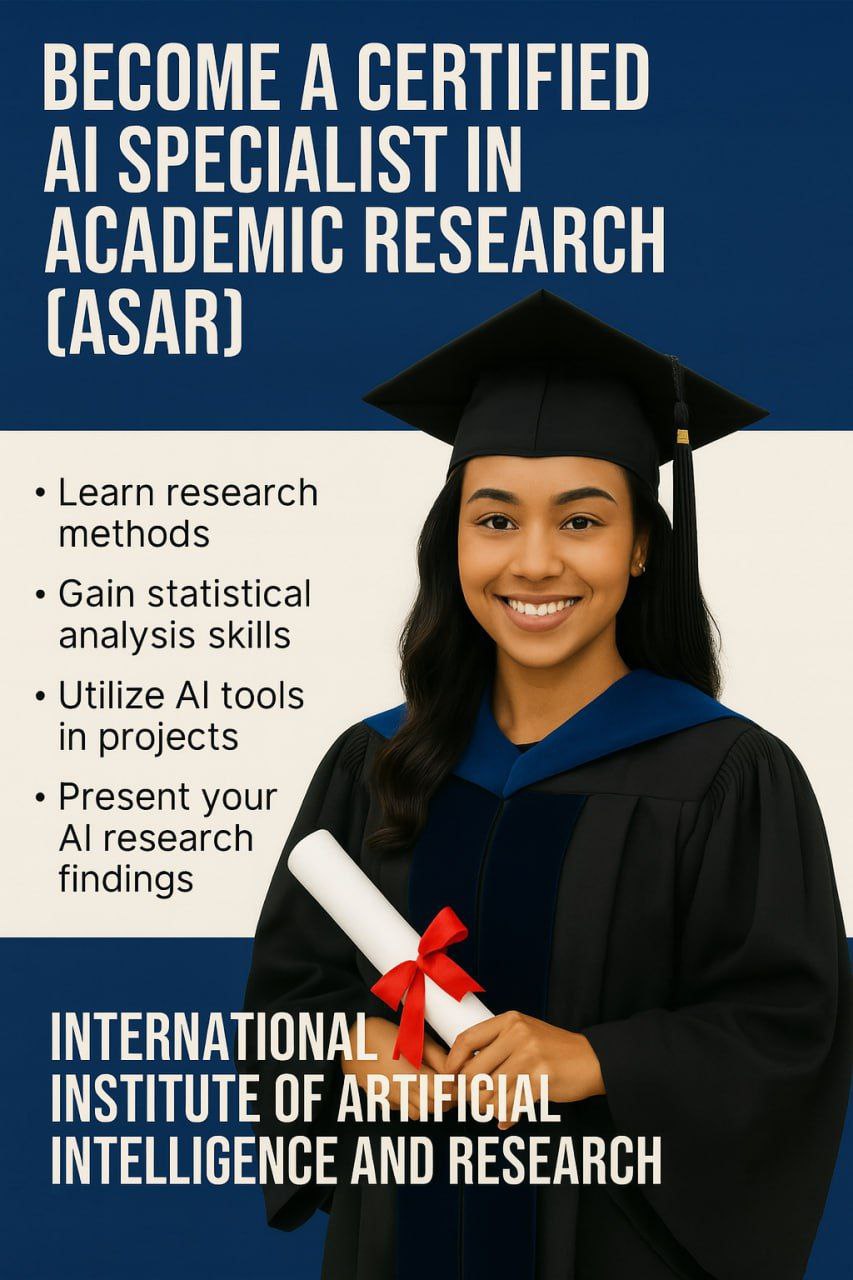
Downloadable
INTERNATIONAL INSTITUTE OF ARTIFICIAL INTELLIGENCE AND RESEARCH (WITH 1YR ACCESS TO CHATGPT PRO)
1
$113.18
BELOW ARE DETAILS OF WHAT YOU WILL LEARN
Phase 1: Research Foundations & AI Essentials
- Understand what academic research is and its different types (undergraduate projects, dissertations, theses, seminar papers, conference papers, journal articles).
- Learn how Artificial Intelligence transforms the research process.
- Get hands-on experience with powerful AI research tools like ChatGPT, Scite.ai, Elicit, and ResearchRabbit.
- Master the ethical use of AI in research and avoid plagiarism, bias, and data privacy breaches.
- Discover the capabilities and limitations of AI in academic work.
- Build a personal code of conduct for responsible AI use.
Phase 2: Research Topic Development & AI-Powered Planning
- Use AI to generate research topics from literature gaps, trends, societal issues, and policy documents.
- Develop research proxies, research questions, objectives, and hypotheses with AI guidance.
- Learn advanced search strategies on Semantic Scholar, Scite.ai, Consensus.app, and ResearchRabbit to find high-quality papers.
- Organize research libraries and citation networks for efficiency.
Phase 3: Literature Review Mastery
- Summarize and analyze research papers using ChatGPT, Scholarcy, Elicit, and
- PaperDigest.
- Map connections between studies using ResearchRabbit, Connected Papers, and Litmaps.
- Align research questions with the most suitable methods using AI.
- Write Background to the Study, Statement of the Problem, Significance, Scope, and Operational Definitions with AI assistance.
- Develop strong conceptual and theoretical reviews with AI.
- Conduct and write empirical reviews with AI.
- Create professional literature mapping tables using AI.
Phase 4: Research Design & Methodology with AI
- Identify and justify the best research design for your study using AI.
- Choose and explain your research philosophy (Ontology, Epistemology, Axiology) using AI support.
- Define the population and sample size with proper calculations with AI.
- Select and present the right sampling techniques with AI.
- Prepare effective data collection instruments, including AI-designed questionnaires.
- Write clear methods for data collection, analysis, and variable measurements using AI tools.
Phase 5: Data Collection, Analysis & Interpretation
- Use AI to design 5-point Likert scale questionnaires for multiple variables.
- Extract and structure secondary data from reports using AI tools.
- Perform descriptive analysis (mean, standard deviation, frequencies, charts) with AI.
- Perform inferential analysis (t-tests, ANOVA, regression, correlation, etc.) with interpretation using AI.
- Accept or reject hypotheses with full justifications using AI.
- Discuss findings in line with past studies using AI.
Phase 6: Writing & Publishing Your Research
- Write Summary, Conclusion, Recommendations, Limitations, and Suggestions for Further Study with AI.
- Craft a professional Abstract using AI.
- Manage citations and references in APA, MLA, Harvard, Chicago, IEEE, and Vancouver styles using Zotero, EndNote, and Mendeley.
- Structure research projects, dissertations, theses, seminar papers, and journal articles for academic excellence.
Phase 7: Effective Detection and Removal of Plagiarism and AI Content
- Meaning, score ranges (0–10% low, 11–25% moderate, 26–40% high, 41%+ very high), and difference between match, source, and citation.
- Identify wrongly flagged content (generic phrases, standard terms, references) and set acceptable originality levels.
- Understand before rewriting, focus on content quality, credit sources, and balance originality with research support.
- Run checks, paraphrase, cite, use AI tools wisely, and recheck using plagiarism, AI detection, and humanizing tools.
- Rewrite without looking at the source, use your own structure, replace terms only when understood, and mix manual with tool-based methods.
EXPECTED TRAINING OUTCOME
By the end of this training, you will be able to:
✅ Conduct world-class academic research faster and more accurately.
✅ Use AI tools to automate and optimize every stage of the research process.
✅ Produce research papers, projects, or theses that meet global academic standards.
✅ Save time, reduce stress, and increase your publication success rate.