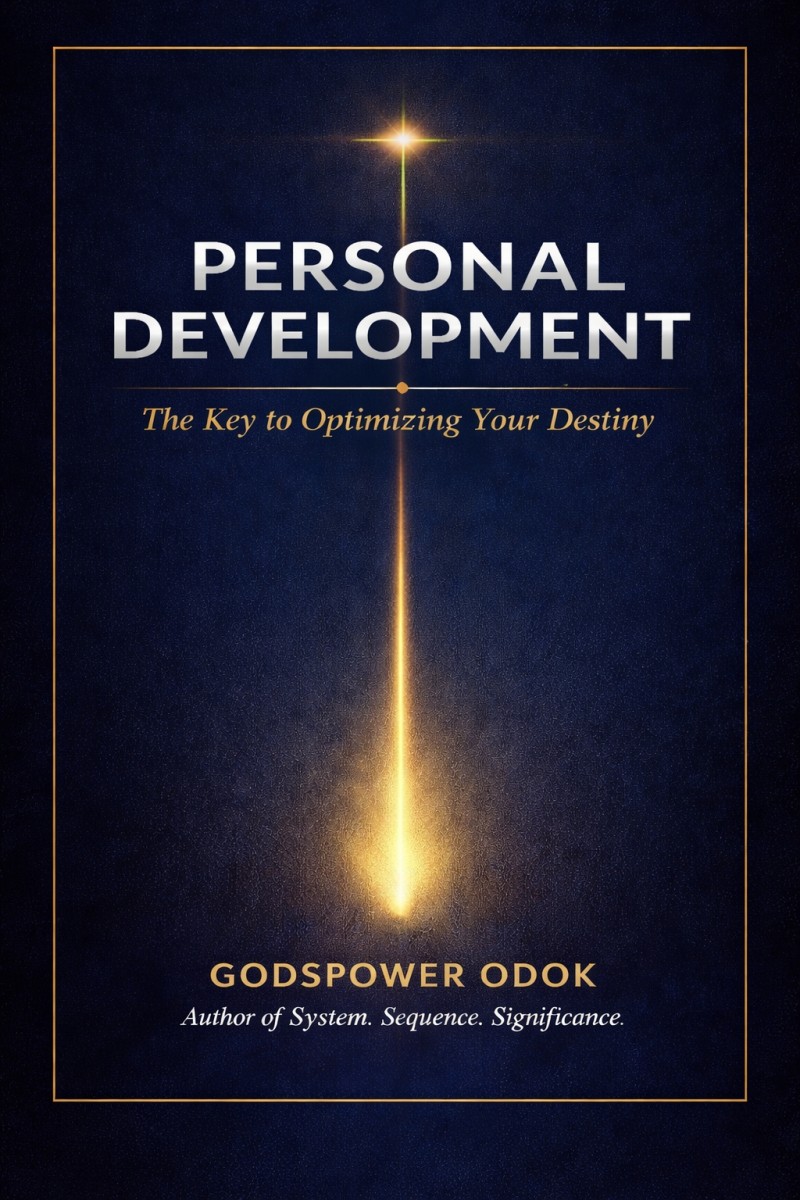
PERSONAL DEVELOPMENT; KEY TO OPTIMIZING YOUR DESTINY

INTRODUCTION
"You can be gifted but not lifted"
— Godspower Odok
DESTINY IS NOT AUTOMATIC
Every generation produces dreamers. Only a few produce builders. History is not shaped by those who
merely desired greatness, but by those who developed the internal capacity to carry it.
Across civilizations, one pattern repeats itself: potential is universal, but disciplined growth is rare.
Ancient Greece produced philosophers. Rome produced systems. The Industrial Age produced inventors.
The Digital Age produces innovators daily.
Yet in every era, for every visible giant, there are thousands of invisible talents that never matured.
Why? Because destiny is not automatic.
The world often celebrates potential prematurely. A young athlete shows promise. A student displays
brilliance. A visionary receives applause for ideas. But applause is not architecture. Recognition is not
readiness. And it is readiness that determines stability in the race of destiny.
The psychologist Abraham Maslow once observed that 'What a man can be, he must be.' Yet Maslow's
hierarchy implies something deeper: growth is progressive. One ascends through development, not
desire.
Desire alone does not produce capacity. Ambition alone does not sustain leadership. Calling alone does
not guarantee impact. Personal development is the missing bridge — the structured, intentional process
of converting potential into performance, vision into value, and identity into influence.
Leadership thinkers like Peter Drucker argued that effectiveness can be learned. If effectiveness can be
learned, then mediocrity is often a choice sustained by neglect. We live in an age obsessed with
visibility. Social media amplifies talent before it is tested. But history is merciless with the unprepared.
Empires collapsed not because they lacked opportunity, but because they lacked sustainable systems.
Businesses fail not because of ideas, but because of structural weakness. Leaders fall not because they
were unknown, but because their inner world could not sustain their outer rise.
In the parable of the talents in Matthew 25, the servants were not judged by possession but by
development. What they were given was less important than what they multiplied. Growth is
responsibility. Growth is gold.
Personal development, therefore, is not self-help sentimentality. It is self-governance. It is the discipline
of building internal systems that can carry external success. Development precedes enthronement.
Research by Angela Duckworth on grit demonstrates that sustained passion combined with
perseverance predicts long-term achievement more accurately than raw talent. Talent may open doors.
Endurance builds legacy.
This book rests on one central conviction: Destiny is potential. Capacity is construction. Leadership is
proof. You may be gifted. You may be called. You may be intelligent. But without intentional
development, you will remain a possibility rather than a phenomenon.
Personal development is not about becoming someone else. It is about becoming structured enough to
become yourself fully. It is about mental refinement, emotional regulation, skill acquisition, spiritual
grounding, and strategic discipline. Because no one rises above their inner architecture for long.
I once lived below my potential, but rose into my significant destiny via the art of self development. If
you read the entire introduction, it goes a long way to show that you've taken the most important step
of your life. Growth is Gold.