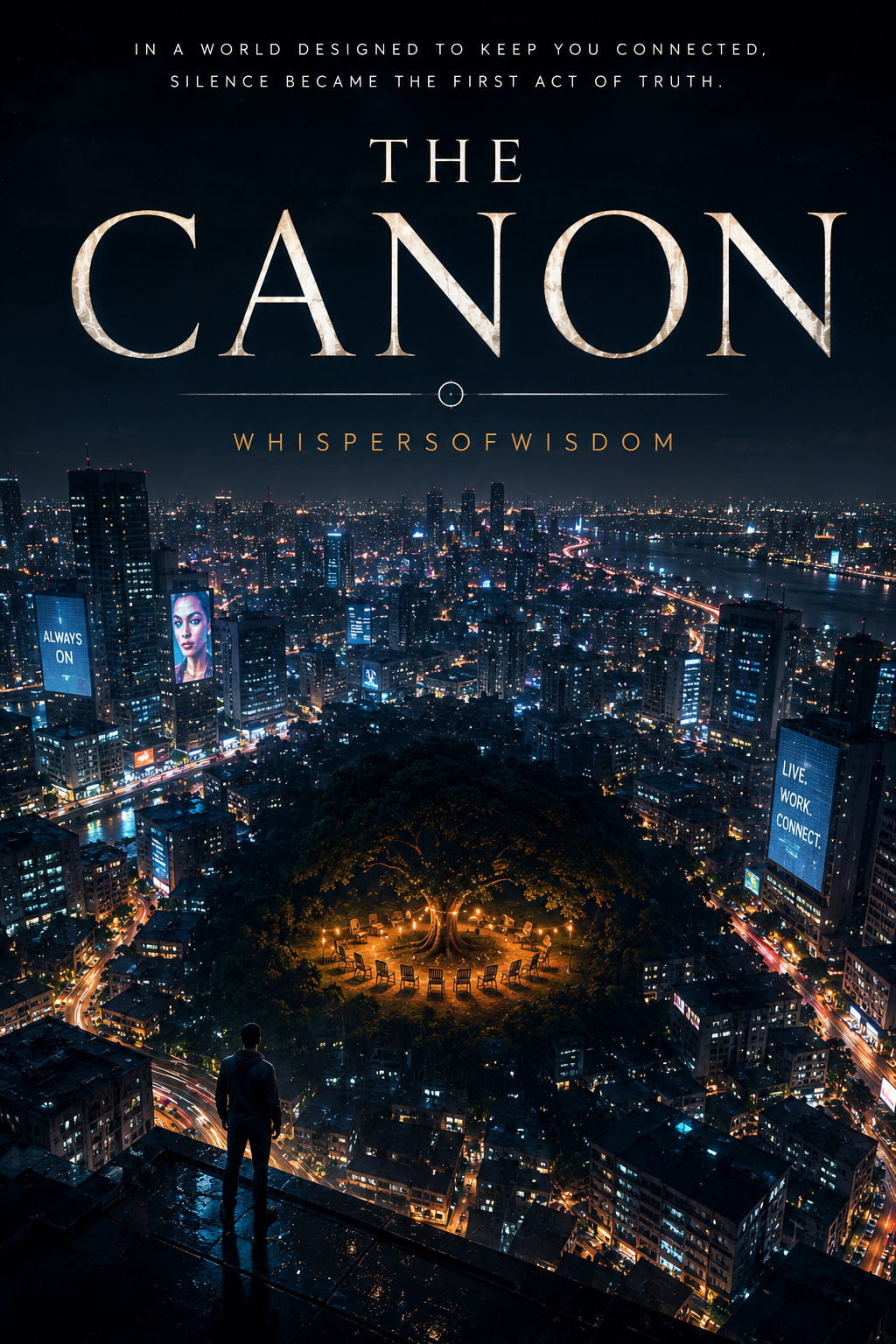
The Canon
THE CANON
WhispersOfWisdom
A city can be connected to everything and still forget how to be present.
In a near-future Lagos where attention has become infrastructure, emotion can be measured, behaviour can be predicted, and ordinary life is increasingly mediated by systems designed to anticipate, influence and retain human attention, four people begin noticing something they cannot easily explain.
Then, one morning, the city goes silent.
For four minutes and eleven seconds, the machinery stops.
Nothing collapses.
No revolution begins.
People simply find themselves without the constant stream of information, stimulation and direction that has quietly shaped their lives.
And in that silence, something unexpected happens.
People talk.
They notice one another.
They become uncomfortable.
They become still.
Some discover relief. Others discover fear. A few begin asking questions they had forgotten how to ask.
The systems recover quickly. The city returns to normal.
But the experience does not disappear.
What begins as a brief interruption gradually becomes something larger: a quiet examination of attention, identity, performance, memory, institutional power, human connection and the possibility of living with greater presence.
The Canon follows the people who begin noticing... and the spaces they eventually create for others to notice too.
It is not a story about destroying the system.
It is a story about discovering what remains human within it.
And beneath everything runs one question:
What if the exhaustion isn't normal?
The Canon is the beginning of an answer.